
What Kit?
Tuesday November 29th 2005, Author: Toby Heppell, Location: United Kingdom
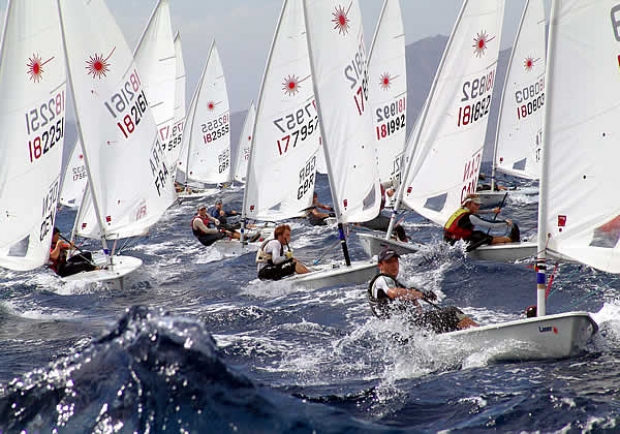
When it comes to highly technical boats the Laser and Laser Radial are usually not ones considered top of the list. Lasers are supposed to be identical, the ultimate one design, and as if this weren’t enough of a great leveller when you attend the Laser World Championships your kit is supplied to you and you must use that.
While this might eliminate all possibility of technical development, the Laser is still a manufactured item, made to maximum and minimum tolerances, so there is a degree of variation from boat to boat and as a result there are some technical ways to improve your chances of winning. This may not help you at a World Championship, but there are still many other events where the equipment is not supplied and you can sail your own boat.
When a mast is made by Laser it has to weigh in between a set minimum and maximum tolerance for it to be sold. Jon Emmett, a prominent Laser Radial sailor and coach,explains how this can be used to your advantage: “The method of manufacture for the Laser masts is extrusion and if you stick them on accurate scales you know how heavy they are and the heavier they are obviously the stiffer they are.” Not all sailors want the stiffest mast section though, as Emmett explains, “Going back a bit, I did the Olympic trials in 1995 and you had people like Bart [Andrew] Simpson looking for the stiffest section he could get hold of and you had people like Steve Cockerill looking for the lightest section that they could get hold of. It is a very small tolerance but I suppose it makes a small difference.”
It could be argued that hunting around for the stiffest or lightest mast might be more effort than it is worth but in a class that is so close and competitive then surely even the smallest difference is important. Not all sailors subscribe to this though and Emmett says that he has always just used whatever mast he got from Laser, until it had broken and then bought a new one. Team GBR’s Laser representative in Athens, Paul Goodison explains his approach to masts: “After I have sailed with a mast if I think it felt good then I will check the weights and diameters of them. The diameters are pretty much the same and the weight only really seems to vary by about five to ten percent.”
To take the idea even further there has been trend for competitors to buy their masts overseas. For example there was a trend recently in the Laser Radial fleet of buying masts from Australia because it was said that they were made closer to the top end of tolerance than any other country. Goodison explains: “It was a really big thing just before the Sydney Olympics.A lot of people thought that the Australian boats were slightly stiffer and all the Australian spars were a lot stiffer. There was quite a lot of mix and match work going on. People were trying to get British bottom sections and Australian top masts so that they would get a soft bottom mast and a stiff top mast. I think that it is still a little bit similar today but generally the British spars are getting stiffer and the difference between the two is very slight at the moment. It is now a case of the old guys that used to do it are still doing it but there is not really that much of a need to do it anymore.” Emmett believes people are following a trend, “a lot of the girls in the Radials have been looking to get Aussie boats and spars because the top female Radial sailors are using them. Actually though some of them might go better with softer kit.”
Something that could well be on the horizon for Laser is a change to carbon masts. The company is said to be testing them but have so far come up against several problems. The primary issue at the moment is that they are breaking on a fairly regular basis. “It is the age old story,” explains Emmett. “You get a spar and it snaps around the join point - or rather it compresses - so you reinforce the compressed section but then it just goes a bit further up past the reinforcement.”
It is not yet clear at what point this change is going to come but it is safe to say that if there is a change to a carbon mast it will not be for several years and certainly not before the 2008 Games. Moving to carbon masts would be a bit of a surprise given Laser’s position in the market as the‘most affordable’ Olympic dinghy. The positive thing about going to carbon spars is that if it is done correctly the spars might last a little longer but presumably they will cost more money. But will a lighter, stiffer spar have that much effect on performance? Emmett does not think that the weight advantage will change anything significantly and says that as the boat is fairly heavy for it’s size anyway it carries weight extremely well and so the weight of a mast is not crucial. He adds that having seen some of the boats trying it out it is hard to tell who is and is not using them because the speed difference is so slight.
Laser sails do not vary that much but some are marginally better than others.“The problem with sails is that it is hard to know what the sail looks like until you have put it up a mast and sailed with it,” explains Paul Goodison. “Also because some spars are stiffer than others that will make the sails set slightly differently so it is very hard to judge. I try to use a similar set of spars if I am looking at sails and then you can see the difference between them a lot easier. There is still a bit of difference between them but you just put them up and go out sailing and see what you think. It can be a bit hit and miss.”
As mentioned earlier Laser hulls are also manufactured to a minimum and maximum weight tolerance. The hulls and decks are made separately and then weighed, lighter decks being partnered with heavier hulls and vice versa. This obviously means that there is a degree of difference between each individual boat. “You do still get lighter and heavier boats and as you would expect the heavier boats will last a bit longer than the lighter boats,” comments Emmett. Also presumably the boats with heavier hulls are stiffer and therefore a little faster.
A big change to the Laser recently has been the introduction of the G-XD pack (£760.00 extra and comes with New XD Harken vang system, New XD Harken powerpack system, XD carbon tiller, Fatso tiller extension, New XD Liros Majic light mainsheet, rolled sail, New adjustable XD padded toe-strap, Fredericksen ratchet block with Harken Mega spring, Vectran V12 traveller, Mega bolt, Vectran V12 rudder downhaul and self bailer) which effectively means that you can now buy a Laser and race it straight away. This is all a bit different to how it used to be as Emmett explains; “Traditionally you used to drive up to the Laser centre, pick your boat up and use the ropes they gave you to tie the boat on and then when you got it home you would put decent ropes on it. Now they supply the boat with decent ropes so you no longer have to buy a boat and then put in several hours preparing it to go racing. I am not sure why it has taken them so long to do this really.”
Emmett says that Laser hulls can stay competitive for quite a long time, depending on their use. “Until very recently Robert Scheidt’s European boat was number 157463,” he explains, “which bearing in mind sail numbers are now 185100 is quite impressive. He has used that boat for years and years. I would say that you can quite happily have a boat for three seasons but what you need to do is test it. Some hulls go soft quicker than others. The way to test is really just to tap it. If you are getting a dull thud then your boat is a bit soft but if it is resonating, so if the sound returns, then you know your boat is stiff.” As with all boats the thing that really wears a Laser out is not sailing it but towing it or mistreating it. Emmett says that because there are quite a lot of boats sold to club sailors who only take them out some weekends it is not uncommon to find a 10 year old boat in very good condition.

As we have previously seen all of this is somewhat irrelevant when it comes down to world championships as you have to sail with the equipment supplied by Laser. At some world championships, however, you are allowed to make some changes. “At the upcoming Radial Worlds in Brazil they are having the foils supplied,” explains Emmett. “In the previous World Championship you were not even allowed to touch them with a piece of sandpaper but that is not the case this time.”
The way competitors sand their foils is another area where approaches differ. “I just lightly sand down my foils to make them smooth,” comments Goodison. “Quite a lot of the foreign sailors and now some of the Brits are big believers in sanding down their trailing edges really hard so that they get a sharper point. I personally feel that it makes them looser in the plate case so I just try to get a nice finish on them. I try to affect the shape as little as possible.”
At this year’s world championships in Brazil the only thing that competitors needed to bring were their ropes and their tillers. Tillers are one of the things on the Laser where there is a little bit of freedom in the design. “Most of the things that you are allowed to change at the Worlds are total personal preference stuff,” comments Emmett.“Some people are using the Swedish tiller because they think it is the stiffest and some people are using tillers with rollers in because they think that they get the most feel.” Goodison adds that because the tiller is the only thing on a Laser that people are allowed to develop this has become quite a point of interest. “The original Swedish Marstrom tiller was always the benchmark,” he explains. “All the other tillers have now come up to about the same standard as the Marstrom one and they are all very similar now. People are experimenting with putting rollers in them and I think that is where the most development is going to happen.”
One thing that almost everyone seems to be in agreement on is the use of blocks. “The Harken kit is very good so pretty much everyone is using that. In fact the blocks are so good that some of the larger guys are now not using all the purchase that they can because they simply don’t need it.” The obvious benefit of this is that the less purchase you have the less rope you have in the boat and the faster you are able to sheet on and ease your sail.
The Laser is very much a dinghy that has been designed to be as one design as possible, so spending time trying to find the stiffest mast or the stiffest boat is not going to increase your speed that much. “Sometimes one country will have a really good batch of boats and other times they are not coming out as good. It is exactly the same with sails. The cloth that comes off the very beginning of the roll might be ever so slightly different to the cloth that comes off the end of the roll, but that is just the way it is,” concludes Emmett. The great thing about this is that theoretically you can just borrow a boat from a friend and provided the equipment is not really tired you will be competitive. This is something that Emmett thinks is important to do because although there are not huge differences in equipment a tiny difference can be enough to put you off your game, and you never know what equipment you are going to be supplied with at the next World Championship.
It would seem that some people win events with all the very best kit from around the World and some people win events in whatever Laser supplies. A lot of the fleet appear to be somewhere in between, getting the best mast and hull they can but not spending too long worrying about it. When it comes down to it having the right gear has the most impact psychologically: if you feel happy and confident with your equipment then it is probably the best equipment for you, whether you spent an hour ordering it over the phone or six months collecting it from all over the World. A fast sailor is a fast sailor and nowhere is that truer than when you are sailing a Laser.
Most Read
Most Commented
Comments
Businesses

Pro businesses
-
United Kingdom
-
-
Netherlands
-
Editor's choice
Member blogs
-
 Ned Collier Wakefield: MOD70 round BarbadosWell that was intense. 12 hard fought for seconds for the win. In idyllic conditions, Tony Lawsons MOD ...
 -
 Mini Transat leg 2 reportThe second leg of the Mini Transat started on 31st October, just over a month after ...
 -
Leg 1 reportI’ve been working towards the Mini Transat now for three years. In 2013 I was part ...
Business blogs
-
 The Island Sailing Club in Cowes, Isle of Wight, is delighted that Prince Michael of Kent ...
 -
Peta Stuart-Hunt chats with the 25 year-old British solo sailor Lizzy Foreman before she sets sail ...
-
The 2015 Student Yachting World Cup (SYWoC), an ISAF-recognised event hosted and run by students for ...
Editor's Choice
All time favourites...
-
 Three legs down into Ian Walker’s
 -
 Winning all but two races at
 -
 For the first time in its
Latest Comments
Add a comment - Members log in