
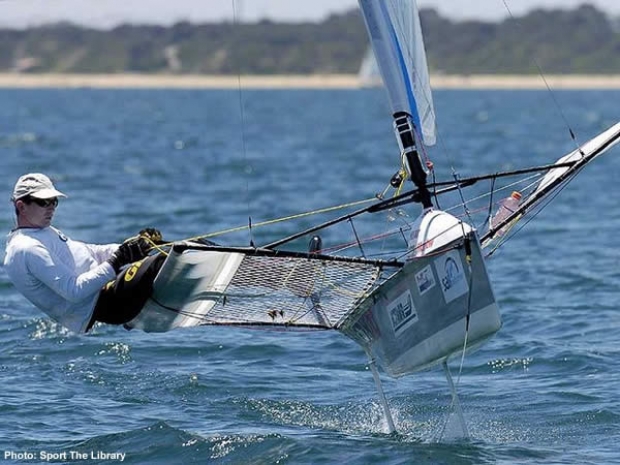
Low flying objects
Friday January 28th 2005, Author: Adam May, Location: United Kingdom
Upwind boat speeds in the 10-16 knot range, with over 20 knots downwind. Faster than 14s, 49er’s, and most catamarans, and the ability to sail at almost twice windspeed in 8 knots of breeze it sounds like the stats for a new maxi yacht or a multihull.
No it is the 11ft long International Moth!
The 2005 Worlds: A Hydrofoil Perspective:
The International Moth class World Championships have just been completed in Melbourne, Australia. Rohan Veal dominated the event, winning every single race on hydrofoils. His experience of sailing foiling Moths showed through, especially in the waves off his home sailing club of Black Rock. Veal put together the complete package, a new boat, refined foil package, lots of time on the water in the venue, superb boat handling, and solid racing.
Second overall was Simon Payne, the 2004 European Champion, with Adam May in third, a strong result for the British foilers to have two inside the top three. A Moth Worlds feat that hasn’t been done for quite a while. Mark Robinson was strong upwind and finished in fourth and Les Thorpe the Australian National Champion in a conventional skiff style Moth in fifth.
There was quite a correlation between results and time spent foiling. This became most apparent downwind in waves. Performances were close upwind, but it was those who had spent the most time sailing in waves, and could push hardest and sail deepest who came out on top. Apprehension at sailing in waves at the start of the regatta became eager anticipation at getting the next big wave right.
Surfing, or rather foiling downhill at around 20 knots above the face of a 1.5m wave is quite a challenge, but very rewarding if you survive! Rohan and Simon could push the boats hard downwind, and showed us all the next level of sailing these things. Many thought that sailing hydrofoil Moths in waves was not going to be practical, but the Worlds showed that the foilers happily cruise over the top of the waves upwind, and everyone is learning fast how to sail them downwind. With everyone learning so much during the regatta, it is fascinating to consider where the limits of sailing these boats actually are.
New foilers have a quicker route to successful foiling because there are a growing number who can do it well, and with a good transfer of knowledge down the fleet, the numbers will grow rapidly.
Since Rohan turned up to the 2003 Worlds in France with his Fastacraft hydrofoils, the general trend is that the number of ‘foilers’ has roughly doubled at each major event. There were two for the Australian Nationals at the end of 2003, five foilers in Weymouth for the 2004 Europeans, and 13 foilers in Melbourne before the start of the 2005 Worlds. Unfortunately a few had breakages and others chose to race with their conventional setups for the Worlds. 10 boats used foils during the Worlds though.
With much activity around the World, the prospect for the 2005 Europeans on Lake Garda in the first week of August looks very promising. Many of the UK fleet did not attend the Worlds because they were buying hydrofoils instead, and are enthusiastic about the future.
There are a few new boats in the UK, but the majority are just converting their current boats, providing a great route into the class. Learn to sail an older cheaper Moth, progress to a modern narrow skiff, and then put hydrofoils on it.
Developments
The Worlds was a great chance for people to see, use and talk hydrofoil Moths. While there may not have been any new and wild developments (at the event….) it was fascinating to see the different approaches made by a few people, and appreciate the level of refinement that has gone into the current configurations.
Rohan, Simon and Mark all sailed ‘Prowlers’ from John Illet at Fastacraft. John was the pioneer behind the current foil systems, and deserved to see his foils taking the top foiur overall, and three of his hulls in the top four. The configuration is the same as Rohan used at the 2003 Worlds in France and the 2004 Europeans in Weymouth, but the sailing techniques and wand control have been refined.
May used Fastacraft foils, but his own design hull, a ‘Mistress’ hull which is being built by Linton Jenkins of Full Force in Weymouth. Although not seen at the Worlds Linton is producing hydrofoil sets with a recessed in rear flap for potentially lower profile drag. With many of the UK fleet using these Full Force foils the next big showdown with all these different foil types could be interesting.
Camber induced windsurfer style rigs were pretty much universal, with KA sails from Andrew McDougal the choice of the top foilers, and a Truflo sail being used by Les Thorpe.
The top four used the standard Fastacraft setup with a bow mounted wand, and had spent time just learning to sail with this setup. The foiler development squad from Perth had tried to move the game on further though.
John & Garth Illet, Glen Oldfield (see top pic page 2), and Brett Burvill all turned up with centreboard mounted control wands. Instead of having a bow mounted wand linked to a cable to control the flap on the centreboard, they used a sensor mounted on the trailing edge of the centreboard with a direct link to the flap. While it was very simple, very easy to fit to the boat, and lighter it proved harder to sail with in the waves off Melbourne. The bow mounted sensor gives feedback relating to the water surface height you are about to sail into, whereas the centreboard mounted one senses the water level just behind the board. Fine in flat water, but tricky in waves.

John and Garth took the next step on from the rectangular planform foils currently used and had elliptical tips (see above) on the same inboard section. Glen Oldfield took it to a very elegant extreme and produced a stunning set of very high aspect ratio elliptical planform foils. Unfortunately Glen was down slightly on centreboard lifting foil area and couldn’t quite foil upwind like the others, but his very efficient looking foils could well be the route forward. Glen’s boat also featured a ‘Glen Lever’ (below), a little lever on the cockpit floor that could be used to adjust the angle of the centreboard, and thus the angle of attack of the main lifting foil with your foot.

While most of the foilers had stuck with what is now the current ‘conventional’ foiling Moth setup, there were several other configurations. The uni-foiler concept was seen in two different guises on Chris Dey (Aus) and Burkhard Staabs’(Ger) boats (see below). They utilised a small canard foil under the boat to provide lift, that would raise the bow and thus give an angle of attack to the fixed main lifting foil on the centreboard. The canard foil would control the height of the bow, and the main foil would settle at a ride height consistent with the angle of attack required at that speed. Steering was accomplished by a conventional rudder.

Unfortunately both Dey and Staabs struggled to foil consistently during the Australian Nationals and sailed the Worlds in conventional Moth mode, but both were convinced it was the way forward and will continue developing.
With raked forward centreboards and big rudder gantrys being used to separate the lifting foils as much as possible to gain pitch stability, Phil Stevenson took the next logical step and built a boat with the mast 50cm further forward in the boat. This allowed the centreboard to be moved forward for the same balance, and thus gain on foil spacing.
Brett Burvill, who was the developer of the wing mounted surface piercing foils that amazed the fleet at the 2000 Perth Worlds, arrived with a boat that featured two centreboard cases, and the facility to use a bow rudder. Brett sailed with the more conventional foiling Moth setup for the Worlds as he hadn’t had sufficient time to develop the concept but spoke openly about some potential performance benefits. Brett had tested a variety of foil configurations in a number of places, the most novel of which was a bow rudder with T-foil, and a rudder off the transom with T-foil, linked together so that the turning of the transom rudder moved the bow rudder the other way. There was no centreboard, but the boat was well balanced and with maximum foil spacing the boat was quite stable in pitch and could be driven hard downwind. Early testing proved encouraging, so this could be something to look out for in the future….
While there are still potentially large gains with new concepts, the smaller detail things were making differences at the front of the fleet. Each of the sailors adding something (however small) to the development of these amazing boats.
Greater wand control from the elastic by using a ‘May stick’ to control the wand recoil, and a ‘cleat de Payne’ to allow easy adjustment of the amount of elastic tension applied to the wand were soon adopted amongst the foilers. ‘Robo ropes’ were essential to keep toestraps tight to allow the adoption of the ‘Veal heel’ when sailing upwind. With a bow up, and heeled to windward attitude upwind, tight toestraps are a must. Hiking with a lot of windward heel has been likened to hiking off a window ledge with your feet above you! The length of the sensor wand is understood more now, and many ran a much shorter wand for the waves, with talk of going long again in flat water or lighter conditions.
Although still in the early days of course racing foiling, refinements are already being made, and sailing skills progressing quickly. Most of the top foilers can now gybe on foils (occasionally seeing the apparent coming from in front mid-gybe!) but Rohan has now started to spend most of the tack on foils as well, dropping off only at the end of the turn on the new tack, but quickly rising again.
It is an exciting and very interesting time to be sailing Moths.
The Season Ahead
The fleet are eagerly awaiting the 2005 Europeans, to be held on Lake Garda. Rohan Veal, and Mark Robinson have already confirmed they will attend, and a few others from ‘down under’ are considering it. So with the top four from the Worlds attending and a host of new foilers from all over Europe it is shaping up to be a great event. With that and the 2006 World Championships to be held in Denmark, the class is looking forward to the huge interest in the class turning into increased numbers at events.
Adam May
IMCA Secretary
GBR 4063 ‘The Mistress’

Most Read
Most Commented
Comments
Businesses

Pro businesses
Editor's choice
Member blogs
-
 Ned Collier Wakefield: MOD70 round BarbadosWell that was intense. 12 hard fought for seconds for the win. In idyllic conditions, Tony Lawsons MOD ...
 -
 Mini Transat leg 2 reportThe second leg of the Mini Transat started on 31st October, just over a month after ...
 -
Leg 1 reportI’ve been working towards the Mini Transat now for three years. In 2013 I was part ...
Business blogs
-
 The Island Sailing Club in Cowes, Isle of Wight, is delighted that Prince Michael of Kent ...
 -
Peta Stuart-Hunt chats with the 25 year-old British solo sailor Lizzy Foreman before she sets sail ...
-
The 2015 Student Yachting World Cup (SYWoC), an ISAF-recognised event hosted and run by students for ...
Editor's Choice
All time favourites...
-
 Three legs down into Ian Walker’s
 -
 Winning all but two races at
 -
 For the first time in its
Latest Comments
Add a comment - Members log in