
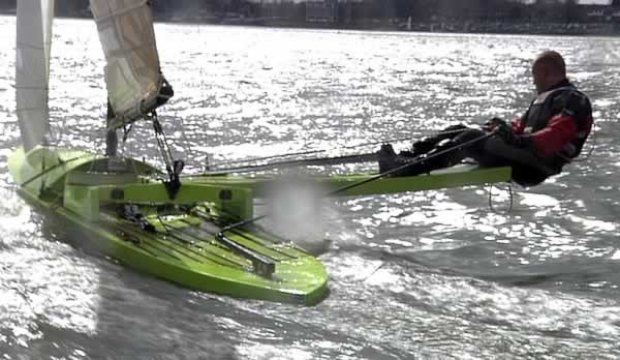
Canoes come to Weymouth
Friday November 19th 2004, Author: Peter McLaren, Location: United Kingdom
The XV Canoie Sailing World Championship and the Defence of the NYCC International Cup are to be held on Portland Harbour next August.
In additon to the World Championships in Canoe Sailing (held under the authority of the International Canoe Federation every three years - read more about the Canoe class here) as current holders of the historic New York Canoe Club International Cup the British sailors will also have to prepare to defend it with a team of three. The three races for the Cup will be held immediately after the Championship.
History
Canoe sailing has historic roots in the very development of Canoeing as a sport in the last quarter of the 19th Century largely through the enthusiasm of Warrington Baden Powell, brother of Lord Baden Powell the founder of the Scout movement. Sailing canoes were taking part in organised racing in the 1870s, providing keen, amateur sport at reasonable cost at a time when "yachting" was an activity for the wealthy. In 1898 the Royal Canoe Club, the leaders of the sport in Britain and based on the Thames at Teddington, adopted a craft 17ft long with 42in beam, very close to the dimensions of modern sailing canoes.
By 1914 the Club had built up a fleet of fast singlehanded canoes that sailed most of the year on the restricted waters of the Thames but were seaworthy enough to compete in coastal waters for the major trophies that were held at the annual Summer Meet. All this came to a halt with the Great War of 1914 to 1918.
Not until 1932 did a new generation bring new ideas and renewed enthusiasm. Meanwhile in the United States canoe sailing had followed a different line of development and it seemed too many that the two could not be brought together.
Uffa Fox, later to make his name as a designer and builder with many small sailing craft to his credit, thought otherwise. He built two canoes which complied with both the British and American rules and, with Roger de Quincey, went to America in 1933 to win the coveted New York Canoe Club International Cup (which had remained in the United States ever since it was presented in 1884) and many other trophies. As a result both sides saw the advantage of compromise and an International Rule that combined the best features of British and American practice was agreed between the American Canoe Association and the Royal Canoe Club.
One major sporting advance was the gentlemen’s agreement which stated that the winning country would hand over technical documentation and line drawings of the winning boats to the losing country, so resetting the advances to zero and stopping any one country holding an advantage. Imagine that written in to the rules of Formula One! In Britain a fleet of high quality was built, largely by Uffa Fox, until once again war brought development to a halt in 1939.
In 1948 the international governing body for canoeing was re-formed as the International Canoe Federation and adopted the Anglo-American International Canoe. Progress was slow in a war-stricken world but in Britain racing was quickly re-established with the existing fleet that was augmented by a trickle of new building, despite shortages of materials.
International competition in Europe was encouraged when Sweden and later West Germany adopted the International Sailing Canoe and the first post war World Championship was held in 1961 at Hayling Island. The adoption of a 'one design' hull in 1971, by reducing production costs, gave farther impetus to the spread of canoe sailing so that in 2005 it is expected that over 60 competitors from at least eight countries and three continents will be competing, despite the great distances that many will have to travel.
The XVth Championships will for the first time include the asymmetric variant, with its colourful spinnaker supercharging the down wind legs, adding yet new challenges to this timeless thoroughbred.
New York Canoe Club International Cup
The N.Y.C.C.International Cup is another strand in the story of international racing.
Presented in 1884, it is the oldest international trophy for small sailing craft in the world and second in age only to the America's Cup itself among yachting trophies. The rules originally required that the races be held in the 'home waters' of the Holder and subject to challenge on behalf of a Club representing a country foreign to the Holder, there being no national Canoe authorities at that time.
Despite challenges from Britain (including Warrington Baden Powell himself) and Canada it remained in the United States until 1933 when Uffa Fox and Roger de Quincey brought it across the Atlantic. After successful defence against challenges from Canada and the U.S.A. the Cup returned to America in 1952 and over the succeeding years travelled back to Britain, to Sweden and finally returned to the U.S.A.
This was the position in 1993, when the World Championship was held in San Francisco Bay. At this point changes were made to the rules for the Cup which recognised that now canoe sailors come together every three years it would be sensible to make provision for a challenge to be made alongside the Championship.
It was agreed that the results of the first four races of the Championship (there were seven races in total) should determine which nation could sail against the Holder, with a team of three.
Nowadays it is the responsibility of the National Canoe Authorities to make the challenge and the defence. In the event Great Britain won the right to challenge in 1993, went on to win the Cup and has defended it successfully ever since.
True Amateurs
At a time when so much sport has become professional and is geared to the requirements of television, Canoe Sailing is entirely amateur. To control costs many competitors do much of the work in finishing professionally built hulls and rigs themselves. One thing is certain; money cannot buy success, only skill and agility to an extent not surpassed by any other sailing craft. Perhaps it follows from this that international competition is characterised by intense competition on the water with good sportsmanship and camaraderie on shore.
Canoe sailors in Britain, as in other countries, come from all walks of life and all parts of the United Kingdom. Among them may be found an accountant, local government officer, professional engineer, carpet layer, lawyer, sheet metal worker, Thames pilot, teacher, college lecturer and insurance broker be they from England, Wales or Scotland.
Britain has won the Gold Medal on four of the six most recent World Championships, as well as a number of Silver and Bronze Medals. Following the XIVth World Championship held in 2002 in United States of America the British contingent successfully defended the New York Canoe Club International Cup against a challenge from the USA. The demonstration asymmetric variant was convincingly dominated by the British with the first American boat in ninth place.
The Europa Cup, which is held in non-World Championship years, is effectively the European Championship: In 2004 it was held in Portland and Robin Wood added the Asymmetric title to his past three World titles, with Gareth Caldwell taking the gold medal for the Standard boat. These achievements illustrate the depth of talent in the British fleet.
The 2005 World Championship
The honour of hosting the 2005 Championship falls to the British Canoe Union. The venue, the Weymouth & Portland Sailing Academy is the home of the successful British Olympic Sailing squad and site chosen for the London 2012 Olympic bid.
The British team will be entered by the British Canoe Union, During the past summer the BCU Sailing Committee has held a series of five qualifying regattas. The results will determine the selection. It is intended to have a large British representation at the Championship.
As well as a strong UK team, competitors are expected from all the major canoe sailing countries, USA, Canada, Sweden, Germany, France and Australia, as well as possible representatives from the Cayman Islands, the Netherlands and New Zealand.
Schedule
The Championship regatta programme requires that nine races (each of around eight nautical miles) be sailed over a period of five days from 7 August 2005.
The NYCC challenge series of three races will be held on the sixth day. In addition two days will be required for registration, measurement checks and a practice race. This will require a minimum of eight days on site, plus an extra time for overseas competitors to overcome jet lag and up to two days each way travelling time, around 15 days in all for some.
Costs
Unfortunately, to run an event of this magnitude, costs a lot of money. The organising committee is actively looking for a partner to help run the regatta.
Interested parties should contact Competition Organiser Peter McLaren here.
Most Read
Most Commented
Comments
Businesses
Pro businesses
-
-
France
-
United Kingdom
-
Netherlands
Editor's choice
Member blogs
-
 Ned Collier Wakefield: MOD70 round BarbadosWell that was intense. 12 hard fought for seconds for the win. In idyllic conditions, Tony Lawsons MOD ...
 -
 Mini Transat leg 2 reportThe second leg of the Mini Transat started on 31st October, just over a month after ...
 -
Leg 1 reportI’ve been working towards the Mini Transat now for three years. In 2013 I was part ...
Business blogs
-
 The Island Sailing Club in Cowes, Isle of Wight, is delighted that Prince Michael of Kent ...
 -
Peta Stuart-Hunt chats with the 25 year-old British solo sailor Lizzy Foreman before she sets sail ...
-
The 2015 Student Yachting World Cup (SYWoC), an ISAF-recognised event hosted and run by students for ...
Editor's Choice
All time favourites...
-
 Three legs down into Ian Walker’s
 -
 Winning all but two races at
 -
 For the first time in its
Latest Comments
Add a comment - Members log in