
Your feedback
Friday March 5th 2004, Author: James Boyd, Location: United Kingdom
Following on from this week's articles on foilers including
- a state of the nation in the Moth class
- an interview with designer Clive Everest about his new foiler RS300
- an interview with former Tornado sailor Adam May who is building a foiler Moth to his own design
- the views of RMW Marine's Richard Woof and Hobie TriFoiler designer Greg Ketterman
Dan Vincent writes
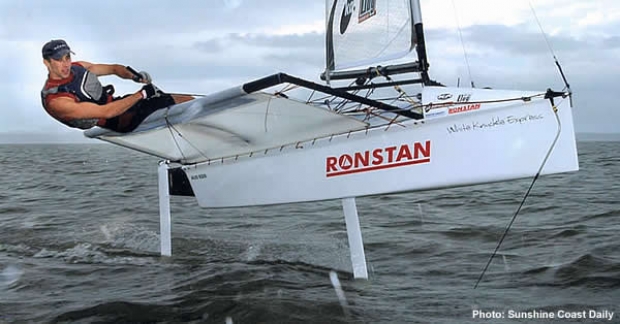
I would love to 'have a go' at foiling. I get the impression that most of the recent converts, including myself, have been inspired by the photos of Rohan Veal's bi-foiler International Moth. I think this is largely down to the fact that it looks 'right'. Having the T-foils on the centreboard and rudder it looks like a normal dinghy, neat, sorted and a million miles away from previous foiling 'contraptions'.
As discussed in the today's article the tri-foilers (such as the Hobie and even the Clive Everest design to some extent) tend to look like mutlihulls and one wonders how they would steer and roll. I am not sure that top speed matters it is more about how they 'feel'. Think bicycles v tricycles.
Although I have thought about getting a Moth, I think I am a bit on the big side and I agree with Clive when he suggests that foiling will drive competitive Moth sailors to get even lighter. Perhaps a low cost alternative would be to buy a second-hand RS600 and convert it to the Moth bi-foiling system. If someone (maybe RS) were to produce a conversion kit I would be very interested. This may be one way of "breaking the ground " as Richard Woof described in his interview.
From the US Doug Lord writes:
Thanks for the foiler reports!
I don't think that there is any question that foilers are the future of high performance dinghy racing. But you will see canting keel boats utilising retractable foils as well in the not too distant future.
And for the fun of it production folers can be designed to safely jump(and re-enter) which offers all kinds of potential down the line.
But the leadership in innovation are the Ilett foilers and Rohan Veal who have shown that a practical foiler can win races around a course - quite an historic breakthru!
Trisha Schuster writes:
Foil born craft can only operate in clean water! Any debris in the water that gets in the way of the foil will cause a crash. Long's tri-foiler self destructed in Corpus Christi going for the record when she picked up a plastic bag. Destruction was complete, I had to see a picture of the boat to identify the many & various pieces of fiberglass.Took a long time in the shed to piece it back together. Ciao, Longy
Jim Champ writes:
One criticism of the Trifoiler type approach is that they've tended to be boats where someone sits in the middle. Thus the foils on each side have quite different jobs to do and it must surely be unbalanced, and there's no body movement for trim etc. On the other hand all the Moth sailors have balanced and trimmed their boats properly and just used the foils for lift, which must surely make for a far more efficient craft - and I think the results prove it. It looks to me as if the Mothies have achieved as much in two years of foil development as has been achieved in any 10 year interval in the past...
Cam Elliott writes:
There's no doubt that the new foiler Moths look exciting and as I've seen first hand they are extremely fast .This is the result of John Ilets commitment and hard work to the foilers and has done a fantastic and professional job. But, at what cost to the class?
I used to sail skiff Moths at the same time as John and like him we all made the class a hands on boat. In other words we all designed and made our own boats, sails foils, etc.
We enjoyed state championships of up to 50 boats. Now the class is professionally-built and boats are costing $12.000 up to $14.000 and now with the advent of foils could add upwards of $3000 -$4000 to the cost of the boat.
It is very important to have a think about what this rise of cost will do to the class and as you all pointed out, you simply will have to have them to compete in the Moth class now. THERE ARE NO MOTHS SAILING IN THIS STATE ANYMORE AS A CLASS . So please think very carefully about the impact these foilers will have on the classes you wish to put them on.
If readers wish to add to the debate you views will be published by emailling us here .
Most Read
Most Commented
Comments
Businesses

Pro businesses
-
United Kingdom
-
-
France
-
United Kingdom
Editor's choice
Member blogs
-
 Ned Collier Wakefield: MOD70 round BarbadosWell that was intense. 12 hard fought for seconds for the win. In idyllic conditions, Tony Lawsons MOD ...
 -
 Mini Transat leg 2 reportThe second leg of the Mini Transat started on 31st October, just over a month after ...
 -
Leg 1 reportI’ve been working towards the Mini Transat now for three years. In 2013 I was part ...
Business blogs
-
 The Island Sailing Club in Cowes, Isle of Wight, is delighted that Prince Michael of Kent ...
 -
Peta Stuart-Hunt chats with the 25 year-old British solo sailor Lizzy Foreman before she sets sail ...
-
The 2015 Student Yachting World Cup (SYWoC), an ISAF-recognised event hosted and run by students for ...
Editor's Choice
All time favourites...
-
 Three legs down into Ian Walker’s
 -
 Winning all but two races at
 -
 For the first time in its
Latest Comments
Add a comment - Members log in