
The A-25
Thursday August 26th 2004, Author: James Boyd, Location: United Kingdom
An event that this jaded old hack is looking forward more than any this year is the first C-Class catamaran racing in some eight years.
Traditionally these boats, the world's most efficient sailing machines with their solid wingsail rigs, have raced for the Little America's Cup, officially known as the International Catamaran Challenge Trophy. But two years ago the Trustees of this Trophy, in their infinite wisdom, changed the rules and the ICCT is now raced in more run-of-the-mill Formula 18HTs.
Ironically at about this same time two C-Class challengers emerged, one from Australia another from the UK to take on the current holder, American Steve Clark, whose immaculately conceived, built and sailed, Cogito in 1996 beat Yellow Pages Endeavour of legendary C-Classer Lindsay Cunningham in the Australian's own backyard.
While the ICCT F18HT event is taking place again this year in October, so Steve Clark is holding what is being officially termed the 'International C-Class Catamaran Championship' on Narragansett Bay, Rhode Island from 16-26 September out of Bristol Yacht Club. Four boats are expected to take part.
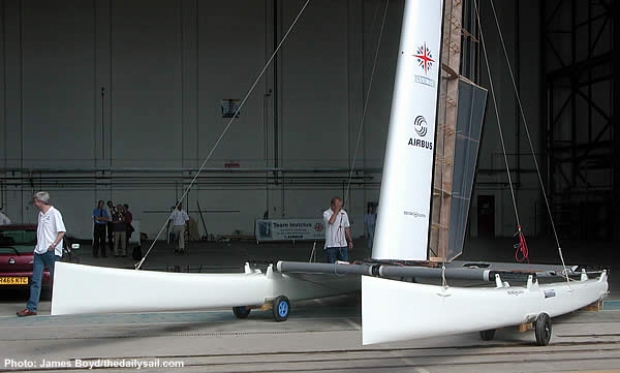
Yesterday thedailysail witnessed the unveiling for the first time of the British C-Class cat Invictus Challenge down at the giant Airbus facility in Filton on the outskirts of Bristol (England). Unfortunately the project has been running late due to a combination of financial and build issues and the team have not been able to launch the boat and put her through her paces in the UK. Nonetheless the boat is complete and today she is being loaded into a container and shipped to the States, where the team have a week to trial her before racing commences.
While Invictus Challenge has been conceived by aircraft designer and Airbus employee Norman Wijker, a large team have been working on the project including former Concorde pilot, Tornado sailor and the last British C-Class challenger John Downey, Mr Speed Freak himself Paul Larsen and Helena Darvelid. Martyn Smith ( Spirit of Apricot, Firebird, etc) who designed the nosecone on Concorde has been a consultant, while RS designer Clive Everest drew the catamaran's hull. Many of the parts of the boat were built by Dan Emuss of Independent Composites with materials supplied by Matrix Mouldings. The boat is very much a Bristol effort.
But what of the beast itself?
John Downey has previously described on these pages the concept of the Invictus Challenger. Under C-Class rules the boat must simply be a 25ft long by 14ft wide catamaran with 700sqm of 'sail' area. The rules stipulate that it is to be sailed by two crew, and only one can be on a trapeze although it is probable that the rules will change at some point in the future to allow twin trapezing.
The platform of course is not the exciting bit. The hulls of the boat are more slender and longer than those of a Tornado or an F18. The bows have a rise at deck level to help reduce the chances of nose diving (capsizing or pitchpoling these boats tends to be terminal for the craft in question and thus to be avoided). There are twin daggerboards and the rudder foils slot down into cassettes mounted on the transom with gudgeons and pintles.
The crossbeams are simple carbon tubes, the forward one with a substantial dolphin striker beneath it to counter compression load in the beam from the rig. Thanks to the solid rig there is no bowsprit or sail controls forward of the main beam as you might find on a conventional catamaran.
All-up weight of the boat is 170kg, a fraction heavier than spec and compares with 160kg for the benchmark boat, Steve Clark's Cogito but light compared with say the 180kg minimum weight of a Formula 18, some 7ft shorter. The platform is 'on spec' weight-wise at 80kg, the bare hulls hulls just 20kg apiece.
Thus the combined crew weight is fractionally less than the boat itself. "It makes it an interesting boat to sail because you are such a high percentage of the overall package, that the two 'moveable weights' on the boat make a huge difference as to how it is going to sail. You might find you trapeze a long way forward," says John Downey.
Obviously the main eye-catcher is the solid wing sail rig. To give some idea why these rigs are special: While a standard mast-softsail combination develops a lift co-efficient of around 1, C-Class rigs have been known to develop lift co-efficients of up to 2.1, thus considerably more horsepower per sqm of sail.
For those unfamiliar with solid wingsail rigs the object of the exercise is effectively to stand an aircraft wing on its side, but with the key difference being that the wing must work on both tacks (a standard aircraft wing is effectively a one tack wonder). Herein lies the challenge for both the designers and engineers - how to create a solid aerofoil that can change shape so dramatically.
Cogito and Yellow Pages both use multiple element wings and 'slots' - the whole wing able to rotate on a ball and socket joint on the main beam, like a Tornado or 60ft trimaran mast. Cogito for example has three sets of symmetric aerofoils the aft two moving in relation to the front aerofoil to simulate an asymmetric wing shape on either tack. The slots - the gap between the aerofoils - are deliberate and if designed correctly can further increase laminar flow over the wing, some of the wind being released from the high pressure side of the wing to the low pressure side, similar to the slot between the mainsail and jib/genoa on a conventional rig (to read more about Cogito's rig - click here).
The rig on Invictus Challenge achieves the same but in a different way. Aft of the solid nose cone is a section that is best imagined in plan view as being a hinged parallelogram, the parallelogram distorting according to which tack the boat is on. Aft of this are two pairs of flaps hanging off the rear two corners of the parallelogram. "It can flop from one side to the other so that the low pressure, working side of the rig approximates a very efficient standard aerofoil section while the other side will have a few minor dimples, but it is still a lot more efficient than the hollow behind a mast on a conventional sail," explains John Downey.
This type of wing is known as 'split flap' and a one tack version of it is to be seen on aircraft classics such as the Spitfire or Dakota. Upwind obviously there is little camber between the three elements and the flaps are together completing the aerofoil's trailing edge. Downwind to increase lift more camber is induced between the three elements, but particularly by the flaps that can move relative to the parallelogram by up to 35 degrees although it is unlikely they would ever be used to this degree. Downwind in optimum conditions the weather flaps will be trimmed more than the leeward ones and in addition to generating more power a side effect of this is that it creates a vortex between the two flaps that encourages air flow off the leeward side of the wing.
Compared to a slotted wing, the Invictus split flap wing is believed to have less drag upwind, whereas downwind the high lift co-efficient of the slotted wing and the ability to maintain flow over the wing at deeper angle is said to pay.
"We’ve got the advantage, which none of the other boats have ever achieved before, of having a tackable aerofoil," says John Downey, whose challenger in the 1980s, The Hinge, also used split flaps but had a symmetrical aerofoil instead of the hinged parallelogram structure of the Invictus rig. "So at the moment even Cogito, the benchmark boat, has got a collection of symmetrical aerofoils with slots. So they are still creating an asymmetric aerofoil but by moving symmetrical aerofoils. What we are achieving is an asymmetric aerofoil without having to do that. So potentially it is a very powerful section.
"Where we will be at a disadvantage is at 6-8 knots trying to go really low - it will be very easy to stall this rig, whereas Cogito will be able to keep on going because they have the slot helping. Upwind I would be surprised if we aren’t totally competitive. Whether we can hang in there downwind is something we’ve got to discover. If there is any sort of wind, anything above 10 knots, I would be surprised if Cogito gets away from us, because at that point you have to get rid of the power. Then drag becomes an interesting factor and so on..."
Norman Witjke adds that there was no point in copying the American and Australian slotted wing design because it would have take too long to catch up with their technology. The technicians at Airbus also say that with slotted wings it is essential that the shape of slot remains under control otherwise it rapidly becomes very inefficient aerodynamically and this is hard to achieve in such a lightweight structure. Also because the Little America's Cup course is not a pure windward-leeward but a windward-leeward-windward-zigzag, only one quarter of the racing is fully downwind.
So to recap: Cogito achieves its assymetric wing section by moving three symmetric elements relative to each other, while the Invictus rig relies on its 'hinged parallelogram' central element and the angle of its flaps.
The issue beyond this is how to power up and depower the rig so that it can operate in a wide range of wind strengths.
John Downey reckons the Invictus Challenge rig will be fully powered up between 7 and 13-14 knots of apparent wind, although it has been designed to work up to the maximum wind strength allowed under the class rules - 22 knots.
On Invictus Challenge there are three sheets - three ways of depowering or trimming the wing.
The first is the main sheet, which is in fact more like a traveller as it alters the aspect of the entire rig to the wind. This is rigged up so that pulling on the main sheet also operates the control line inducing camber in the wing helping the parallelogram 'pop' on to the new tack, rather like popping battens between tacks with a conventional mainsail.
Then there is the flap control (the red sheet). While this single-line is simple to use out on the water, how this control line affects the flaps must be set-up before sailing. Each day the technical team must make a call on the wind strength they are likely to encounter out on the water. They will then set the degree to which the flaps will operate and how they will deploy. For example in optimum wind strength the wing can be set up so that both flaps deploy equally or if the breeze is up so that only the lower flap deploys or that the lower flap deploys more than the upper flap. Both these latter examples allow the power to be kept on low down while the top of the rig effectively stalls.
In addition to this twist can be induced in the sail. A revolutionary aspect of the Cogito wing was that she was able to induce twist not only over the height of her aft element but her forward element too (to see a solid wing twisting - click here).
John Downey says that there is some flexibility in the structure of the Invictus wing so that it can twist naturally in gusts as 18ft skiff rigs do. They can also emulate twist by deploying the upper and lower flaps by different amounts.
However they can also articifically induce real twist by pulling the top of the parallelogram part of the wing so that it falls off to leeward relative to the bottom section. Downey reckons they have around 20 degrees of twist to play with between the top and bottom of the rig. The crew have a single control line (the blue sheet) to induce twist in the wing and it is likely that they will use this rather than the mainsheet/traveller to trim the wing upwind.
Significant from a usability point of view on the water is that the cats cradle of ropework inside the mast dictating the amount of twist and flap is retained through tacks or gybes.
So this is what is does. How it does this involves many hundred metres of 0.5mm Vectran cordage inside the rig. While the photographs of this look incredibly complicated the basic operation is relatively straightforward, but is cascaded or duplicated at different levels up the mast.
While the forward element, or nose cone, is made from solid carbon/Nomex, the parallelogram section comprises a number of plywood ribs including four control ribs (the solid ones if you examine the photo on page ???).
On each of these control ribs, lines run diagonally in both ways across the parallelogram. If these are pulled they collapse the parallelogram in one direction or the other inducing camber in the wing according to the tack and point of sail. The twist contol lines at the top of the rig work in a similar way but with a block and tackle and they pull diagonally across the parallelogram in the opposite direction to the camber control lines. The controls for each of the four flaps work on a lever system pulling against a hinge, like a pair of scissors. Simple eh?
Equally ingenious is the method by which the degree of flap movement is controlled. Inside the bottom of the forward element are two A-frames (similar to mast spanners) sitting one on top of the other, the upper one attached rigidly to the wing. The flap controls are attached to different points on the lower A-frame their position dictating the degree by which the flap is required to move. If no flap is required then pulling the sheet for the flaps locates one A-frame directly over the other. If flaps are to be deployed the sheet is released and cleverly it is this A-frame arrangements that allows the flap settings to retained between tacks.
"The ultimate elegant thing would be to have a sort of traveller car that you can pull in and out so that you can tune it as you go along, but that was too complicated so it is just tied off," says Downey. "So we say ‘it is going to be a windy day and we only want the bottom flaps to work', then we put all the upper flaps controls into the middle of the bar so they are not pulled in and out at all (or a tiny amount near the pivot) and then all the lower ones we have them out. Then on a normal day if you wanted everything to work properly you’d have them tied off at the holes all across the bar. The lower ones you want to move more than the upper ones."
Invictus Challenge arrives in the US on 7 September and the team will have one week of training, tuning and learning how to use their rig before the first races of the 2004 International C-Class Catamaran Championship begin.
One week is not long enough to tune up such a complex beast and while they may be competitive the team have resigned themselves to treating this event as a training mission in preparation for developing their next boat. Since the construction of the present boat they have had considerable interest from a company called Fibrefusion (who readers might remember built the fabulous Merlin Rocket on the Harken stand at London Boat Show a while back). Using their technology, by for example using carbon instead of plywood for the frames inside the parallelogram, Witzke reckons that they could take an impressive 40kg out of the wing, which presently weighs in at 90kg.
More photos on the following pages...
Most Read
Most Commented
Comments
Businesses

Pro businesses
-
Italy
-
-
United Kingdom
-
Netherlands
Editor's choice
Member blogs
-
 Ned Collier Wakefield: MOD70 round BarbadosWell that was intense. 12 hard fought for seconds for the win. In idyllic conditions, Tony Lawsons MOD ...
 -
 Mini Transat leg 2 reportThe second leg of the Mini Transat started on 31st October, just over a month after ...
 -
Leg 1 reportI’ve been working towards the Mini Transat now for three years. In 2013 I was part ...
Business blogs
-
 The Island Sailing Club in Cowes, Isle of Wight, is delighted that Prince Michael of Kent ...
 -
Peta Stuart-Hunt chats with the 25 year-old British solo sailor Lizzy Foreman before she sets sail ...
-
The 2015 Student Yachting World Cup (SYWoC), an ISAF-recognised event hosted and run by students for ...
Editor's Choice
All time favourites...
-
 Three legs down into Ian Walker’s
 -
 Winning all but two races at
 -
 For the first time in its
Latest Comments
Add a comment - Members log in