
Sliding seat speedster
Thursday March 25th 2004, Author: James Boyd, Location: United Kingdom
The International 10sqm Canoe is a sailboat that has seen evolution of Darwinian proportions from its origins when caveman discovered that the wind could save him paddling his hollowed out log.
In fact the origins of the International Canoe class are a little more contemporary, dating back to the mid-1800s when canoes were being used for cruising and makeshift sails were added to save paddling prior to them being raced for the first time in the 1870s.
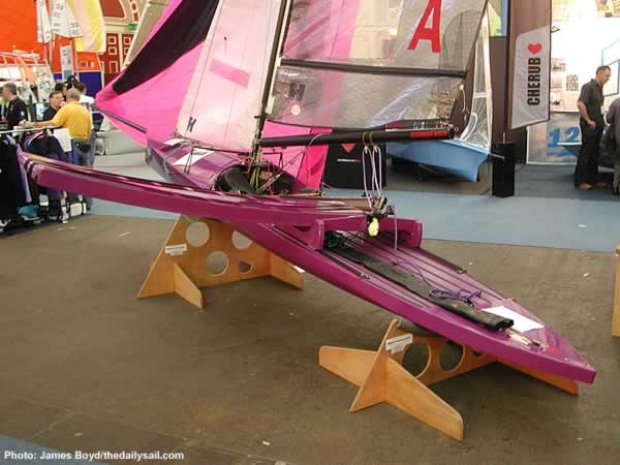
Born of canoes rather than scaled down seafaring vessels makes the International Canoe unique in the sailing world. Modern canoes vaguely look like their paddle born equivalent - they are decidedly narrow, class rules allowing a BMax of just 1018mm on a 5.18m long hull and have a canoe-style stern tapering to a point, yet due to their unique evolution the class' official governing body is the International Canoe Federation rather than ISAF.
This has its advantages. "There’s a lot of money in paddling canoes, so we get sponsorship and assistance for travelling around the world from the ICF," says Andy Biden, UK class Sailboat Coordinator. "In theory we can put our canoes on the Thames for nothing and our official club is the Royal Canoe Club on the Thames at Teddington, where these boats come from." The class is 'international' because it falls under the ICF's jurisdiction.
The modern International Canoe is a fabulous piece of equipment even if it might seem a little eccentric. Aside from being incredibly narrow its unique feature is its sliding seat first introduced by the American canoe sailor Paul Butler in the 1880s. Canoe seats not only slide from side to side but also fore and aft and the way they are handled has developed considerably over the last 120 odd years...
"You sit on the end of the seat and if you put any pressure down on it, it stops sliding, but when you’re not on it, you can move it with one finger," explains Biden. The bearings on modern boats are such that when sailing water actually lubricates them.
Under class rules the seats are allowed a horizontal extension from the centreline of the hull of 2040mm, although another 6 inches or so may soon be allowed under class rules. What many people don't realise, says Biden, is the use of the seat itself for ballasting. Minimum weight of the whole boat (ex sails) is 83.5kg of which up to 10kg can be used in correctors and of the all-up weight the seats must be 9-12kg. Moving this fore and aft and side to side has a significant effect on the way the boat handles.
While getting to grips with the seat is obviously what differentiates the class from its piers, Canoe sailors have recently been coming to terms with a more recent development in the class - asymmetric spinnakers.
"It was shown to work by a German in the early 1980s," says Biden. "They played around with it and then Rob Michael [of the principle UK class builder Emsworth-based Razorback Boats], got it to work in the form it is in today. We only did it to go and have fun with because the boat is a bit slow downwind and everyone liked it so much that they all wanted one. There are about 40 UK boats that have converted now. So the members are voting with their chequebooks. It is great fun - I love it." However as with all such developments, the introduction of the asymmetric to the class does have its decentors.
In the UK asymmetrics have been used in anger in the class for five or six years during which time the Canoe sailors have been learning how to use them. Biden reckons that they have now come to terms with it. "The results from the Nationals where five different boats each won a race shows there’s a lot of competent people at the front of the fleet capable of handling it."
Unlike other development classes where much scratching of beards takes place before new innovations are drawn into the class rules, with the Canoe class Biden says it is more impromptu. "It is a funny class because someone will say ‘look, I’ve done it. It works’. Then everyone says ‘okay, we’re upping the rules’. So we develop along strange lines in that we don’t all sit down and say now what are we going to open xyz up."
Performance-wise modern Canoes are matching 505s upwind and downwind, where Biden says non-asymmetric Canoes can be a little pedestrian by current standards, their performance has been transformed thanks to the asymmetric kites. "Downwind 23.5sqm doesn’t half make it move. At Hayling the fleet have been having so much fun just screaming around that we’ve not been doing too much serious club racing. We’ve been told off about that, but at the end of the day we’ve been enjoying ourselves and learning how to sail the boats and we’re going to get some serious racing in this year."
Aside from the introduction of the asymmetric kites, Biden says there has been a general simplication of the cockpit layout and the control lines. "It became very very complex. So now we've got things like shock cords on the pump system. So when you get in the boat, you’re singlehanded, it’s got to be there for you. You get in you can see the handles, they’re different colours, you grab the right one instantly. You can’t afford to overstep the mark because you are scrabbling around with the lines. It’s simple and it works." Modern boats now only have one cleat for the jib sheet instead of two.
While the Canoe is unlikely ever to be a mainstream boat the market in them does seem to be quite healthy at the moment with few secondhand boats on the market in the UK and with six new boats in build. "We reckon that 4-5 boats per year are the class’ average so we’ve above that," says Biden.
In the UK there are two main builders - Razorback Boats and John Ellis. Razorback are in the process of building five with John Ellis building the other two including one for the Chief Measurer Colin Brown and another for Class Chairman Phil Robin.
At present when racing, the asymmetric and conventionally rigged Canoes are taking the same start, but the asymmetrics sail off to a wing mark after rounding the weather mark.
"Basically if you take the asymmetric sail off, take off the control lines and pull the pole out the front, you can race it as a standard boat," says Biden. "I’ve been racing an asymmetric as a standard boat this last year. I’ve not been doing too well, but that’s my fault. In some of the heavy weather races the whole fleet has started as a standard boat and raced around as a standard boat."
After a successful Nationals at Stone last year, this year the class are holding the Europa Cup - the combined Europeans and UK Nationals - at Weymouth & Portland Sailing Academy from 31 July until 6 August. "We should get about 40 boats. It should be a good event. We've got the Worlds coming there again when they will have the new facilities up and running." Aside from the UK fleet,Canoe sailors from Sweden, Germany and France are expected to take part in the Europa Cup.
At present Biden says the UK has the most active Canoe fleet internationally although the present world champion is American class stalwart Steve Clark. "I would expect to see the UK boats dominant at the Worlds in 2005. At the last Worlds most of the fleet were busy messing around with the kite at the front. All the previous top boats had gone into asymmetrics. They eventually won the New York Challenge Cup between us and the Americans."
Another interesting aspect to the class is that because of its long heritage there are a considerable number of lavish mugs to be won. The Sailing Challenge Cup is believed to be the second oldest sailing trophy in the world after the America's Cup itself.
In terms of who sails Canoes one gets the impression they are a similarly undefinable bunch like those who drive Bristol cars (but possibly not as wealthy). Rather than having big fleets in any one place boats are scattered around the country and they tend to race on handicap with the exception of the small number of class events. "People seem to think that the boat is a bit of an oddball," says Biden. "They try to steer clear of it, but usually that’s because they’ve never sailed one. If you sail one you realise what it is all about. Very few people leave the class and go and buy another performance boat like it.
"The trouble is with the new classes it is almost like a fashion. We see it at Hayling Island. When the Laser 5000 came along everybody piled into that out of all the traditional classes and then it was the B14 and it was the same. Suddenly our club had 30 of them. And now the RS800 is the flavour of the month. And there was about 30 of them a year or two ago and now you only get about a dozen of them going out. We still have the same number of Canoes all the time."
At Halying Island Sailing Club, the Canoe is by all accounts the longest serving class. "It has got its stalwarts who won’t sail anything else. I stopped sailing a Canoe about 20 years and then I saw one with an asymmetric and then I thought, I need to get back into one of them," says Biden.
Most Read
Most Commented
Comments
Businesses
Pro businesses
-
France
-
-
United Kingdom
-
Italy
Editor's choice
Member blogs
-
 Ned Collier Wakefield: MOD70 round BarbadosWell that was intense. 12 hard fought for seconds for the win. In idyllic conditions, Tony Lawsons MOD ...
 -
 Mini Transat leg 2 reportThe second leg of the Mini Transat started on 31st October, just over a month after ...
 -
Leg 1 reportI’ve been working towards the Mini Transat now for three years. In 2013 I was part ...
Business blogs
-
 The Island Sailing Club in Cowes, Isle of Wight, is delighted that Prince Michael of Kent ...
 -
Peta Stuart-Hunt chats with the 25 year-old British solo sailor Lizzy Foreman before she sets sail ...
-
The 2015 Student Yachting World Cup (SYWoC), an ISAF-recognised event hosted and run by students for ...
Editor's Choice
All time favourites...
-
 Three legs down into Ian Walker’s
 -
 Winning all but two races at
 -
 For the first time in its
Latest Comments
Add a comment - Members log in