
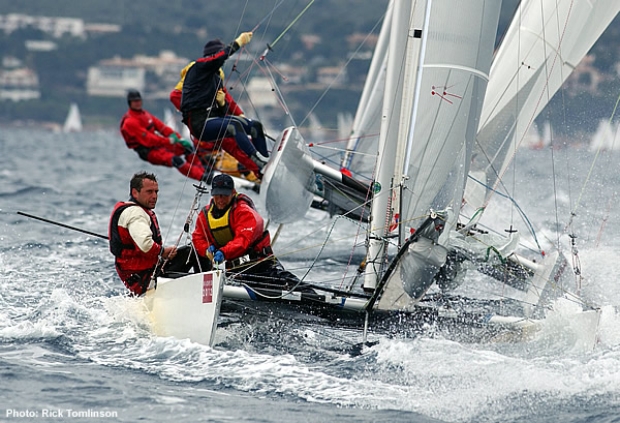
Olympic preview - the Tornado
Friday August 20th 2004, Author: Adam May, Location: United Kingdom
Introduction
The International Tornado Class Catamaran was designed by Rodney March from England in the autumn of 1967, specifically for the purpose of being the new Olympic Catamaran.
International Status was granted to the Tornado as a result of its outright winning of the IYRU Trials held in England. The next step, adding the Catamaran event to the Olympic program, occurred two years later, and the Tornado saw its first Olympic competition in 1976 in Montreal, Canada. The Tornado is an outstanding example of a class that was designed specifically for Olympic competition that has become a successful International class on its own merits.
The Tornado has since remained unchallenged as the ultimate one-design catamaran. With its modern, stylish rig and sleek lines the Tornado is quick to catch the eye of any on-looker. With its ability to reach speeds of 14-15 knots upwind, and excess of 30 knots downwind the boat is an impressive speed machine.
Over 4,800 Tornados have been built, with 1,200 class association members based in more than 30 countries worldwide. This year on the Saronikos Gulf in Greece, the Tornado will be making its seventh appearance at the Olympic Games.
Except for refinements in technical details - improvements in hull, sail, and spar technology, better blocks and lines - the Tornado was unchanged from its beginnings through to the early 1990s. Then, as a result of the increasing popularity of other, smaller catamarans, the Tornado class undertook a major development programme in 1993. This was specifically to respond to a request from the IYRU to search for ways to improve the public and media awareness of the sport of yachting, and secondarily to fend off possible challengers to its position as ‘top cat’.
Much development took place, with variations in main and jib combinations, and the testing of spinnakers. The International Tornado Association spent much time and money on the testing, evaluation, reporting, and finally balloting process to the class membership, to find the fairest and best ways to improve the class and the sport in ways acceptable to the sailors. The two-thirds majority required by the class to implement a change was not reached though and the Tornado retained its sailplan for the next two Olympics.
The issue of changes in the boat were revisited in 1999, when the ISAF decided to have Multihull Evaluation Trials in France to look at “possible replacements” in the Olympic programme for the Tornado. At the time, there were a number of technical changes in materials that allowed for better spinnakers, and better control, and there were then a number of successful double-trapeze plus spinnaker catamarans on the market in the Tornado size range - 20 feet - that were becoming popular.
The Trials were interesting. Except for the custom, all-carbon Marstrom 20, the standard Tornado dominated upwind, beating all production challengers from Hobie, Nacra, Mystere, and others. Only by piling on sail area, plus a spinnaker, were any of the challengers able to beat the Tornado around the race course, and even then the advantage disappeared as the wind increased. But the extra athleticism needed to sail with a double trapeze, and the extra visual interest provided by the spinnakers, was undeniable, and the final outcome was that the ISAF decreed that the equipment for the 2004 Olympics would be the 'Tornado with double trapeze and spinnaker', and left it up to the class how to implement the changes.
The class took an approach that allowed some development and testing, with the goal of keeping crew weight in the same range as with the old rig. The final result, approved by the class in early 2001, were both evolutionary and radical. First was a new mainsail with a flat top and more area, providing more heeling moment to compensate for the double instead of single trapeze and help keep crew weights with the same range. Second, done to clear the trampoline to make spinnaker work possible, was to redesign the jib. The new jib had the same area, but was longer on the luff and shorter on the foot to allow it to be sheeted to the main beam. With the adoption of jib tracks on the main beam to aid jib handling, tacking actually became an easier manoeuvre than previously.
Finally, of course, there was the spinnaker, and the class set only size limits, allowing the question of spinnaker handling equipment to be settled on the race course.
Again, the advantages of spinnaker launching tubes quickly established themselves, and became a class standard. Interestingly, the two biggest boathandling improvements, the self-tacking jib and the spinnaker tubes, were quickly adopted by the classes below the Tornado, especially the International Formula 18, which was becoming the Tornado trainer for future Olympians.
The Tornado Class Rules have evolved and been developed over many years and now ensure strict attention to all details relating to the performance of the boat. Rules are modified as needed and wanted by the sailors themselves, to allow the Tornado to advance with modern technology yet always considering the long-term effectiveness of the changes.
The Olympic status of the Tornado has brought some of the finest sailors from all over the world to the class. With many nations regularly attending the annual World and Continental championships, and with the medals won at the Olympics going to sailors from all the continents where the boat is active, the Tornado has a worldwide level of racing matched only by a very small handful of other classes.
The Class Rules allow the boats to progress with technology and let modern materials such as carbon fibre, nomex, epoxy resins, and high-grade aluminium to be used as they fall in price and can be incorporated into the boat, resulting in constantly improving quality. This helps resale values and enables the Tornado to maintain its status as the ultimate speed machine; to this day, almost 40 years after it birth, the Tornado is still the fastest one-design production boat in the world.
For the immediate future, the class is concerned with ways to bring in more modern, lighter materials while maintaining the one-design nature of the boat, and done in such a way that the purchase price of a new boat can be contained.
There is currently a ballot within the class regarding the refinement of the rules, and the adoption by the class of a one design carbon mast. The intended goal of this ballot is to strengthen the one design rules of the class and to lower the costs of owning and racing a Tornado. Many are keen for sailors to always have access to the same equipment, but others feel the class is so strong because of the freedom that exists for development within the current rules and do not want to see limits on the equipment used in what is probably the most open Olympic class.
To summarise: in its first Olympics, the Tornado was the fastest and most spectacular of the Olympic classes. Now, after the turn of the century, it is still the same boat that is the fastest, most exciting, and most spectacular of the Olympic boats.
Sailing the Boat:
Sailing a modern Tornado is unlike many other boats. Coming from conventional dinghies, tackling a Tornado is quite a challenge. It is a big powerful boat, with high sheet loads, and speeds to match! Faster round a windward-leeward course than an 18ft skiff, the Tornado is amongst the fastest course racing boats. It has a much quieter, surreal sensation of speed, than fast dinghies, with the sight of the windward foils knifing through the water your only indication of speed until you go past something. Tornado sailors often joke in training that they’ll just use any other class of boat as a windward mark as they all appear stationary in comparison!

Medal Contenders:
The competition at the top of the Tornado fleet for Athens is extremely tough. Whereas there were three clear favourites in 2000, there are probably now seven teams seriously capable of winning the Olympic Regatta and nine that are capable of winning a medal. All of these teams are athletic, experienced, mentally tough, and very fast.
The top seven teams would be listed as Argentina, Australia, Austria, France, Great Britain, Netherlands, and USA. The remaining two teams in the Top 9 are Germany and Spain, who are unlikely to win Gold or Silver, but are credible Bronze medal contenders.
The three medallists from Sydney will be competing again in Athens, although Germany's Roland Gaebler has a new crew.
An interesting feature of this Olympiad has been the level of cooperation and training undertaken between teams from different countries. Many with close battles for country selection teamed up with others in similar situations to form tuning groups. The Netherlands, GBR, and the US team are one such group who all use the same sails. Austria and Argentina have been doing a lot of sailing together, with France as well, although they all use different sails. The Australian, German, and Greek crews are also known to have trained together.
All the top teams will have a similar standard of gear and rigs, although they will come from a variety of manufacturers. There will be boat speed differences depending on the conditions, but nobody is likely to dominate the regatta purely on boat speed if Athens delivers its variety of wind directions and strengths.
If there are a couple of light and unpredictable days, there will be some big scores. Tornados can achieve huge amounts of separation in the light conditions and looking over your shoulder at somebody flying a hull while you still have both hulls in the water is a painful feeling. Occasionally racing in Athens it has been possible to be behind and yet sail around the fleet on the final leg.
Rising to the occasion and being consistent will determine the outcome of the Tornado event.
Listing the top contender for the Gold medal is tough. With so many top teams it really is a hard one to call. If you were to list two teams to emerge at the top of the leader board at the end of the Games though it would be the Gold and Silver medallists from Sydney, the Australian team of Darren Bundock and John Forbes, and the Austrian team of Roman Hagara and Hans Peter Steinacher.
The Australians have been at the top of the fleet for years, and although it appears the rest of the fleet have caught up in recent events, it would be no surprise to see this experienced team come out on top again. The Austrians haven’t had a great few regattas recently, but watching them race in some warm-up regattas in Athens recently they looked to be in very good form. The Saronikos Gulf is a very difficult venue, and any team that can get a handle on the conditions before the others will succeed.
Who will win? It remains to be seen, but it will an impressive performance to win in the tricky conditions Athens can throw up.

Equipment
Since the advent of the new rig for this Olympic cycle, there has been considerable development within the class. The evolution of the rig has been the biggest concern of the fleet, and even in the final run up to the Games considerable developments have continued to be sort after.
Sails:
Within the fleet there is quite a variation in the sails used. Many have embarked on their own rigorous sail testing and development programmes, either individually with a sail loft, or as a tuning group.
Sail development had progressed within the class at expected levels, with a number of sailmakers featuring, but the last few months have seen an amazing amount of activity. A catalyst for this may have been the success of the Dutch-Anglo-American training group.
They have developed a new lightweight polyester cloth they have labelled T fibre. A much lighter sail is possible out of this cloth, but early sails had a tendency to rip forcing the group to take extra care on the detailing and finishing of their sails. Used in the mains and jibs the sails are made by Ullman Italy (Pablo Soldano) and USA (Jay Glaser). At the Palma worlds these three boats won six out of the nine races, finishing 2nd, 5th and 7th in the Worlds. Many teams were keen to get their hands on the material, and failing this they have forged ahead on their own programmes.
The French are using Incidence-made string sails, which is similar to 3DL but made by Incidence in France. Originally developed by Yann Guichard, Backes have taken over the development and testing of these sails following the French selections.
Argentina have been using North 3DL mains (unclear from what loft) but recently in training races run by the GBR team they have been seen with conventional cloth Jessenig sails.
The Spanish appear to have got some cloth very similar to the GBR, NED, USA group and were undertaking a lot of rig work prior to the Games.
Australia are likely to use an Italian Ullman mainsail, an Olympic sail from Sydney or a development sail from their coach Mike Fletcher. So many sails have been seen up and tested it is hard to call. They undertook some practice racing in June with a blue Dacron mainsail! Their understanding of the Tornado rig is superb though, and having led the fleet for a number of years they will continue to develop fast kit. It will be interesting to see what they use in Athens.
Spinnaker-wise, again much development has been undertaken but it has been hard for any sailmaker to better the Grand Segal spinnaker which has become almost a class standard. There will be Jessenig, and Ullman spinnakers in use, but all have very similar flying shapes.
Some spinnakers have been developed that enable you to sail lower than with the Grand Segal, but they lack the versatility to go high if needed. Do you therefore go for a kite that is potentially quicker if you are in a clear lane or do you retain some options in case of a mid-fleet battle? A tricky call in a 17 boat fleet.
Spinnaker cloth was also developed by the NED, GBR, & USA group who used a laminated cloth throughout 2004 including the worlds until it was banned in late May at Spa regatta. Even within the confines of a ‘one design’ Olympic class there are still last minute developments going on in both main and jib cloth and spinnaker cloth to gain an edge. Great for giving new technology to sailing.
Platform:
Everyone will be using a platform from Goran Marstrom in Sweden. Marstrom’s hulls are very well built from Nomex and pre-preg glass, and have dominated the class since the early 1990s. Several teams tried a new ‘White boat’, tweaked by Yves Loday and built by the Whites in Brightlingsea. It was thought that this slightly finer with a more Veedd shape might be better with the modern Tornado rig. Team GBR’s Rob Wilson used the first new rig White boat in the Cadiz Worlds as did Leigh McMillan in Miami, but neither found it as quick as their Marstrom platforms. The French squad spent the most amount of time testing the two platforms, but I don’t think we will be seeing one in Athens.
Mast:
Marstrom masts will be the most widely used spars in Athens. The biggest difference being whether teams use a tapered version (tapered from the hounds position up to a min girth measurement) or use the untapered tube. The tuning group of NED, GBR, & USA all use the untapered version and as a result many other teams have been trying this, but it looks as though there will be a split among the fleet with regard to their favoured mast.
The untapered tube results in a slightly different bend profile, with a more even curve and a less aggressive curvature change at the hounds but at the expense of the greater windage of the larger head portion. All masts adhere to a total weight and tip weight rule so this is not a factor.
How stiff do you want your mast within the production variations is quite a topic. Many thought you should use the stiffest mast possible, but while this gives you a more consistent bend and stiffer set-up you seem to lack the rig response, and the dynamics of the rig are different. Exactly how the top Tornado teams select their masts is still something of a black art…
Hobie masts, Nacra masts, and a variety of other sections have all been used on the circuit, but most teams have stuck with a Marstrom mast. Teams have found a mast they are happy with and based their sail development around that.
Foils:
With the classic Tornado rig, centreboard shapes had begun to evolve towards thin, very fine fronted sections, and a number of different sections were being used by the fleet. The adoption of the new rig increased the righting moment of the boat and loaded up the foils more. The relatively small Tornado foils struggled with this and many people are using more tolerant sections now. Some are still using finer sections but these are harder to sail with, and may not be ideal for Athens. The standard Marstrom centreboards will be the standard in Athens although a number of teams will be using their own foils, notably the Australians and Americans.
Rudders are almost universally Marstrom, with the only difference in the finishing and fairing of the foils some teams have done.
Spinnaker Systems:
The fleet is universal in its adoption of spinnakers being launched and stored from a bag or carbon tube under the bridle wire, enabling a much faster hoist and drop than was ever possible with a bag on the tramp.
Most commonly used is the Graham Eeles pole, which consists of a carbon spinnaker pole with an oval carbon pole mounted on the side of it to contain the spinnaker. Teams such as AUS, ARG and FRA are using these poles.
The other style is a small diameter outer tube, blending into a larger tube in the inboard portion which houses the spinnaker. Marstrom produced early versions of this with a very high ‘mouth region’. Full Force boats in the UK developed a neater looking pole with a tapered rear section in an oval shape. The American team are using one of these poles.
The simplest system is that used by Mitch Booth and a few others, with a carbon mouth element in front of the bridle wire mounted on a carbon pole, joining to a sailcloth bag. Although lighter and simpler, with easy hoists and drops from the large mouth it has probably more windage.
Eeles has developed a newer version of his side mounted pole, which is similar in appearance to the Full Force and Marstrom poles. Whether the British team who have been working with Eeles, use this pole remains to be seen.
The Sailors - 17 Entries
Argentina
Santiago Lange & Carlos Espinola
World Championships: 1st in 2004, 3rd in 2003
World Ranking: 3rd
Additional Info: Previous Olympic Results: Espinola Silver medallist in Sydney 2000, Mistral class, 24th in 1992, Lechner class. Lange – 9th in 1996, Laser Class. The 2004 World Champions have few weaknesses. They are smart, flexible, fast in all conditions, confident, and consistent. Recent sail testing with 3DL sails and also new Jessenig may prove a distraction, but a contender for a medal.

Australia
Darren Bundock & John Forbes
World Championships: 3rd in 2004, 1st in 2003, 2002, 2001, 1999, & 1998
World Ranking: 9th
Additional Info: Silver medallists in Sydney 2000, with Forbes winning the Bronze in 1992 as Mitch Booth’s crew. Their ranking position is misleading - this is likely to be the team to beat. Up until recently you would have said they had no weaknesses, but several of the fleet have caught them up with advancements and understanding in sails and rig. They also haven’t spent as much time in Athens as many others, with Forbes back in Australia a lot in recent months. They do have a great competitive edge and resilience, great tactics and speed. And, they really rise to big events. Experience of racing against Bundy is that this team still have something in reserve for the big occasion.

Austria
Roman Hagara & Hans Peter Steinacher
World Championships:
World Ranking: 1st
Additional Info: Gold Medallists in Sydney 2000. This team are superb in light to moderate and shifty conditions, but probably not a favourite in a breeze. They are very good ‘big event’ sailors, and in some recent racing in Athens they dominated the racing. Certainly Gold medal contenders.
Brazil
Mauricio Santa Cruz Oliveira & Joäo Carlos Jordäo
World Championships: 24th in 2004
World Ranking: 72nd
Additional Info: Santa Cruz Oliveira finished 11th in Sydney 2000.
Canada
Oskar J & John Curtis
World Championships: 17th 2004, 28th 2003.
World Ranking: 15th
Additional Info: Some good showings at previous regattas in Athens will be encouraging for this team along with a good performance in the Miami OCR this year. Some good individual race results are possible, but they are lacking the necessary speed and experience to be considered within the top group.
France
Olivier Backes & Laurent Voiron
World Championships: 6th 2004, 11th 2003, 2nd 2002
World Ranking: 4th
Additional Info: 2nd at the 2004 European Championship. This team is fast across the entire wind range, with consistency as one of their greatest strengths. A long drawn-out selection process may not have helped them, but recent warm up races in Athens have shown them to be potential medallists.
Germany
Roland Gaebler & Gunnar Struckmann
World Championships: 12th 2004, 4th 2003.
World Ranking: 8th
Additional Info: Gaebler was the Bronze medallist in Sydney 2000, and finished first in the 2000, 1997 & 1996 World Championships, second in 1998, and third in 1999. Gaebler is a great all-around helmsman returning to form with a very young new crew. With Gaebler’s break from the class for two years, they have a big gap to close though. They are capable of a Bronze, but other teams are likely to be battling for the top prize.

Great Britain
Leigh McMillan & Mark Bulkeley
World Championships: 5th in 2004, 2nd in 2003
World Ranking: 5th
Additional Info: They are the youngest of the top teams. Very fast downwind, and being part of the NED, & USA tuning group has given them very good all-round speed. This team have been battling at the front of the fleet since winning SPA regatta in 2003.
Greece
Iordanis Paschalidis & Christos Garefis
World Championships: 36th 2004, 14th 2003.
World Ranking: 17th
Italy
Franceso Marcolini & Edoardo Bianchi
World Championships: 34th in 2004, 12th in 2003.
World Ranking: 25th

Netherlands
Mitch Booth & Herbert Dercksen
World Championships: 7th 2004, 5th 2003
World Ranking: 2nd
Additional Info: Booth was the Silver medallist in 1996 sailing for Australia, with Derckson finishing ninth in the same Olympics. Booth finished first in the 1997 Worlds, second in 1997 & 1993, and third in 1994
The 2004 European Champions have always been fast in heavy air, but beatable in moderate and lighter conditions, although recent rig work has helped this considerably. Booth’s experience in the class shows with very solid tactics, although he is a little temperamental with race committees. Seeing Mitch in a protest during the Games would not be a surprise!
Portugal
Diogo Cayolla & Nuno Barreto
World Championships: 15th 2004, 26th 2003.
World Ranking: 14th
Additional Info: Barreto won a Bronze in 1996 in the 470 class, while Cayolla was competing in the Star class, finishing 21st.

Puerto Rico
Enrique Figueroa & Jorge Hernandez
World Championships: 20th 2004, 17th 2003
World Ranking: 10th
Additional Info: The team finished 8th in Sydney 2000, and Figueroa had competed in the 1992, and 1988 Olympics in the Tornado class as well. A win in Miami OCR at the start of the year surprised many, so some good individual race results could be expected but unlikely to be in the top group at the end of the event, unless further training with Mitch Booth helps.
Russia
Andrey Kirilyuk & Valery Ushkov
World Championships: 10th 2004, 47th 2003
World Ranking: 16th
Additional Info: Kirilyuk competed in the 1996 Olympics in the Laser class.
Spain
Fernando Echavarri & Anton Paz
World Championships: 4th 2004, 13th 2003
World Ranking: 7th
Additional Info: A solid all-round team. Third at Hyeres this year, and fourth in the Worlds puts them as medal contenders, but there are other teams with stronger results going into the Games. A likely contender for Bronze.
Sweden
Martin Strandberg & Kristian Mattson
World Championships: 11th 2004, 39th 2003
World Ranking: 12th
Additional Info: Strandberg competed in the Sydney Olympics, finishing 12th. Qualifying for the Olympics with a sixth place in the 2002 Worlds, this team has struggled to maintain that form, and ranks just outside the top group.

USA
John Lovell & Charlie Ogletree
World Championships: 2nd 2004, 9th 2003.
World Ranking: 6th
Additional Info: The team competed in the Sydney and Atlanta Olympics, finishing 7th and 8th. The 2004 World Silver Medalists, have now been on the podium at almost every event in 2004. They are very fast, and tactically smart. Possibly not as quick as their tuning partners, Booth and McMillan in a breeze, but one of the quickest teams in the light.
Most Read
Most Commented
Comments
Businesses
Pro businesses
-
-
United Kingdom
-
-
Editor's choice
Member blogs
-
 Ned Collier Wakefield: MOD70 round BarbadosWell that was intense. 12 hard fought for seconds for the win. In idyllic conditions, Tony Lawsons MOD ...
 -
 Mini Transat leg 2 reportThe second leg of the Mini Transat started on 31st October, just over a month after ...
 -
Leg 1 reportI’ve been working towards the Mini Transat now for three years. In 2013 I was part ...
Business blogs
-
 The Island Sailing Club in Cowes, Isle of Wight, is delighted that Prince Michael of Kent ...
 -
Peta Stuart-Hunt chats with the 25 year-old British solo sailor Lizzy Foreman before she sets sail ...
-
The 2015 Student Yachting World Cup (SYWoC), an ISAF-recognised event hosted and run by students for ...
Editor's Choice
All time favourites...
-
 Three legs down into Ian Walker’s
 -
 Winning all but two races at
 -
 For the first time in its
Latest Comments
Add a comment - Members log in