
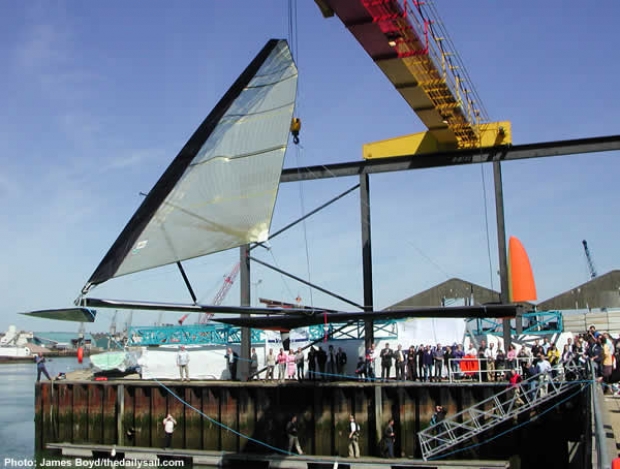
What a machine....
50 knots in 20 knots of breeze...
Friday April 23rd 2004, Author: James Boyd, Location: United Kingdom
Listen to Paul Larsen discuss his immediate plans for SailRocket -
here
The long awaited launch of Paul Larsen's speed sailing machine, SailRocket, took place this morning outside her birthplace of wind turbine blade manufacturer NEG Micon on Southampton's Itchen River.
Finally complete after a long and loving construction by Larsen, Helena Darvelid and a team of helpers over the course of the last year, SailRocket saw the open air for the first time today and was briefly launched into the water.
The craft is destined to break the outright world speed record. This is currently held by Simon Daddo's Yellow Pages who was clocked at a 46.52 knot during a timing run over a 500m course in October 1993. This record is long overdue for being broken. Down in Australia, the Yellow Pages team have been making attempts to better their own time recently, but the correct weather has failed to materialise. The most successful recent attempts have been made by sailboards. In December 2003, Virgin Islander Finian Maynard came very close with an average speed of 46.24 knots. For Larsen and the SailRocket team the ambition is first to break Yellow Pages' outright world speed record, then to crack the 50 knot barrier.
Star of the show today was SailRocket herself. This extraordinary vessel was designed by Malcolm Barnsley although many other companies and individuals are involved with the project including CFD expert Richard Pemberton, responsible for the foil design and development, wingmast specialist Nick Barlow who worked on the composite build side with Andy Bellamy and Chris Hornzee Jones who was in charge of the control systems.
So how does the new beast work? SailRocket is a one tack wonder - she is only designed to sail on starboard tack. Back in 1988 Malcolm Barnsley designed a boat called Alien which had many of the same features. "She had the inclined sail and the crossbeam on a swivel, but it was an attempt to do a two tack version and it also lifted on hydrofoils on the windward side rather than just lifting surfaces," he says. "The experiences we had with that boat showed us that the tacking manoeuvre was very difficult and it involved a lot of compromises on the design. So when we started afresh with this one we decided to go with the single tack."
SailRocket comprises a full length weather hull with minimal drag due to a huge hollow in the middle allowing the hull to sit on just two planing surfaces when travelling at high speed. The pilot sits in the cockpit right at the back of the hull and there is a foil, inclined to port forward. The crossbeam extends forward to port and has a tiny bullet shaped float at the end of it on which the mast sits. At around 35 knots this float is designed to fly 0.5m above the water and rather than using a lifting foil to achieve this, lift is provided by a flap on the trailing edge of the crossbeam that can be trimmed to dictate the speed at which the float starts to fly. Thus at high speed the boat will fly its leeward hull - the opposite of a conventional catamaran - and only the two planing surfaces on the weather hull will remain in the water. At present the flap will be left at a fixed setting and tuned between runs, but future plans are for Larsen to be able to alter the flap angle from the cockpit during runs.
The mast is inclined to weather and the degree of its inclination is adjustable via a support strut the bottom of which attaches to a track running on along the top of the beam.
The reason why the rig and the foil on the weather hull are inclined and the beam is raked forwards is central to the design concept. "The beam is inclined so that its line of action passes through the sail and the hydrofoil on the windward side," explains Barnsley. "They are inclined at the same angle so that the sail and the main hydrofoil pull in direct opposition. It means there is no roll moment and the boat can be driven to much higher sail loadings than you can get with a vertical rig, so the limit to the speed is to do with the strength of the boat and not any stability limitations. So that is why the sail is so far out to leeward."
The rake forward of the beam can be altered thereby shifting the fore and aft position of the rig relative to the foil. "The further the sail is to leeward, the further forward it needs to be to get the right line of action," says Barnsley. "It is just lining up the forces. If you drew a line through the centre of effort of that sail it would be directly abeam of where the foil is. But it is all highly tunable."
The two planing surfaces on the weather hull are a long way apart providing good resistance to pitching like the long wheelbase on a car. At high speed only a tiny part of the two planing surfaces will be in contact with the water. "You’ll be running on maybe a 200mm length of each of those surfaces. There is something like 0.25sqm contact area in the water," says Barnsley.
Another unique feature of SailRocket is her air rudder, the equivalent of the tailfin rudder on a plane. "The thinking behind that is that the water rudder could be subject to problems like ventilation and cavitation at the top end of the speed range and by flicking it out of the water and having an air rudder you eliminate that possible problem," says Barnsley. One of Paul Larsen's jobs, other than keeping his eyeballs in their sockets, will be to flip up the water rudder at around 35 knots.
Barnsley says they had a design for such an air rudder on one of Tim Colman's Crossbows, but he doesn't know if it was ever actually built and tried. "To eliminate those problems on the water rudder it is quite worthwhile."
The mainsail does not have the large roach maximum power profile one would expect.
"There are two reasons for that," explains Barnsley. "One is that the geometry of the boat dictates that you keep the centre of pressure low otherwise you have to make the whole boat wider. And then there is enormous leech tension, much more so that you get in say a Tornado mainsail. So if you go for excessive roach you have more trouble controlling that area of the sail." He points out that while their sail has the same area as a Tornado mainsail at high speed it will have approximately three times the amount of force running through it.
With an all-up weight of just 170kg and her pilot taking it up to 250kg, with 22sqm of sail the boat has a respectible power to weight ratio. So 'how fast will it go, mister?' Barnsley wheels out his stock answer: "One of the things about this is that there is no obvious upper limit on paper. We can predict 52 knots in a 22 knot wind but the funny thing is if you say ‘what happens in a 25 knot wind? will you do 58 knots?’ But in reality you come unstuck because either something isn’t strong enough or the waves start getting too big and either of those things could be the real limit. If it all holds together we should be hitting 50 knots of wind in 20 knots." This is marginally more breeze than the present record holders, Yellow Pages, require.
As Paul Larsen explains in the audio file above the next step is to get the boat to Weymouth and iron out the bugs. Launching her will be hard, but probably not harder than a skiff - while Larsen has controls allowing him to lower the rig to weather completely, to raise it again he will need assistance from someone in a RIB.
There are also many future developments. The most signficant of these will be replacing the present soft sail with a solid wing. "I think we will do that because we know on paper it increases the top speed, but it was too much work at this stage," says Barnsley. "We think we would get an extra 3-4 knots with a wing, but that is assuming you are not getting a cavitation problem on the foil. If that is holding you back you might be pumping more power in, but if there is a real barrier there it should be worth 3-4 knots more quite readily."
TheDailySail will be following SailRocket's progress closely over the next few weeks
More photos on the following pages...or view the Powerpoint presentation of the SailRocket project .

Most Read
Most Commented
Comments
Businesses

Pro businesses
Editor's choice
Member blogs
-
 Ned Collier Wakefield: MOD70 round BarbadosWell that was intense. 12 hard fought for seconds for the win. In idyllic conditions, Tony Lawsons MOD ...
 -
 Mini Transat leg 2 reportThe second leg of the Mini Transat started on 31st October, just over a month after ...
 -
Leg 1 reportI’ve been working towards the Mini Transat now for three years. In 2013 I was part ...
Business blogs
-
 The Island Sailing Club in Cowes, Isle of Wight, is delighted that Prince Michael of Kent ...
 -
Peta Stuart-Hunt chats with the 25 year-old British solo sailor Lizzy Foreman before she sets sail ...
-
The 2015 Student Yachting World Cup (SYWoC), an ISAF-recognised event hosted and run by students for ...
Editor's Choice
All time favourites...
-
 Three legs down into Ian Walker’s
 -
 Winning all but two races at
 -
 For the first time in its
Latest Comments
Add a comment - Members log in