
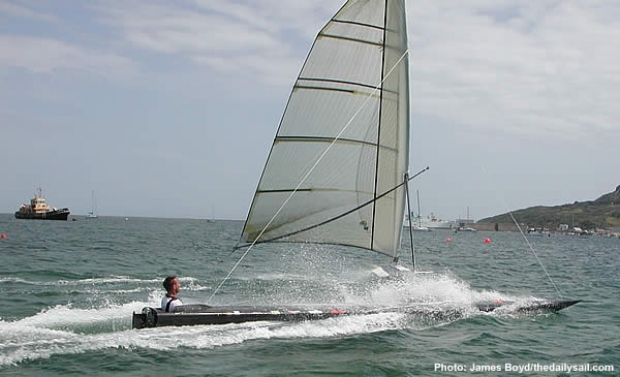
Australian in a ball of spray
Tuesday July 20th 2004, Author: James Boyd, Location: United Kingdom
The moment that those of us interested in breaking the barriers of speed under sail arrived this weekend in Portland Harbour with the maiden voyage of Paul Larsen's radical weapon
SailRocket. However at present the team are getting a feel for the fundamentals of the boat and the prospect of squeezing the World Record for speed under sail, let along 50 knots out of her is some way off.
"We took it out the front in about 9-10 knots of wind and just pottered around," recounts Larson of their first voyage. "We knew that 90% of the time handling this boat on the water would be towing it up and down the course or tied alongside a RIB, so we had to get that side of it right. And we had to look into raising and lowering the rig. And we went out and it was all carnage capers and we made all the little mistakes. At one stage we had the whole mast in the water in front of the boat – we ran into it with the boat and shoved the nose cone through the head of the sail and snapped it off…
"It’s a very unusual boat to have to rig so far out to one side of your centreboard and if you go a little too head to wind by towing it with the RIB all of a sudden you get into a tacking situation which is a like having your headsail on and not easing the sheet and it’s backwinding and no matter what happens the nose of that boat is going to blow around and the RIB can’t stop it because we have a 30ft lever arm there.
"The boat is only a one tack boat so when it backwinds all sorts of strange forces go there. The only thing that stops the sail falling down is the strut and with all that pressure on it there’s a lot of tension on the strut and the pull up mechanism was only a bit of core without a cover on it, it was too much for the cleat and the cleat let go so then the rig dropped down about 10-12ft and then there was no forestay or backstay tension so the rig was just free floating around there so it went flying off in front of the boat and came crashing down in the water.
"So we put a stronger rope in the cleat and all of a sudden it can handle the back wind, but more importantly we learned how to hook the boat up."
At present SailRocket is based down at the Weymouth & Portland Sailing Academy. They lift the boat into the water with the rig lowered and cleverly have a large orange inflatable marker buoy which acts as a fender wedged between the mast and the cross beam. This prevents the sail dragging in the water when they are towing the boat and also raises the rig enough so that Larsen can haul it up without leaving the cockpit at the very back of the weather hull. Lifting the rig up involves hauling on the car at the bottom of the strut towards the mast while gradually easing the forestay and backstay to allow the rig come up. Once raised, one of the support crew clambers along the beam to detach the fender and then it is time to take a deep breath and fire the afterburners.
Saturday saw SailRocket's first voyage and Larsen is almost apologetic that at this stage it is something of an anticlimax for on-lookers.
"Everyone is looking for it to take off doing 50 knots. At the moment we are thinking 'look, we can’t even tow it at four knots.' So we took it down and hung it off the pontoon with a few strings to see how the baot wants to sit, so we got that bit of it sorted. And then we put it on the RIB and realised we could quite easily stop the boat dead in the water and not make any leeway or anything like that and just hold it there and get the rig up and down in as much time as we like. So we took it up the course and let the thing rip yesterday...
"When we took off at speed we did about 15 knots and we’ve always said we’re going to need about 16 knots of wind to get over the hump. But surprisingly in about 12-13 knots of wind the boat is getting up and planing. But yesterday what was happening was that it was planing on the back surface and not the front surface. So if the back of the boat lifts before the front, the front will never lift because it will have a nose-down attitude. The centreboard is a lot more powerful than the planing surface because it is a cavitating surface as opposed to a non-cavitating one. So we were just going along mushing the nose through the water and for it to be doing 15 knots with that much drag was pretty impressive."
Thedailysail visited the team as they went out for the third time on Sunday. For this run they had removed the aft planning surface just to let the forward one do the work. "I sheeted on a lot more because we were sailing downwind yesterday and we sailed more upwind this time and that helped lift the bow up a bit and she popped up on to her front skid but there was an amazing amount of water. The spray was just incredible..."
On the first run Larsen bore away and zigzagged around a buoy, proving the manoeuvrability of the boat using his joystick rudder (the air rudder is currently not fitted). He then headed off downwind, before heating the boat up again. The acceleration of the boat is formidable and although the boat has yet to be fitted with a GPS or a log we guessed that her peak speed was 20 knots, in around 12 knots of breeze gusting to 14 knots.
After the laborious procedure of dragging the boat back up to weather, this time closer to the Weymouth side of Portland Harbour Larsen set off on his second run, this time closer to the wind. Again it seems possible to pootle along in cruise mode and then to sheet on and see the boat take off.
The optimum point of sail designer Malcolm Barnsley believes is 90-100 degrees but as Larsen explains: "Because of the way this boat has no righting moment we don’t have to bear away or anything like that, this boat lives in what would be the 'death zone' for all other boats and it feeds off the power there because it has no heeling moment - that takes a while to get your head around. If you are going to thrive off the apparent you have to have a rig which is very flat and very stiff and you’re talking leach loads that are going to be three times as much as a Tornado’s just to keep the leach standing up. That’s our problem now - the rig’s now quite man enough."

Some of the images show the boom bending alarmingly and Richard Woof is kindly rummaging around at present for a broken International 14 mast as it is felt it may take something of this girth to be man enough for the job.
"We also need an intermediate batten in the head of the sail and we need to take more luff curve out of the luff pocket so that the mast doesn’t bend so much when we tension the whole thing up so the sail is supporting the rig more," says Larsen.
Support for the project is increasing. Two weeks ago they broke their mast in two as they were pre-tensioning the rig. Within a week they had had a sleeve sent out from the Czech Republic. "Then - wham bam - it is all back together, even better. So we’ve got a pretty good set up to cater for these mishaps, and we expect a few of them..." he admits.
At the present speeds they have achieved the steering is very easy. Initially the boat has major lee helm and Larsen can keep her head to wind with the rudder and the sail sheeted in. Then bearing away with the rudder the boat takes off...
"But if I back the sail off it luffs up into weather because the drive then goes forward of the centreboard. It is like a sail board in some respects. It’s a funny one. As soon as it takes off you can feel it has a lot of power and once again if we get the rig sorted and we get going in 22 knots of breeze, once we get to know the angle of the boat I think the acceleration is really going to be pretty spectacular."
At present, Larsen, the test pilot is getting a feel for the boat, what happens when it powers up. "You enjoy the sail for 10 seconds and then you start going through, looking at things inside the boat and feeling the tension in the sheets and when a gust hits, feeling the tension in the backstay and the beam and seeing how much it is panting and pumping when the thing is going along. And from never having been educated as a test pilot, you think 'check, check, check' to get as much information out of a run as you possibly can.
"When I was going downwind the forestay was quite slack meaning we were sailing too much downwind which was giving too much of a nose down attitude because there is a bit of pitch in the downwind state with the boat. But I can’t remember how much it was or exactly what the wind was doing because we don’t have any instruments on the boat. Spending all your time worrying about instruments when you have a boat you don’t know how to push around with a RIB is a waste of time too."
Aside from flattening and beefing up the rig, the boat is profoundly wet. The images of her sailing exactly ressemble images of Yves Parlier's radical new catamaran, a boat which like SailRocket has two planing surfaces on each hull. "I couldn’t see anything," says Larsen. "I ended up looking more at the prison on the top of the island of Portland there to get a bearing rather than looking at the buoys ahead. I thought if I kept the power on here the boat might step up out of this, but couldn’t see if there was anything in the water, a buoy or anything so I had to just stop the boat."
In addition to the planing hull, the water appears to be exploding off the metal structure holding the beam onto the hull.
During Sunday's runs SailRocket was also taking on a lot of water - Larsen reckons around 25-30kg - so they will have to seal up the front of the boat more effectively and open a hole in the transom to allow the water to drain out.
While these are all teething problems Larsen points out they are all associated with doing 20 knots and there will be a completely different set of problems approaching 50. "The boat is going to struggle at these low speeds and it is only at the high speeds where it really will step clear of the water and will sit on those planing surfaces nicely. So I don’t think we want to change anything now. We just want to see how much speed we can get out of it now. If that becomes a limiting factor, then we change the planing surface. But at the moment we are still only doing it in 15-16 knots of breeze. I think if we got the rig right I think in the winds we had today we could get up to 30 knots."
Another issue is the sailing area. Sailing down Portland Harbour on Sunday there was too much chop, but ultimately runs will take place along the beach. "The sail boarders say that on a spring high tide you can nearly go along on a sailboard with your hand dragging along the beach there. If the locals want to help us bring the record back down here to Portland and Weymouth you could go 100m out and put 500m of the stuff they put in to stop the ripples going down swimming pools. It’s not expensive, it’s readily available. And you could have that mark out the 500m course and then you’ve got glassy flat water that you can run within a couple of feet of."
In our view Portland Harbour simply isn't big enough to do a 50 knot run. After spending a good half hour or more gingerly towing the boat back upwind, a run seems to be over in around two minutes, bearly enough time to work out what's going on let alone get the boat trimmed up. Fortunately they video the runs and this allows for analysis once they're back on shore.
"It would be nice to do longer runs," says Larsen. "But I think it is either right or it’s wrong and I think once we get an eye for what we’re doing once we start to narrow it down to ‘is the sail powered up or not’ then you don’t want to do a 3km run. You go ‘no, it’s not’ and you go back and do it again. So it’s good - short sharp experiments.
"If you think of Yellow Pages they have such a balancing act getting that boat in the groove for a whole 500m course they have to pick the best section of a 3km run and I can understand why they do that. Yellow Pages did 18 minutes of sailing when they set the B class record of 44 knots. Now you see 18 minutes of sailing is a long time. You do a couple of minutes and your run’s over.
"With this we’ll either be right or wrong and we’ll get to know that pretty quickly. We’ve only been sailing here for three days and we might find the course is more gusty than you’d expect. But I’m pretty confident it is going to be a good place and we’re going to get this boat developed to its ultimate state at this place. Whether this place is the ultimate to run it at we’ve yet to discover. I don’t know where this place is - I hope it’s here."
In short, they have been in the water for just three days, they have learned how it manoeuvres, have worked out how to hoist and lower the rig in an orderly fashion and have already achieved 20 knots without severely damaging the boat or losing control. "We have a going boat and no breakages - that pretty unheard of in radical boats like this. We are very happy - it’s been rapid progress." Much of this Larsen attributes to designer Malcolm Barnsley who has been working on variations of this design for the best part of 25 years.
Despite the increased publicity he is getting which is set to go through the roof once the boat starts putting in some fast runs, SailRocket remains without a sponsor. Larsen and chief helper, Helena Darvelid are living out of a 40ft container, which also doubles as a workshop and storage for the boat. They get regular help from SP System's Andy Bellamy, Richard Pemberton and designer Malcolm Barnsley.
With or without a sponsor Larsen remains committed to pressing on in his quest for the world speed sailing record and we will be watching his progress with interest. Any generous benefactors should contact Paul here.

Most Read
Most Commented
Comments
Businesses

Pro businesses
-
United Kingdom
-
-
-
Editor's choice
Member blogs
-
 Ned Collier Wakefield: MOD70 round BarbadosWell that was intense. 12 hard fought for seconds for the win. In idyllic conditions, Tony Lawsons MOD ...
 -
 Mini Transat leg 2 reportThe second leg of the Mini Transat started on 31st October, just over a month after ...
 -
Leg 1 reportI’ve been working towards the Mini Transat now for three years. In 2013 I was part ...
Business blogs
-
 The Island Sailing Club in Cowes, Isle of Wight, is delighted that Prince Michael of Kent ...
 -
Peta Stuart-Hunt chats with the 25 year-old British solo sailor Lizzy Foreman before she sets sail ...
-
The 2015 Student Yachting World Cup (SYWoC), an ISAF-recognised event hosted and run by students for ...
Editor's Choice
All time favourites...
-
 Three legs down into Ian Walker’s
 -
 Winning all but two races at
 -
 For the first time in its
Latest Comments
Add a comment - Members log in