
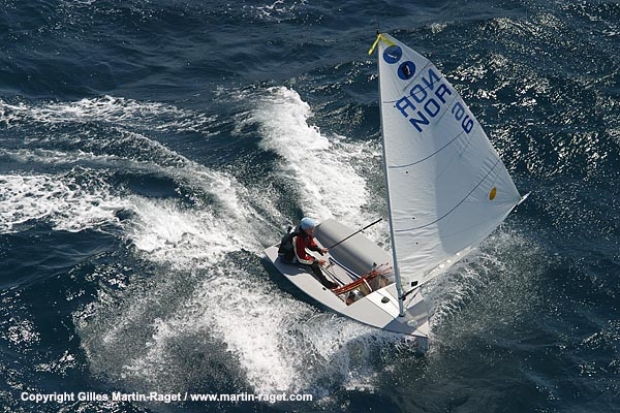
Siren Sundby does her stuff...
Olympic preview - the Europe
Wednesday August 11th 2004, Author: James Boyd, Location: Mediterranean
The Europe, the women’s singlehanded dinghy, was first used at the Olympics Games in Barcelona in 1992, but had substantial history prior to this.
The boat was designed in 1960 by Alois Roland from Belgium as a one-design to comply with the International Moth rules of the day, although it is a far cry from the present generation of minimally hulled foiling machines. Originally called the Europa Moth it was subsequently renamed the Europe, due to its popularity on the continent. Its own class association was formed in 1963 and the boat was granted International status by the IYRU in 1976.
This is the fourth time the Europe has been used at the Games and over this time competition has progressively reached new heights as gear and sailing techniques have developed.
The boat is light - weighing marginally less than the person sailing it – and thus highly responsive to crew movement. “The difference between doing it badly and doing it well is very marked because it is so light,” claims Chris Gowers, coach to team GBR’s Europe hope Laura Baldwin. The boat surfs easily but in strong winds can be knocked around by waves and it is easy to capsize sailing downwind or when manoeuvring.
While in the past there has been a speed differential upwind, this is no longer so pronounced among the top Olympic sailors. Courses are short so getting off the line well and choosing the correct side of the course are crucial elements to the beat. Among the Europe sailors in Athens there are probably ten sailors capable of getting to the weather mark first.
At present in regattas it is on the downwind legs in the Europe that the biggest gains can be made principally by anticipating the waves and using them to accelerate the boat. The grand master of this technique is Siren Sundby, the Norwegian sailor who’s immaculate record since her 19th place at the Sydney Olympics, the year she also won the Youth Worlds, has placed her as surefire favourite for the Gold in the Europe class Athens.
Unlike other Olympics classes where there is an optimum crew weight, at the top end of the Europe fleet there is a wide range from the tiny Dane Signe Livbjerg at a mere 55kg up to Finnish sailor Sari Multala at 69kg, with Sundby at 65kg. At 1.65m (5ft 5in) tall Sundby is one of the shortest, densest Europe sailors.
Over this present Olympic cycle average crew weight has gone down from approaching 70kg to closer to 60kg. This has been enabled due to developments in the rig that have allowed it to be handled by lighter weight sailors, although it may also be an attempt by the sailors to emulate Sundby.
The result is that lightweight sailors are showing the way on the run, but are having to depower more when conditions increase upwind. Lighter weight sailor should also benefit in the light sea breeze conditions in Athens.
The gear
While there are a number of officially licensed Europe builders the present boat of choice is that produced by Winnerboats in Spain.
There has been little change to the hulls and foil packages over the last Olympic cycle other than a tightening up of the build tolerances that has resulted in a new generation of boats being built for this Olympiad.
Tolerances are also much stricter for the mast and sail packages. Europe Class rules allow wingmasts to be used for another two years, but these are banned from Olympic sailing. Experimentation has been taking place with the bend characteristics of the masts and the latest rigs can work in a wider range of conditions and it is this development that now benefits the lighter sailors who can effectively depower the rig upwind in stronger conditions.
In the early Olympics for the Europe it was possible to do reasonably if you were good in or had your boat set up for one set of conditions. In Athens where there is the possibility of a wider range of wind conditions from the 5-10 knot sea breeze to the 15-25 knot Meltemi, good all-performance is essential. “To be successful these days you have to be good across the wind range. The fleet is too competitive for you to carry any big results,” says Chris Gowers.
Compared to the hull a wide variety of sailmakers’ wares will be in use in Sydney. At present Green sails from Denmark are popular as are Tony Tio and North New Zealand, WD Sails from Finland and North UK.
Form guide:
As Andy Rice pointed out yesterday with all the singlehanded keelboats there is one clear favourite at these Olympics and in the Europe the golden girl is Norwegian sailor Siren Sundby.
This year Sundby has won the Worlds in Cagliari plus Spa and Hyeres and last year got Gold at the Cadiz Worlds and the Europeans. In fact Sundby has won the last nine regattas in a row she has sailed in prior to the Games, a scoreline even the immaculate Ben Ainslie in the Finn or Robert Scheidt in the Laser haven’t been able to emulate.
Many believe Sundby’s strength to be eking out that little extra downwind. She has not been secretive in her approach. In fact the Europes this time around have been remarkably open in their training, regularly swapping partners, something that Sundby has also subscribed to. “She is quite prepared to sail with other people and keeps thrashing them every time,” says Chris Gower.

If Sundby is the unquestionable favourite for Gold, many feel that Finnish sailor Sari Multala who finished fifth in the class at Sydney is her pretender and best hope for Silver. A conservative, consistent sailor who has been competing in the class for eight years, Multala has had own share of first places at significant regattas including Spa, the Princess Sofia Trophy and the Athens Eurolymp in 2003, prior to Sundby’s more recent string of wins. Past regattas have demonstrated her to be particularly fast in stronger winds.
Apart from Sundby and to a lesser extent Multala, there are many other sailors capable of medalling in the Europe.

Germany’s Petra Niemann (above) has been in the class for 10 years and is a definitely possibility for the podium in Athens. A strong run of results over the past two seasons has seen her win on home waters at Kiel Week last year and she too has seen success in Athens, winning last year’s Saronic Gulf Regatta. Niemann seems to be peaking at the right time and her last regattas have included third places at Spa and the Worlds and a second at Kiel Week.

Past results have seen Australia’s Sarah Blanck win the World Championships when they were held in Canada in 2002. In contrast she was 20th at the Worlds last year but she has since been a regular top ten placer. With recent results including a second place at Princess Sofia and a third at Kiel Week this year she too appears to be coming on form just at the right time. She is known to be strong in light winds.
Also in this league is Lenka Smidova fourth at this year’s Worlds. From the Czech Republic Smidova is another Europe sailor who has been in the class for a decade now and since scoring a ninth in Sydney has been putting in regular good results including a win at the Rolex Miami OCR in 2003 and 2004 as well as this year’s Sail Melbourne Regatta.

America’s Meg Gaillard (above) is also in with a chance if she can hold it together. Third at the Cadiz Worlds last year, this year she has finished second at the Rolex Miami Olympic Classes Regatta and followed this with a third place at the Princess Sofia. However her scoreline also includes a 21st place at Hyeres this year.
Ninth in Sydney, New Zealand’s Sarah Macky is tall and good in strong breeze. She has sailed consistently over the last couple of seasons but despite a string of single figure results has not been a regular on the podium at major regattas, with the exception of a third place at the Europeans and Hyeres last year. Her best results this year have been a fourth at Hyeres and a second place at the Open Week prior to the Europeans in which she came ninth. If the Meltemi sets in Macky will be in her element.
Not to be discounted are two of the class’ oldest hands. This includes Belgium’s Min Dezillie who sailed her first Europe Olympiad in 1992 and came sixth in Sydney. Significantly Dezillie seems to like the Athens conditions: she won Athens Eurolymp Week earlier this year and was fourth at this regatta the year before. Otherwise her results have been inconsistent, the low point being a 38th place at the Worlds in Cadiz last year.
 Traditionally the Netherlands Carolijn Brouwer has been one of the strongest sailors in the class having won the Worlds championships in 1996 and 1998 following a 10 year tenure in the class, with a break in the middle to campaign a 470 in Sydney. Immensely fit, she is good in all conditions, but has been suffering from a slight slump in form over the winter that has seen a string of double figure results since her eighth place at last year’s World Championship.
Argentinian sailor Serena Amato, the bronze medallist from Sydney is the only medallist from Sydney competing. Although clearly with potential she only returned to the class at the beginning of last season. She has proved to be good in light conditions, but has not been on the podium since her return. Even Spain’s Neus Garriga, who has been sailing the Europe for a decade now and came fourth in Sydney has only been on the podium twice recently – both times at Palamos Christmas regatta.
And what to make of Belarus sailor Tatiana Drozdovskaya, who amidst a string of double figure results this year won Kiel Week or France’s Blandine Rouille who amid some very average results won Spa this year or Mexican Tania Elias Calles who was third at Hyeres?
Among the outside chances are Britain’s Laura Baldwin, who’s game has been improving wholescale since she set out on the Olympic path three years ago but probably not enough to put her into the ‘medal zone’ at Athens.
As with all the classes racing at Athens the form guide will take a hammering the moment conditions chance from being a sea breeze (as is currently being forecast for the start of the regatta). While we will be surprised is Siren Sundby doesn’t take the gold and gobsmacked if she doesn’t make the podium, the fight for the remaining podium positions is likely to be a close run thing between around eight sailors.
Line-up
| Sailor | Nation | ISAF ranking | 2004 Worlds | 2003 Worlds | Sydney 2000 |
| Siren SUNDBY | NOR | 1 | 1 | 1 | 19 |
| Petra NIEMANN | GER | 2 | 3 | 5 | 13 |
| Sari MULTALA | FIN | 3 | 2 | 2 | 5 |
| Lenka SMIDOVA | CZE | 4 | 4 | 9 | 7 |
| Meg GAILLARD | USA | 5 | 7 | 3 | |
| Carolijn BROUWER | NED | 6 | 8 | 8 | 13 (470) |
| Sarah BLANCK | AUS | 7 | 5 | 20 | |
| Sarah MACKY | NZL | 8 | 9 | 6 | 9 |
| Signe LIVBJERG | DEN | 10 | 15 | 11 | |
| Tania ELIAS CALLES | MEX | 11 | 12 | 21 | 17 |
| Neus GARRIGA | SPA | 14 | 20 | 12 | 4 |
| Monika BRONICKA | POL | 15 | 23 | 14 | 14 |
| Teja CERNE | SLO | 17 | 28 | 10 | |
| Tatiana DROZDOVSKAYA | BLR | 18 | 13 | 19 | 24 |
| Maria COLEMAN | IRL | 19 | 19 | 15 | 12 |
| Blandine ROUILLE | FRA | 20 | 24 | 24 | |
| Laura BALDWIN | GBR | 23 | 17 | 26 | |
| Larissa NEVIEROV | ITA | 24 | 16 | 35 | 8 |
| Min DEZILLIE | BEL | 25 | 38 | 6 | |
| Joana PRATAS | POR | 34 | 37 | 37 | 21 |
| Anastassia MALETINA | RUS | 35 | 43 | 23 | |
| Shen XIAOYING | CHN | 36 | 30 | ||
| Maiko SATO | JPN | 39 | 35 | 72 | 23 |
| Serena AMATO | ARG | 67 | 36 | 3 | |
| Virginia KRAVORIOTI | GRE | 46 |
Most Read
Most Commented
Comments
Businesses

Pro businesses
-
-
Italy
-
Netherlands
-
France
Editor's choice
Member blogs
-
 Ned Collier Wakefield: MOD70 round BarbadosWell that was intense. 12 hard fought for seconds for the win. In idyllic conditions, Tony Lawsons MOD ...
 -
 Mini Transat leg 2 reportThe second leg of the Mini Transat started on 31st October, just over a month after ...
 -
Leg 1 reportI’ve been working towards the Mini Transat now for three years. In 2013 I was part ...
Business blogs
-
 The Island Sailing Club in Cowes, Isle of Wight, is delighted that Prince Michael of Kent ...
 -
Peta Stuart-Hunt chats with the 25 year-old British solo sailor Lizzy Foreman before she sets sail ...
-
The 2015 Student Yachting World Cup (SYWoC), an ISAF-recognised event hosted and run by students for ...
Editor's Choice
All time favourites...
-
 Three legs down into Ian Walker’s
 -
 Winning all but two races at
 -
 For the first time in its
Latest Comments
Add a comment - Members log in