
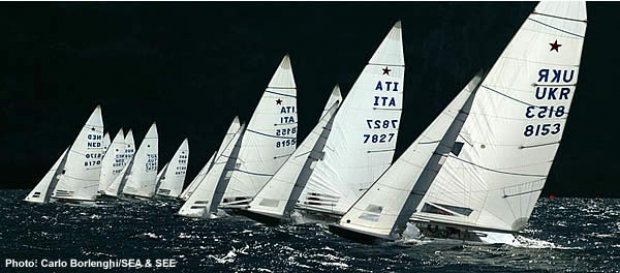
Olympic preview - the Star
Tuesday August 17th 2004, Author: Anthony Shanks, Location: Mediterranean
Introduction to the Star
All of the superlatives and clichés have been used many times before to list the previous competitors and winners in the Star class. Suffice to say I have been privileged to sail among people whom I have read much about and in a class with such a rich history.
This article is focused on the recent history of the class that I have been competing in, for the last three years. I have the utmost respect for all of those going to the Olympic Games - it was my goal and dream for many years. This time we did not qualify, but Max and I will be back for Beijing in 2008.
The Star was designed in 1910 by Francis Sweisguth in New York. During the winter of 1910-11, 33 boats were built and now 8000 later we have the modern boat, the same in overall concept but a wildly different beast.

Introduced to the Olympic Games in 1932 it has been there every year except 1976. With the dropping of the Soling, Athens 2004 will be the first Olympic Games with only one mens' keelboat. In addition to this, the number of countries allowed to compete by the International Olympic Committee is more restricted than ever. With no other keelboat all of the usual suspects have been joined by many dinghy sailors looking to try their hand in the Star, which has made competition tighter than ever.
Eight of the competitors have won the World Championships, two of them twice, This is the measure of the class that has attracted all the great sailors of the last 50 years. Star sailors have been providing the core of America’s Cup teams for many years now.
The entry to Athens has been restricted to 17 Countries. This is how they qualified:
Five of the countries were decided at the World Championships in Los Angeles that Iain Percy and Steve Mitchell (GBR) dominated over Torben Grael (BRA) and Xavier Rohart (FRA). Paul Cayard qualified the United States of America and Peter Bromby secured the slot for the tiny island nation of Bermuda.
The Cadiz Combined World Championships 2003 decided the next seven countries, with first place going to the already qualified Xavier Rohart. Freddy Loof and Anders Ekstrom (SWE) secured their place by coming second and Iain Percy was third. The additional slots went to Ireland, Italy, Netherlands, Austria, Switzerland and Australia.
The final round of qualification was at the 2004 Star World Championships in Gaeta Italy. Freddy Loof (SWE) crewed by Anders Ekstrom secured his second World Championships (having won the European Championships for the third time only weeks earlier) whilst also sailing Iain Percy down the fleet in the last race, this a reverse of the result from Sydney in the Finn. Flavio Marazzi and Enrico de Maria (SUI) took advantage of this and sailed well enough to finish second overall. The race for the remaining Olympic slots was carrying on further down the fleet. Roberto Bermudez De Castro (ESP) had, with average points for the last two races, secured Spain’s slot, Stig Westergard secured a place for Denmark, Ross MacDonald’s amazing recovery secured Canada’s, the last went to Germany with New Zealand unluckily missing out during the final race.
It must be noted that two of the countries, Denmark and Germany, were qualified by people who would not be going to Athens - Stig Westergard and Mark Pickel. Denmark will be represented by the youngest Star helm - Nicklas Holm - and Germany by the oldest helm - the legendary two time Star World Champion, Alex Hagen. In addition to this, the first European winner of the Bacardi Cup Portuguese Afonso Dominguez and Bernardo Santos narrowly missed qualification after such early season promise.
Only five people in this Olympic Games have won medals and only three of them in the Star:
Torben Grael has the full house of Gold, Silver and two Bronze medals from five Olympic Games, his silver was 20 years ago in Los Angeles in the Soling. In addition to this Torben and his crew Marcelo Ferreira are the only Star medallists from Sydney to be competing in Athens. Ross Macdonald won the Bronze medal in 1992 behind Mark Reynolds and Rod Davis. Colin Beashel (AUS) won the Bronze medal in 1996 behind Torben Grael and Hans Wallen.
The pre-eminent Star sailor of the last four Olympic Games, Mark Reynolds, failed to qualify this time having been beaten in the US trials by Paul Cayard. Mark has won two Gold Medals in 2000 and 1992, losing the Gold Medal to Great Britain’s Mike McIntyre and Bryn Vaile, at the 1988 Olympics, in the last race.
In addition to these legendary sailors we add two of the Sydney 2000 medallists from the Finn Class, Iain Percy and Freddy Loof. Iain won the Gold Medal, at his first attempt and under the guidance of legendary coach David Howlett, with one race to spare having sailed Freddy Loof out of contention in the penultimate race. Freddy Loof, arguably the best Finn sailor of the 1990s, finally won a Bronze medal at his third attempt in Sydney, undoubtedly a poor return from a sailor who has only finished outside of the top three in the Finn Gold Cup once in 10 years and won it three times.
Equipment
Boats
There are three builders, two of them Folli and Lillia are based on the idyllic Lake Como within a few miles of each other. Sadly Danillo Folli passed away earlier this year. When Max and I went to collect our new boat last year, Danillo took great pride in showing us around the factory, which is an example to all boat builders. Folli boats gained a reputation for consistency that has led to it being the default boat.
Lillia have captured many new sailors most notably Iain Percy and Xavier Rohart, this has led to far more competition between the builders than ever before. Strangely, Mader the third builder in Germany, have very few boats competing at the highest level, and will have none in Athens.
| Folli | Lillia |
| Colin Beashel | Torben Grael |
| Paul Cayard | Ross Macdonald |
| Mark Mansfield | Hans Spitzauer |
| Peter Bromby | Xavier Rohart |
| Roberto de Bermudez | Iain Percy |
| Leonidas Pelekanakis |

|
| Francesco Bruni |
|
| Alex Hagen |
|
| Mark Neeleman |
|
| Flavio Marazzi |
|
| Freddy Loof |
|
| Nicklas Holm |
|
The mast is a very small section, this leads to many broken masts. Generally they break due to operator error and many star sailors will spend months practising the downwind technique. When you go downwind the spreaders articulate forward, the windward running backstay is released and the mast leans forward over the foredeck allowing the mainsail to set properly. The jib is raised up and a jib stick holds the clew to windward. This creates a problem downwind as the boat can become very unstable with a loose mainsail leech. When the boat rolls to windward the jib pole can dip in the water, causing the mast to beak or bend unless the crew is very quick to take the pole off the mast.

Paul Cayard has bent or broken three masts this year, the urban myth is that Torben Grael broke more than eight in one year, just practising!!!. The waters of Athens have already claimed the masts of Iain Percy last year and Paul Cayard and Mark Mansfield this year. Iain Percy broke his metres from the Finish line in the first race of a two race day, in the pre-Olympics, thus meaning he missed both of those races. Sailing a Star in strong wind can be a war of attrition…
Masts are produced by both Spartec in the US and Emetti in Lake Como. There has been very little development in the masts and I would be very surprised if anyone used anything other than the Emetti spar, as that is what the sails have been designed around and what people have been using for the last 4 years.
Sails
Quantum.
The San Diego Quantum loft is owned by star legend Mark Reynolds who has produced the default sails for the last ten years. With Athens’ variable breeze most will use the Z4 mainsail, a light to medium air sail, in all the racing. Changing between races will be very tough. Reynolds introduced this sail in the 1992 Olympics that he won convincingly. He has made small changes but the continued use of the sails is a testament to his superb abilities over the last 20 years.
North.
There are two different North Lofts producing star sails, firstly North San Diego, who under Vince Brun himself a Star World Champions have produced an enormous number of sails for the US market although we will not see many of their sails in Athens. Secondly North UK have teamed up with Iain Percy, this is what Iain did to great effect in the Finn. Using the San Diego Norths as his base Iain has developed sails which have him consistently at the front of the fleet.
Sailing the Star
Prospective crews should prepare themselves for a submarine experience enjoying a view of the world from a duck’s perspective! Pascal Rambeau described it to me as “the life of a tea bag”!
The boats all have a remarkably small difference in speed up-wind. But like all boats, the harder you hike the faster you go. Both helm and crew have to straight leg hike off the start line and also at critical times. The most efficient position for the crew is to drop hike, with a harness. This allows the crew to be low to the water thus reducing the pitching moment.
The greatest revolution over the last three years is the level of intensity in hiking by both the helm and crew, this has been made even more important as the crew weight rule favours the heavier helm providing they hike like hell. The boat is fully powered up in as little as seven knots which means that light wind racing is just that, there are serious rewards for getting the crew dropped earlier than the others.
Over the last three years the Finn sailors have shown the way down wind, with wider and wider angles being sailed, the boat is now being powered down the waves like a big Finn. With this comes the inherent risk of breaking the mast as we all try and learn these skills. I am sure that much of this has gone full circle as every time an influx of talent infuses itself into the class the direction of experimentation changes.
Competitors Form

Without a doubt the form team for Athens is the Swedish pairing of Freddy Loof and Anders Ekstrom. During the course of the past year they have hardly been outside the top three in any event. Winning the Worlds for the second time and the Europeans for the third time only a very short time before Freddy became a father, for the first time, they have set themselves up as the boat to beat.

If you are to look at consistency then the Bermudans, Peter Bromby and Lee White (above) would be second favourite by winning both SPA regatta and Kiel Week. The measure of the class is the sheer number of sailors who could finish in medal positions.

Iain Percy and Steve Mitchell (GBR - above) are the fastest boat in the breeze bar none and with newfound pace in the light, they are definitely a force to be reckoned with. Their total domination of the worlds in 2002 and two third places since sets them apart from the rest as a supremely well prepared and fit team. With a Gold medal already, Iain definitely knows how to win on the big stage. Once again under the watchful eye of coach David Howlett they have been practising more than anybody in the Saronik Gulf. If it is shifty then they will be hard to beat.
Among the others, Colin Beashel and David Giles (AUS) have a habit of turning it on when the time is right, a second and two thirds in their national qualifying events is a testament to this.
Mark Neeleman and Peter Van Niekerk (NED) have shown a level of consistency that has impressed me, but I doubt their ability to finish the job and much of their impressive work has been in the big fleets.

Paul Cayard and Phil Trinter (USA) have been the top Americans for the last three years, this was underlined by their comprehensive win of the US trials. Paul’s big successes in the Star came more than 12 years ago and he will have to roll back the time to produce a vintage performance to take a medal, but do not count him out he is a world class performer.
Ross MacDonald and Mike Wolfs (CAN) are the light-airs speed kings. However up untill now they have not produced the consistency in the breeze to turn in a medal performance, but Athens has potential to be light and variable. Ross’s never say die philosophy sets him apart from nearly everyone else, don’t be surprised if he comes good towards the end.
Xavier Rohart and Pascal Rambeau (FRA) paired up after Kiel Week 2003 when Xavier’s previous crew Yannick Adde unfortunately fell ill. This new combination produced immediate results providing France with her first Star World Champions. The Cadiz Worlds was the team’s Olympic trial where they beat the enormously talented Phillipe Presti who finished fourth. Following Cadiz, Xavier and Pascal have had a dip in form, which was only to be expected. Their second place finish at the European Championships proves that they are still a boat to watch.

Of the first group of sailors that I have not already mentioned is the truly exceptional pairing or Torben Grael and Marcello Ferreira (BRA). Torben’s ability to recover from dreadful positions is matched by his instinctive ability in the Star. With four medals from five Olympics ignore him at your peril. Besides Iain Percy, Torben is the only other Gold medallist in the fleet. His last big result was the 2003 European Championships, in Cascais, beating Mark Neeleman in the last race, only a week before he had won the pre-Olympics showing his undoubted skills in both the small and big fleets. During this year he has been performing below par, much of this may well be down to the Europeans and Worlds being so early and in cold weather not suiting Torben and Marcello who are more used to sailing on the waters off the Copa Cabana!
The afore mentioned sailors are where I believe the medals will come from but there are many other superb sailors populating the Star Fleet.
Hans Spitzaeur (AUT) crewed by Andreas Hanakamp has won the Finn Gold Cup and been to three Olympic Games in the Finn. During the last three years he has shown flashes of excellence but no consistency. Andreas has been to the Olympics before sailing the Star with the ten time Olympian Hubert Raudaschl, so this sets them up as very experienced campaigners.
Mark Mansfield (IRL), who has been to three Olympics, crewed by fellow Cork man Killian Collins, beat Max and me over a three regatta trials. Last year he won the Spring European Championships in the light and shifty breeze on Lake Balaton. Mark’s experience and tenacity has enabled him to consistently finish in the top 10 in the world championships over the last four years
Two time world champion Alex Hagen (GER) and crew Jochen Wolfram surprised everyone by finishing fourth at the European Championships in L’Escala and ensured his membership of the German Squad. What was even more surprising was that none of the other Germans made the squad. Alex then had an unobstructed journey to the Olympics, I think he is unlikely to medal but then he was unlikely to be at the Olympics, especially after he broke his collarbone kite surfing in August last year.
The mercurial Nicklas Holm and Claus Olesen (DEN) have been more up and down than anyone else, though when they are up they usually do very well. Nicklas finished third in the Europeans two years ago but has not performed anywhere near his early promise, coached by Star silver medallist Rod Davis and gold medallist Magnus Liljedal the Danish federation have brought in the big guns. Nicklas is the youngest helm at the Olympics so only time will tell.
Flavio Marazzi and Enrico de Maria’s (SUI) second place in the World Championships this year has enhanced their reputation as up and coming Star sailors but their inability to produce form outside this event leaves question marks. Coach Jean-Claude Vuithier has assisted his team into the position of being a boat against which anyone can measure their speed.
Roberto Bermudez De Castro and Pablo Pablo Arrate (ESP) qualified Spain at the World Championships this year by finishing seventh, an awesome result considering their short time in the boat from 31st last year to seventh is a fairly meteoric rise. Roberto, well known in Spain, is in the process of putting himself on the Star map, they are a boat to watch. Their result at the Worlds was made easier by the fact that they had average points for the last two races, but don’t let this hide the fact that he is a wily fox.
Francesco Bruni and Guido Vigna (ITA) also qualified in Gaeta and have steadily improved, but their lack of Star experience is likely to be their downfall. Franceso is going to his second Olympics, the first in 1996 in the laser so he has sailed at that level before.
Last but not least is the local pairing of Leonidis Pelekeanakis and George Kodogouris (GRE) rather surprisingly little has been seen of them over the last few years and little will be expected of them. On their day they are able to produce results so don’t be surprised to se them up there in races.
In conclusion I think the medallists will be Swedish, British and Bermudan, not necessarily in that order, but remember that the Olympics has a habit of throwing up a surprise or two.
Recent form
| Pos | Helm | Crew | Country | Best WC | #OG | Best OG | Cadiz | MOCR | Bacardi | Europns | Worlds | SPA | Kiel | Av Pos |
| 1 | Freddy Loof | Anders Ekstrom | SWE | 1st 2001/2004 | 4 | Bronze 2000 (finn) | 2 | 3 |
|
1 | 1 |
|
3 | 2.00 |
| 2 | Peter Bromby | Lee White | BER | 3rd 1997 | 3 | 4th 2000 | 5 |
|
5 |
|
6 | 1 | 1 | 3.60 |
| 3 | Mark Neeleman | Peter Van Niekerk | NED | 4th 2004 | 3 | 4th 1996 | 7 | 8 |
|
3 | 4 | 3 | 2 | 4.50 |
| 4 | Iain Percy | Stevie Mitchell | GBR | 1st 2002 | 1 | Gold 2000 (finn) | 3 |
|
6 | 7 | 3 | 4 |
|
4.60 |
| 5 | Paul Cayard | Phil Trinter | USA | 1st 1988 |
|
|
|
4 |
|
|
5 | 7 |
|
5.33 |
| 6 | Xavier Rohart | Pascal Rambeau | FRA | 1st 2003 | 3 | 7th 1992 (finn) | 1 |
|
8 | 2 | 9 | 13 |
|
6.60 |
| 7 | Ross MacDonald | Mike Wolfs | CAN | 1st 1994 | 3 | Bronze 1992 |
|
16 | 2 | 5 | 12 | 2 | 4 | 6.83 |
| 8 | Colin Beashel | David Giles | AUS | 1st 1998 | 5 | Bronze 1996 |
|
2 | 3 | 13 | 13 | 15 | 12 | 9.67 |
| 9 | Mark Mansfield | Killian Collins | IRL | 3rd 2000 | 4 | 12th 1996 | 5 |
|
|
8 | 11 | 11 | 19 | 10.80 |
| 10 | Flavio Marrazi | Enrico de Maria | SUI | 2nd 2004 | 2 | 15th 2000 | 15 |
|
10 | 16 | 2 | 12 |
|
11.00 |
| 11 | Francesco Bruni | Guido Vigna | ITA | 12th 2003 | 1 | 12th 1996 (laser) | 12 |
|
|
17 | 17 |
|
6 | 13.00 |
| 12 | Roberto Bermudez | Pablo Arrarte | ESP | 7th 2004 |
|
|
31 |
|
|
15 | 7 | 5 |
|
14.50 |
| 13 | Hans Spitauer | Andreas Hanakamp | AUT | 9th 2003 | 3 | 4th 1996 (Finn) | 9 | 20 | 9 | 21 |
|
14 |
|
14.60 |
| 14 | Alex Hagen | Jochen Wolfram | GER | 1st 1981/1996 | 1 | 10th 1988 |
|
|
26 | 4 | 22 | 16 | 8 | 15.20 |
| 15 | Torben Grael | Marcelo Ferreira | BRA | 1st 1990 | 5 | Gold 1996 Bronze 1988/2000 |
|
|
|
11 | 15 | 21 |
|
15.67 |
| 16 | Nicklas Holm | Claus Olesen | DEN | 17th 2002 |
|
|
20 | 6 |
|
6 | 29 | 18 |
|
15.80 |
| 17 | Leonidas Pelekanakis | George Kodogouris | GRE | 16th 2004 | 1 | 11th 2000 (as crew) |
|
45 |
|
|
16 | 10 | 13 | 21.00 |
Medal results at the Star Worlds 1981-2004
|
|
2004 | 2003 | 2002 | 2001 | 2000 | 99 | 98 | 97 | 96 | 95 | 94 | 93 | 92 | 91 | 90 | 89 | 88 | 87 | 86 | 85 | 84 | 83 | 82 | 81 |
| Colin Beashel |
|
|
|
|
|
|
1 |
|
|
|
|
|
|
|
|
|
|
|
|
|
|
|
|
|
| Hans Spitauer |
|
|
|
|
|
|
|
|
|
|
|
|
|
|
|
|
|
|
|
|
|
|
|
|
| Peter Bromby |
|
|
|
|
|
|
|
3 |
|
|
|
|
|
|
|
|
|
|
|
|
|
|
|
|
| Torben Grael |
|
|
2 |
|
|
|
2 |
|
3 | 2 | 3 |
|
|
2 | 1 |
|
|
|
|
|
|
|
|
|
| Ross MacDonald |
|
|
|
|
2 | 2 |
|
|
|
|
1 |
|
|
|
|
3 |
|
|
|
|
|
|
|
|
| Nicklas Holm |
|
|
|
|
|
|
|
|
|
|
|
|
|
|
|
|
|
|
|
|
|
|
|
|
| Roberto Bermudez |
|
|
|
|
|
|
|
|
|
|
|
|
|
|
|
|
|
|
|
|
|
|
|
|
| Xavier Rohart |
|
1 | 3 |
|
|
|
|
|
|
|
|
|
|
|
|
|
|
|
|
|
|
|
|
|
| Iain Percy | 3 | 3 | 1 |
|
|
|
|
|
|
|
|
|
|
|
|
|
|
|
|
|
|
|
|
|
| Alex Hagen |
|
|
|
|
|
|
3 | 1 |
|
|
|
3 |
|
|
|
|
|
3 |
|
|
|
|
2 | 1 |
| Leonidas Pelekanakis |
|
|
|
|
|
|
|
|
|
|
|
|
|
|
|
|
|
|
|
|
|
|
|
|
| Mark Mansfield |
|
|
|
|
3 |
|
|
|
|
|
|
|
|
|
|
|
|
|
|
|
|
|
|
|
| Francesco Bruni |
|
|
|
|
|
|
|
|
|
|
|
|
|
|
|
|
|
|
|
|
|
|
|
|
| Mark Neeleman |
|
|
|
|
|
|
|
|
|
|
|
|
|
|
|
|
|
|
|
|
|
|
|
|
| Flavio Marrazi | 2 |
|
|
|
|
|
|
|
|
|
|
|
|
|
|
|
|
|
|
|
|
|
|
|
| Freddy Loof | 1 | 2 |
|
1 |
|
|
|
|
|
|
|
|
|
|
|
|
|
|
|
|
|
|
|
|
| Paul Cayard |
|
|
|
|
|
|
|
|
|
|
|
|
3 |
|
|
|
1 | 2 |
|
3 | 3 |
|
|
|

Most Read
Most Commented
Comments
Businesses

Pro businesses
Editor's choice
Member blogs
-
 Ned Collier Wakefield: MOD70 round BarbadosWell that was intense. 12 hard fought for seconds for the win. In idyllic conditions, Tony Lawsons MOD ...
 -
 Mini Transat leg 2 reportThe second leg of the Mini Transat started on 31st October, just over a month after ...
 -
Leg 1 reportI’ve been working towards the Mini Transat now for three years. In 2013 I was part ...
Business blogs
-
 The Island Sailing Club in Cowes, Isle of Wight, is delighted that Prince Michael of Kent ...
 -
Peta Stuart-Hunt chats with the 25 year-old British solo sailor Lizzy Foreman before she sets sail ...
-
The 2015 Student Yachting World Cup (SYWoC), an ISAF-recognised event hosted and run by students for ...
Editor's Choice
All time favourites...
-
 Three legs down into Ian Walker’s
 -
 Winning all but two races at
 -
 For the first time in its
Latest Comments
Add a comment - Members log in