
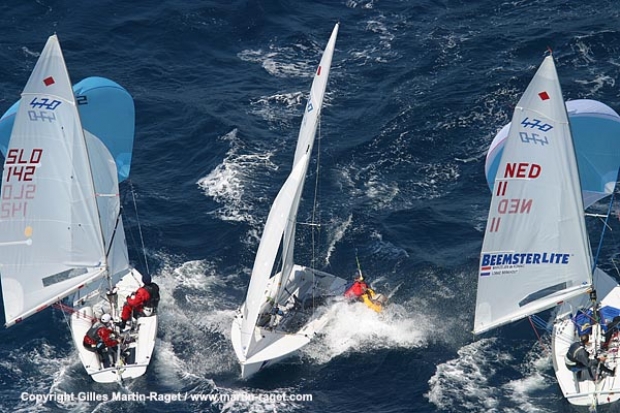
Olympic preview - 470 men
Tuesday August 3rd 2004, Author: Chips Howarth, Location: United Kingdom
 Introduction
The 470, designed in 1964 by Frenchman, Andre Cornu was one of the pioneering classes designed specifically for GRP construction after hundreds of ‘wooden’ designs from a previous era. The class flourished, especially in continental Europe until it was selected as the men’s double hander class for the 1976 Olympic Games. The 470 has been the equipment choice ever since, where it was also chosen as the preferred women’s class for the 1988 Games and is now the longest running ‘dual’ Class in the Olympic Games.
A single trapeze boat, the 470 is notorious as one of the most fiercely competitive classes in the Games, with many 470 Olympians going on to hold serious positions in America's and Admiral's Cup teams. Many of the UK’s leading yacht skippers are ex-470 sailors (Kevin Sproul, Jeremy Robinson, Lawrie Smith etc…)
Technical
Like most single trapeze boats, it pays to have a light helmsman (58-64kg) and a tall crew (70-74kg, ideally 6ft tall). In recent years the class has evolved to sail on shorter courses resulting in a more ‘explosive’ style of sailing. This has allowed helms to be slightly heavier as the power gain with weight has advantages on the new courses.
Despite numerous builders, the fleet is split down the middle between MacKay Boats from New Zealand or Zeigelmayer Boats from Germany. Although the boats ‘feel’ different to sail, they are very similar in speed. The outstanding feature on both boats is the incredibly high build quality. Both Dave MacKay and Sebastian Zeigelmayer are fanatical about producing the perfect 470.
Another trend in the class since Sydney is that the average age of sailors is slightly older. For many of the teams competing in Athens, this will be their second Games and the class is clearly older and wiser. The trend in Sydney was to use standard equipment and try and sail the boat to perfection. In the last four years there has been significantly more experimentation with masts and sails and there will be a greater mix of gear in Athens.
Masts are split between the Proctor Cumulus or the Superspar M7. These are traditional ‘soft’ rig styles that are very user friendly and are highly dynamic and responsive. Two notable exceptions to watch are the Australian team of Nathan Wilmott/Malcolm Page who will be using an Australian modified Goldspar rig that has been squashed to increase fore and aft stiffness. Also, the Spanish team of Gustavo Martinez Doreste and Dimas Wood using the ‘stiff’ rig option of the Proctor Epsilon. This could prove super fast on certain days.
Sails-wise, the biggest move has been a shift from Olimpic Sails (although still popular) to the Spanish Quantum rig. The Quantum Sails are radically straight in the exit for 470 sails, but have proved quick. There is still a small but significant following with North Sails developed at both the British and Japanese lofts. The Japanese have been the first to succeed in developing a fast radial cut main and jib, although it is rumoured the GBR team of Nick Rogers and Jo Glanfield may have something up their sleeves.
There is lots of talk that some teams have developed new foils, particularly centreboard, but I suspect a lot of this is just talk as the foil has to be a non-profiled ‘plank’ under class rules. I personally converted my favourite ST foil into a coffee table following the 2000 trails!!
The Yellow Flag
One feature exclusive to the 470 is the race officer’s use of the yellow flag. When this is flown (in 10 knots and above) rule 42 no longer exists and it is a free-for-all on pumping. Some fantastic crew kinetics have evolved to maximise this advantage requiring 470 teams to be among the fittest athletes at the Games.
Watch the crew work in the Portugese team for a master class is crew kinetics.
Form Guide
As mentioned above, the 470 is notoriously competitive and in any Olympic cycle, there is rarely a single team that is ever dominant for any length of time. The exceptions were Spanish sailor Jordi Calafat (now with Alinghi) who proved unbeatable in the final six months before the 1992 Games in Barcelona, as was Tom King in 2000 who went on to Gold in Sydney.
Although no one has shown this clear dominance in the latest Olympic cycle, the results of team GBR's Nick Rogers and Joe Glanfield (below) this year are close to domination following their win in the highly competitive Princess Sofia regatta in Palma and the European Championships, plus a bronze at this year’s world championships. In my opinion these guys are the form team.

AUS - Nathan Wilmott and Malcolm Page
Both fantastic sailors, with Nathan very close to selection for the 2000 Games (beaten by the Gold medallist). They have many things in their favour, including No 1 ISAF World Ranking position at the time of the Games, reigning World Champions and their coach Victor Kovolenko ‘the medal maker’ whose charges have won the last two Olympics.
Strengths - good speed, Victor and that strong Aussie self belief.
Weaknesses – Not many, but I suspect that Nathan has never really ‘bought in’ to Victor’s Eastern European style of coaching and there is potential friction in the hot bed of the Games. Also, Malcolm is liable to explode under pressure.
Likely Equipment – Zeigalmeyer/Goldspar/Japanese North

GBR – Nick Rogers and Jo Glanfield
These guys appear to be peaking at just the right time and have benefited from a very strong GBR team ethic. If these guys win, they owe a big thank you to their training partners of Graham Vials and Nick Asher. Working closely with them is 470 legend and coach Hamish Wilcox who coaxed the most out of them to achieve fourth place in Sydney.
Strengths – Unfinished business following the loss of bronze down the final reach in Sydney. Good all-round package and are very relaxed. Could be unstoppable in heavy air.
Weaknesses – Sometimes give the impression they aren’t trying. The characters of the fleet, but this could be a millstone round their neck.
Likely Equipment – MacKay/Superspar/North Sails
POR – Alvaro Marinho and Miguel Nunes
Arguably the most naturally gifted sailors in the fleet, but are not leading the way with equipment development. Have been sailing together for many years and were fifth in Sydney. If the conditions are light and choppy all regatta, they would be favourites to win. Seem to be dominating the training regattas in Athens during July.

Strengths – Experience and excellent skills in light winds. Look like they were born to sail 470s. Alvaro appears very focussed since his recent marriage
Weaknesses – Could be average in heavy air.
Likely Equipment – Zeigelmayer/Proctor/Quantum or Olimpic
USA - Paul Forester and Kevin Burnham
The oldest guys in the fleet but do have three silver medals between them. Despite the many jokes about them needing zimmer frames to get on the podium, their enormous wealth of experience when the ‘chips are down’ could be the difference. Despite winning Silver in Sydney, Paul has changed crew to Kevin Burnham (silver medallist in Barcelona), but has never shown quite the same form.
Strengths – Experience and a boldness to try extreme tactics that can often pay in the smaller Olympic fleet.
Weaknesses – Can be too radical and don’t appear to be fast enough.
Likely Equipment – MacKay/Superspar/Ullman USA
GRE - Andreas Kosmatopoulos and Kostas Trigonis
The second most experienced guys in the fleet and have home advantage. Ex-World Champions, this will be their third Games and it is time to deliver. They rarely win races but always up there and know their home waters particularly well, although they're actually from Thessiloniki. Two of the nicest guys on the circuit, I would dearly like them to medal.
Strengths - Experience and ability to be consistent, with potential in a wide range of conditions (light sea breezes and strong ‘Meltemi’ mountain winds), which could play to their strengths.
Weaknesses - Too much pressure as the local team and the realisation that it is 'now or never'.
Likely Equipment – Zeigelmayer/Proctor/Olimpic
ARG - Javier Conte and Juan De La Fuente
Bronze medallists in Sydney, and always quietly get on with it. They tend to be very fast in some conditions and weak in others. If conditions suit them, they could be a surprise package. Javier is an ex-Cadet World Champion and one of the best starters in the fleet, but if the race officer gets aggressive with the black flag, they could be vulnerable.
Strengths – Can be extremely fast and very experienced.
Weaknesses – Sometimes hit a slow condition.
Likely Equipment – MacKay/Proctor/Quantum
SWE - Johan Molund and Martin Andersson
Extremely inconsistent, but when they win, they win!! They won the pre-Olympic regatta last year and have occasionally completely dominated Grade 1 events. They were the pioneers of the new Quantum rig and can often show unbelievable speed. They seem to allow themselves to end up in the corner of the race track from promising positions. In reality, they are likely to be first or last. Johan was very ill leading up to Sydney and could have been a major player if it wasn’t for this, so there could be some unfinished business.
Strengths – Speed and self belief
Weaknesses – Tactically weak, inconsistent and too heavy.
Likely Equipment – Zeigelmayer/Superspar/Quantum
Others to watch
ITA - Gabrio Zandona and Andrea Trani: 2003 World Champions, but could be a one-hit wonder
FRA - Philippe Gildas and Nicolas Le Berre: Ex-World Champions and very good sailors, but appeared to have developed slow kit and could be off the pace.
UKR - Eugeniy Braslavets and Igor Matviyenko: Complete dark horses in Athens, 1996 Gold medals and ex-World Champions, have all the pedigree and experience. Some unfinished business following two DSQs in Sydney, otherwise they could have easily added to their medal haul. But they seem to be off the pace in 2004, or are extremely good ‘sand baggers’
ISR - Gidi Kliger and Udi Gal: Very good and passionate sailors, slow in light winds, but extremely good in heavy air. If the Meltemi blows for the duration of the regatta, these guys could feature.
ESP - Gustavo Martinez Doreste and Dimas Wood: Gustavo comes from very good Olympic stock (the Doreste family being the most successful Olympic sailing family in history), has twice been in the medals at recent World Championships and is very talented. Maybe too heavy and off the pace.
Conclusion
One thing you can guarantee, the 470 fleet will be demonstrating some of the finest examples of technical dinghy sailing on planet during the Olympic regatta. The racing will be close and he who performs on the day is likely to medal.
Most Read
Most Commented
Comments
Businesses

Pro businesses
Editor's choice
Member blogs
-
 Ned Collier Wakefield: MOD70 round BarbadosWell that was intense. 12 hard fought for seconds for the win. In idyllic conditions, Tony Lawsons MOD ...
 -
 Mini Transat leg 2 reportThe second leg of the Mini Transat started on 31st October, just over a month after ...
 -
Leg 1 reportI’ve been working towards the Mini Transat now for three years. In 2013 I was part ...
Business blogs
-
 The Island Sailing Club in Cowes, Isle of Wight, is delighted that Prince Michael of Kent ...
 -
Peta Stuart-Hunt chats with the 25 year-old British solo sailor Lizzy Foreman before she sets sail ...
-
The 2015 Student Yachting World Cup (SYWoC), an ISAF-recognised event hosted and run by students for ...
Editor's Choice
All time favourites...
-
 Three legs down into Ian Walker’s
 -
 Winning all but two races at
 -
 For the first time in its
Latest Comments
Add a comment - Members log in