
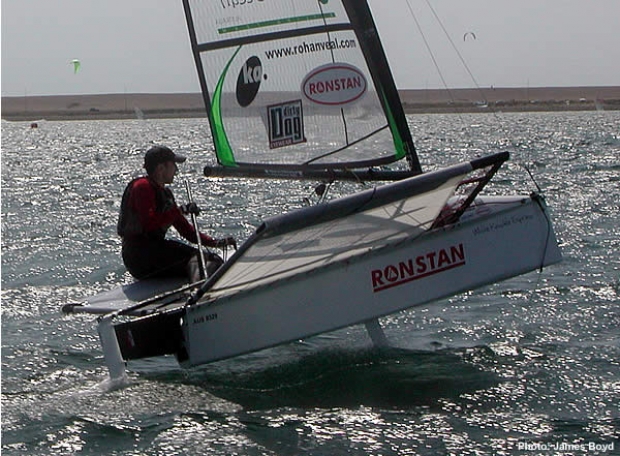
Foil master
Thursday July 22nd 2004, Author: James Boyd, Location: United Kingdom
Earlier this year Rohan Veal revolutionised the dinghy sailing world when he won the Moth class' Australian Nationals sailing a foiler. Using gear developed by John Ilett's Fastacraft company, the young Australian learned how to get airborne not just in one direction at a time, but around the race course. At the Nationals he roundly demolished the opposition winning eight races back to back by a margin of three to eight minutes in every race.
Veal is currently in Weymouth taking part in the Moth Europeans and helping the three UK foiler Moth sailors Adam May, Graham Vials and Simon Payne spread the word about how this ground breaking form of sailing represents at least one future of our sport.
While Simon Payne has bought a Fastacraft Moth from Australia and Veal has shipped his across to the UK, where it has been sold to Colin Newman, May and Vials have been sailing a Moth to May's design built by Linton Jenkins of Full Force Boats.
Veal reckons that there is little to choose between his hull and May's."The hull makes absolutely no difference. As long as it’s light - that’s all that matters."
At present Payne, Veal and May are all running the Fastacraft foil package while Veal is using a new foil package developed by May.
The Fastacraft foils are immaculately built. Both rudder and centreboard have a cord of around 200mm and are both fitted with T-foils both horizontal foils fitted with a trim tab about 30mm deep with a hinge made of Kevlar.
On the centreboard the trim tab automatically adjusts the 'altitude' the Moth flies at using a wand mounted at the bow that senses how high the boat is out of the water. The wand is connected by a Morse cable to a nipple at the top of the centreboard that alters the pitch of the trim tab. If the Moth starts to fly too high out of the water the wand (around a metre long and 3mm in diameter) drops down and the lever mechanism at the bow pushes the Morse cable forcing the trim tab down, reducing altitude.

Veal (above) says that the retrofit Fastacraft foil package is a case of 'fit and forget'. "It works. I don’t really think about it. You just let it do its job and you just sail the boat. It is a standard set-up. It is a standard package and it fits on to any boat. There is hardly anything which needs to be tweaked. Just put it on and it works - we want to make it that way so that people can buy it and not have to worry about that sort of stuff."
While the rudder has a similar trim tab, the horizontal element of the T-foil is smaller. The pitch of the trim tab in this case is adjusted manually by a twisting the tiller extension.
Veal says that having the rudder trim tab is useful but he doesn't think it is essential. "I reckon you could sail without it. I’ve gone out there with the hydrofoil rudder not even working - it was broken and I didn’t realise. I was twisting it, it wasn’t doing anything, but it was still working."

The top of trim tab adjustment mechanism for the rudder
At present the gear also requires occasional maintenance. The linkages built into the foils to adjust the trim tab pitch are model aircraft fittings made of brass. These corrode and need to be replaced every six months.
Now that he has sold his boat, Veal says that for his new one he is going to try a rudder T foil that has a wingspan roughly 10% bigger, but he warns if this much wider the boat is inclined to stuff itself up.
Watching the Moths blast round Portland Harbour on Sunday we were impressed by just how slowly the boats could be going before their foils developed enough lift to make them airborne. Veal reckons the required speed is 9-10 knots - to us it seemed slower.
Veal says they have just stratched the surface of possible developments with this technology. "We’re talking about moving the rig further forwards and one guy in Sydney is just trying that at the moment - but it’s all homemade stuff. You could move the mast at least 1ft further forward and then you can move your centreboard further forward creating more distance between the foils and that creates more stability. And then you can start looking at modifying the hull - do you need that foredeck? Probably not. Do you even need a hull? You could get away with a board or something like that and a lot less weight. The wing frame you can actually support the whole rig and the wings together without the hull - there is no reason why you couldn’t do that. There’s a guy in Switzerland who’s made a tube for a hull and Brett Burville has done the same. You have two bottom halves of the hull so it is just like a torpedo. It does sit along the water. I’ve sailed it and found it pretty difficult because when it goes under there’s nothing to bring it back up. I still prefer these."
The problem with this is that the boat becomes a pure foiler and in light conditions it will go nowhere. Even now with the foiling Moths minimal hulls they have a lot more drag than the non-foiling Moths as Adam May confirms in his reports from Weymouth.
Other development might be automating both trim tabs or removing the trim tabs altogether and using the fore and aft movement of crew weight to adjust the pitch of the whole boat and thus the aspect of the foils.
Alternatives to the Fastacraft wand system for automatically sensing the height of the boat above the water are already in development in Australia. A ski-type floating sensor as used on multihulls such as the Hobie Trifoiler is one alternative.
In Weymouth the foilers were sailing upwind their boats heeled to weather the sails almost falling on top of them. Adam May explains this creates more lift out of the rig, while Veal adds that having the mast slightly to weather of the vertical balances the boat more requiring him to hike less.
Upwind Veal also seems to sit further back on his wing, than May, although May says this is due to incorrect packing of his rudder. "I swing my legs in and I lean back," explains Veal of how he gets the boat set up upwind. "Because you pull the boat so far on top of you can’t be out on the wing too much otherwise you hit the water. So I initially will be flat but then I swing back in when the boat comes over the top of me, because when that happens you need less weight to keep it flat. So you have got to swing in as soon as you get airborne and heeled to windward."
The price of the foil package is expected to come down. Veal says there is already another manufacturer in Melbourne and it is likely that someone soon will offer them in the UK.
While there are obviously many voices within the Moth class from the non-foilers objecting to this new development and this will initially have a downturn in numbers, it is generating huge publicity for the class at present and it is attracting new blood or the return of old hands to the class - May being a case in point. Veal's success in Australia has been at the fore of this publicity and he is anxious to make people realise that he is not the sole Moth foiler. "I am trying to look at it like a class thing and get more than one boat in the shot. People always think I am the only one doing it."
At the Nationals in Australian earlier this year there were just two foilers. Next year at the Nationals Veal expects 10 of the 40 boats to be foiling. We would anticipate similar numbers in the UK.
Thedailysail would like to congratulate the Moth class for having the foresight not to prohibit this exciting development, as they so easily could have.
More photos of the gear on the following pages...

Most Read
Most Commented
Comments
Businesses

Pro businesses
-
Italy
-
-
United Kingdom
-
United Kingdom
Editor's choice
Member blogs
-
 Ned Collier Wakefield: MOD70 round BarbadosWell that was intense. 12 hard fought for seconds for the win. In idyllic conditions, Tony Lawsons MOD ...
 -
 Mini Transat leg 2 reportThe second leg of the Mini Transat started on 31st October, just over a month after ...
 -
Leg 1 reportI’ve been working towards the Mini Transat now for three years. In 2013 I was part ...
Business blogs
-
 The Island Sailing Club in Cowes, Isle of Wight, is delighted that Prince Michael of Kent ...
 -
Peta Stuart-Hunt chats with the 25 year-old British solo sailor Lizzy Foreman before she sets sail ...
-
The 2015 Student Yachting World Cup (SYWoC), an ISAF-recognised event hosted and run by students for ...
Editor's Choice
All time favourites...
-
 Three legs down into Ian Walker’s
 -
 Winning all but two races at
 -
 For the first time in its
Latest Comments
Add a comment - Members log in