
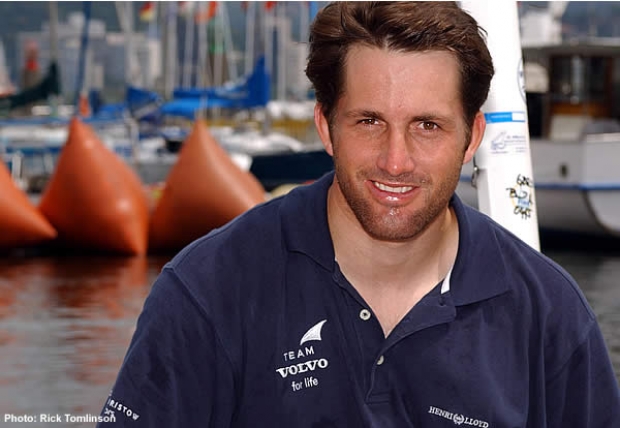
Bionic Ben
Monday July 26th 2004, Author: James Boyd, Location: United Kingdom
 Over the last century sailing has had some exceptional Olympians, such as the four time medallists Paul Elvstrom, Jochen Schuemann, Torben Grael and Valentyn Mankin. While Grael returns again this year in the Star, another rapidly on his way to the realms of Olympic legend is the present Laser Gold medallist, Ben Ainslie, this year odds-on favourite for Gold in the Finn.
After his departure from the OneWorld America's Cup team, Ainslie strode into the Finn class and has since has won the last three World Championships in the singlehanded Olympic dinghy. Only one other person has ever achieved this - tomorrow Robert Deaves of the International Finn Class Association explains the significance of this.
So why is Ainslie so good? Having had a keen sailor father, Roddie Ainslie by his side certainly helped push Ainslie in his early Olympic career. Ainslie senior was still in evidence in Athens when we visited the team GBR sailing squad base last week helping out the Lasers - he is class President.
Ben has also benefitted greatly from the logistical and training support provided by the RYA and ultimately the financial cushion that has come with lottery funding. He honed his competitive skills over two Olympic campaigns in the Laser, culminating in him despatching the supposedly unbeatable Brazilian Robert Scheidt in Sydney to take the Gold medal. On the water Ainslie is said to have developed a supposed 'sixth sense' for spotting shifts and shows an aggression that is entirely not evident from the mild-mannered person, who we once described as shy, you meet on dry land.
Into the Finn, Ainslie says he did benefit from the legacy of Iain Percy's Gold medal-winning campaign in Sydney but not to the degree one might imagine. However he has learned a lot from the training expertise of 'the guru' himself, David 'Sid' Howlett. "I gained a huge amount from the knowledge that Sid's got from his own sailing background and working with Iain, but things moved on quite a bit after Sydney with these Wilke masts and also the HIT masts from Holland, so they brought it on another step," says Ainslie. "So it wasn’t a case of just picking up Iain’s kit and using that. It was starting with a whole new load of equipment. I was fortunate that with Sid's experience we knew what numbers we were looking for and we got some fast kit."
This June Ainslie acquired a new boat, a Devoti once again, and he says he's pleased with it. He will not be specific about what is different about it, except that it "is definitely a one-off."
Perhaps most remarkable is the support that Ainslie has received from the other British Finn triallists such as Matt Howard, Chris Brittle and Andrew Simpson, all of them accomplished and highly ranked Finn sailors in their own right. When thedailysail visited Athens last week all three were in evidence at the GBR base in Gylfada.
"The training has been really good and we join in with the others now and then for the racing, but it has been a real psychological boost having those guys here," says Ainslie. "Our time on the water has been really well spent whereas other people have been wasting one or two hours sailing between groups of people trying to find someone to train with."
While Ainslie goes into the Olympiad the clear favourite, this presumably means that other competitors will single him out as someone to be nailed. Ainslie says he hopes this won't be the case. "I’ve always tried to have a good relationship with the people I sail against. If you try not be too arrogant and be friendly with the guys and try to reduce that 'hate element' it decreases the likelihood of them having a go at you. I think they will be too worried about their own performances initially. If someone has a bad event and they are out of contention for a medal they might come and have a go for whatever reason, but I don’t think so."
Having had such a successful run since entering the class, the perception is that the best Ainslie's competition can hope for is racing for silver. Again he plays this down. "I don’t know. I'd be happy if they thought that, but I’m sure they don’t. Mateusz [Kusznierewicz] sailed very well at the Europeans and Spa and beat me at those two events and there are other people out there as well capable of winning events. It is still going to be a close event with tough racing and it is going to be down to who gets it right on the day. Mateusz is on song for sure and after there is a group of five or six boats who are all in with a shout - Seb Godefroid, Rafael Trujillo, David Burrows, a whole host of guys."
Compared to his rivals Ainslie reckons he is around 10kg off the optimum weight for a Finn sailor. "My gain is in the light stuff, being a bit lighter. I normally keep up alright in heavy stuff, but it should be an advantage downwind and in the light as well. But there is not a lot in it. It comes down to starting well and making the least mistakes."
Obviously one unique feature of racing at the Olympics is the small size of the fleet. How does this affect the racing for him? "It is hard to say because you do it so little, at the end of the day the top guys normally come out but it does make it different tactically. You probably can recover from a poor start easier. If you are someone who is not particularly good at close quarter boat on boat tactics, you are more likely to get away with it than you would if you were in a 100 boat fleet. So it gives you more space, more time."
Despite this being his third Olympiad Ainslie says he still gets butterflies beforehand. "You always get slightly nervous, but when you get out there and start the first race it all goes out and you start focussing on the racing." Dealing with these nerves is essential. "In the Olympics there have been people who normally are right up there and they have just completely lost it due to the pressure and in other classes as well. It is definitely something to deal with."
While Ainslie is in the strongest of positions his only set-back to date is the bout of glandular fever he suffered in the spring. "That was a problem back in January/February this year at the world championships in Rio. It was not great and frustrating at the time, but with a bit of a rest period I managed to knock it on the head. It hasn’t reared its ugly head for a couple of months now."
Ainslie says that at the time glandular fever left him feeling completely drained and without energy and a bit depressed too. "It is not a nice thing to have but I haven't really been suffering from it since January-February time so I’m hoping I’ve been through the worst of it and it won’t be a problem again.
"I picked it up right at the beginning of January and didn’t know what it was," he elaborates. "I just thought it was a nasty virus or cold and I was trying to train really hard leading up to the Worlds. And it was a bad time for me. I had to train through it because I didn’t know what it was at the time. I managed to get through the Worlds and stuff and hadn’t been right for about six weeks, so I got a blood test, and got diagnosed which was a bit of a relief because I knew what the problem was and what had been causing me to be such a bad tempered bastard for so long, and I was able to have a bit of time off before Palma. I didn’t feel so good after Palma, so I had another rest then and I’ve been okay since."
This will be Ainslie's third Olympics yet he shows little sign of getting bored with it. "I still feel passionate about the Olympics. It is a great event to be at and something to go for and I would like to be in Beijing, if it is at all possible. I think I’d have to do it in a Finn again due to the time between the America’s cup and Olympics. There’s no enough time to change to a new class."
This brings us neatly on to the second part of our article, regarding Ainslie's latest news - that, as has been rumoured since October last year, he will be joining Team New Zealand once this Olympic cycle is over.
So why did he join them? "It is a great team, with really good people. I was impressed with Grant Dalton, who is a straight talker if ever there was one and that is really important in a game like that. Sailing with Dean and the other guys in the Bermuda Gold Cup was also good fun and good racing."
Ainslie says that he has been in negotiation with Team New Zealand since October and that a deal has been agreed for some time - like all the other TNZ recruits Ainslie signed up to the Kiwi team early subject to them getting sponsorship.
So does he expect to steer? "The idea is I am initially on the race boat as a strategist and will push along with Kelvin Harrap as a B boat driver. And I'll do the match racing circuit myself with my own team with the idea that if things go well for me and being the guy who pushes Dean, depending upon what happens over the next few years - who knows... That is an ideal scenario for me, to get some wheel time and to learn how it’s done and learn how to match race."
At present the Team New Zealand has Dean Barker on the wheel and Ainslie, Kelvin Harrap, Terry Hutchinson and Kevin Hall in the afterguard.
Ainslie says that he has every confidence that Team New Zealand will not suffer in the same way as OneWorld did in the build-up to the last America's Cup. "For a start the money is definitely there, it is not going to suddenly dissolve into some offshore bank account. The management structure is there in such a way so that the sailing team are not going to get embroiled in the running of the team and legal issues and what have you. I’ve got a bit more experience about it now and I know the people involved and the way it is set up, so I am pretty confident it is a good team with good personnel."
One part of his training in the Finn that will certainly help is that working with Howlett he has been exposed to the technical side of yachting, including design and engineering. "I am a lot wiser now after sailing the Finn than I was in the Laser. To be honest with the Laser I just sheeted in and went, and didn’t really worry about it! With the Finn I have a much better understanding of boat engineering. The key to it all [the America's Cup] is the sailing team working with the design team because they can’t go off and do their own things. It is that transfer of information which is the key."
So if GBR Challenge came up with the money tomorrow - would he be tempted? "No, I’m a bit stuffed now. They’d have to buy me out somehow, I don’t know! It is a shame. For a while it was looking good with Iain and myself and a few others and it looked like they were getting the money, but the long term goal is still to do that."
This week Ainslie is back in the UK, before heading out to Cyprus next week for a British Olympic Association holding camp, used by the athletes for teaming building and to help them acclimatise prior to the Games.
Following the Olympics Ainslie will miss Act 1 of the America's Cup but will join Team New Zealand for the two events in Valencia in October before heading down under to train in Auckland from December on.
Most Read
Most Commented
Comments
Businesses
Pro businesses
-
Italy
-
France
-
-
Italy
Editor's choice
Member blogs
-
 Ned Collier Wakefield: MOD70 round BarbadosWell that was intense. 12 hard fought for seconds for the win. In idyllic conditions, Tony Lawsons MOD ...
 -
 Mini Transat leg 2 reportThe second leg of the Mini Transat started on 31st October, just over a month after ...
 -
Leg 1 reportI’ve been working towards the Mini Transat now for three years. In 2013 I was part ...
Business blogs
-
 The Island Sailing Club in Cowes, Isle of Wight, is delighted that Prince Michael of Kent ...
 -
Peta Stuart-Hunt chats with the 25 year-old British solo sailor Lizzy Foreman before she sets sail ...
-
The 2015 Student Yachting World Cup (SYWoC), an ISAF-recognised event hosted and run by students for ...
Editor's Choice
All time favourites...
-
 Three legs down into Ian Walker’s
 -
 Winning all but two races at
 -
 For the first time in its
Latest Comments
Add a comment - Members log in