
Stealth sailing
Thursday August 7th 2003, Author: James Boyd, Location: United Kingdom
This article follows on from
yesterday's look at the F18-HT class
Former Tornado Olympic hopeful John Pierce is known in catamaran circles as the creator of the Stealth 16. His business is a family concern - he and wife Sue build the boats in Birmingham, although they are shortly to move their base to Pembrokeshire.
The Stealth 16 was designed by David Thomas, famous for among other boats the Sigma 33 and 38, with much input from Pierce. "I gave him the section and he produced what we've got. I knew what I wanted, whereas he could put all the numbers into the computer to decide how it would float and where the centre of gravity is," says Pierce.
Following this the Formula 16 rule was established and at the beginning of 2002, Pierce revamped the Stealth 16 to bring it up to the full spec of the rule - making it 20cm wider, moving some of the jib area into the main, putting a self-tacking jib on to it and T-foils with which they'd been experimenting.
This year Stealth Marine's main focus has been on their new F18 HT, the first ever F18 HT in the UK.
Design-wise the Stealth F18 HT is like an enlarged version of the 16 - a bit longer and a bit wider. "We wanted something that has a fairly flat bottom to generate some lift," says Pierce. "We did testing where we towed some model hulls and it seemed that the flatter-hulled ones worked better. We had also been on the Hurricane 500, which is the scaled-down Worrell boat. And I was very impressed by how that went and that has a flat hull. It was good in breeze, but hopeless in the light."
A significant difference between the conventional (non HT) F18 and the HT is that the latter has a una-rig (or cat rigged), as specified by the class rule. "What they were looking for was a two man A-class when they came up with the rule," says Pierce. "With cat sailing the crew does the work and the helm just steers. With a self-tacking jib it is pretty much the same amount of work whether it’s there or not. And una-rigs are more efficient upwind certainly in light to moderate winds and downwind the jib doesn't really do a lot."
Equally surprising to us is the construction. Because of the minimum weight rule we were expecting F18 HTs to be made in carbon fibre. In fact even with a minimum weight of 130kg most are built in glass. However the Stealth is vacuum bagged and made with epoxy rather than polyester or vinylester resin (so less resin is required), and there is uni-direction carbon fibre in the hulls to take the loads of the main bridle back to the main beam.
Pierce maintains it is fairly easy to get enough stiffness in to the hull without resorting to carbon fibre. "With carbon you’d only be using it to stiffen it up further. You wouldn’t be using it to lose weight." Saying this Stealth Marine do offer a full carbon version (although still with alloy beams) for an extra £1,000.
Clearly the lower minimum weight makes the F18 HT more fragile than the standard F18. "I don’t think there’s any problem with the longevity of the boat provided it is looked after," says Pierce. "But it is not a hoon-it-up-the-beach-at-full-speed boat by any means. But then I would doubt that people buying Tigers would do that. The F18 is a racing boat too and if you do that to the boat, you won’t win races for very long." The Stealth, maintains Pierce, should withstand the crash and bangs that are inevitable on the packed start lines catamaran classes are frequently seeing these days.
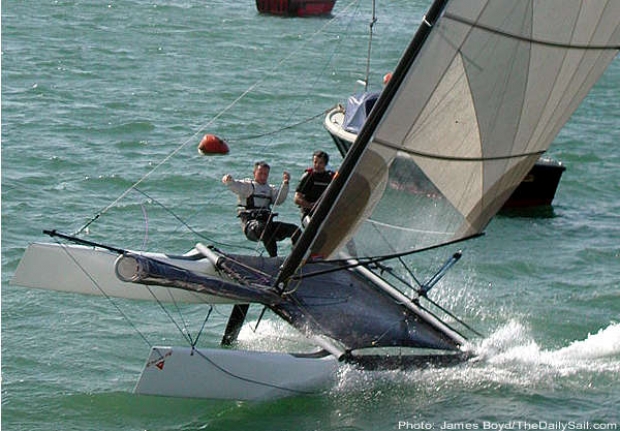
Looking at the Stealth in the boat park prior to the Catamaran Round the Island Race, her narrow, plumb bows reminded us of the Nacra, while the run aft is quite flat bottomed with a rounded deck. The decks from the main beam aft are finished with black non-slip. She has daggerboards and her T-foil rudders are mounted in a mounted in cassettes and are therefore not kick-up - they can however be hoisted up suitably high so that they don't ground when launching or recovering.
"Upwind in a chop they smooth the motion and stop the pitching moment and downwind, when the rig is loaded up, you can drive it a lot harder before the bows go down," says Pierce of the T-foils. Unlike the T-foils on International 14s, the pitch of the foil can only be adjusted on shore. "The guy who designed ours reckons that each rudder will generate up to 50kg of down force or lift so it is like having another guy trapezing off the rear beam."
The main and aft beams are alloy tubes, which Pierce says are the same as the Bimare's original BIM F18 HT. We felt that some of the detailing work around the beam attachment areas looked a little DIY, but this was only a small criticism of an otherwise well conceived boat. The bowsprit is in carbon fibre and has a alloy hoop and bag arrangement into which the spinnaker is dowsed and from which it is launched. Also made in carbon are the boom, tiller, tiller bar and the tiller extension.
The elliptical profile tapered mast is carbon fibre as allowed under the class rule and interestingly was also made by Stealth Marine - specifically by John's wife Sue. This has a single set of spreaders and diamonds. Sails are by Andy Landenberger at the Ullman loft in Germany and the Stealth we saw had a 9:1 purchase main sheet.
"It is ideally suited to a big strong bloke who wants to sail with a relatively inexperienced crew or a combination where you have got someone fit playing the mainsheet upwind and someone relatively small steering it," says Pierce. "It is the quickest way to sail all cats. Perhaps not the Hobie because you tend to crank that in and play the traveller. When the breeze is up, give the crew the main and you go quicker than the guys steering all over the place trying to pull it in with one hand..."
Performance-wise her handicap suggests she will be slower than a Tornado Sport but faster than an F18 - she rates at 98 under SCHRS, while the Tornado Sport is 94, the Inter 20 is 95 and F18s are 101.
Her first outing was a memorable one - the Piers Race on the Blackwater. "There were six Tornado Sports, 15 or so F18s and the same number of Hurricanes with spinnakers and it was light winds," recounts Pierce. "From the word go we were in second place on the water, us and this Tornado Sport. By the time we were one third of the way through the race we could only see the Tornado Sport behind us and by the time we were half way back we couldn’t even see him. And that was out the bag. So it looks like it's got the speed in light winds."
Pierce says that they were faster than the Tornado Sport on close spinnaker reaches, but slower when the point of sail got broader. "We were twin wiring and at one stage we were having to curl the kite a bit to keep our height, but all the time we could hold it down. I think it may have that we had the spinnaker luff set really slack and his [the Tornado Sport] was significantly tighter."
Their performance in the round the island race was less spectacular. "We were lying in sixth or seventh until St Caths and we were going downwind when we capsized. We lost the triller extension and had to beat back from the Needles to Calshot, single trapezing and lost about 15 places as a result," admits Pierce.
Also surprising about the Stealth F18 HT is her price tag. Despite being more of a performance boat, her price of £9,500 (inc VAT) which makes her fractionally cheaper than a standard F18 like the Hobie Tiger. This is partly because the boat has no jib nor jib tackle.
Contact: Stealth Marine tel: +44 121 355 8934 email: stealthmar@aol.com or click here to see their website
Paul Larsen, avid F18 sailor, Maiden II crewman and the man behind the SailRocket speed sailing project - gives his impressions of the Stealth F18 HT, following a blast on the boat up and down Southampton Water.
We sailed the Stealth in quite gusty conditions. For me it took only a little while to get used to not having all the extra strings associated with a jib, but then it was quickly forgotten and then just as quickly appreciated. On all modern F18s the jib is self tacking and you don't have to play with it that much anyway. Sailing without a jib gave clearer visibility and provided a much cleaner deck. To get the most out of this type of boat, the crew should be busy playing with the mainsheet anyway and on this boat, that's heaps.
The mainsheet loads are pretty high as it is a big stick with a lot of roach. I think we were down one purchase on this system. These type of sails respond well to pulling on that last little oomph of mainsheet. The Landenberger mainsail could really be flattened out and playing the cunningham makes dramatic differences to the power on tap. The rolled topsides were nice to trapeze off although the exposed beam ends were a bit agricultural but this is an early boat which will be improved in subsequent models with endcaps.
The hulls are very fine and tall and felt slippery. They are very easily driven and despite being very flat on the bottom they didn't seem to slap like a Hobie Fox but neither did they seem to have the semi-planing effect of a Fox on a trucking reach. That is probably because the Fox is bigger and has more area down there and maybe because we weren't going at the break neck speeds where you really notice it. This is not a bad thing as the design features of the hull are all there but subtle.
You only just notice the dreadnought bows and you have to look right underneath to notice how flat it is. I sailed a Nacra Inter 17 which had very high and fine bows and found it to be a bit too tender up there for my liking but the Stealth was very well behaved although we sailed her in flat water. The deck area up forward was small and fine so I imagine there would not be much tendancy to trip if it did take a dive. I liked the hulls and they made for a unique and almost pretty shape... if you're into cats.
The foils on this boat had had a hard life and 'Hummed' alot. This is very annoying as you can feel it creating drag and slowing you down. The boat had a lot of weather helm but that is how John liked it and I have no doubt that it could be set up for individual preference although it would require a drill!
The boat has T-foil rudders and I was keen to see how they behaved. On the shore they lift in their cassette cases to be clear of the transom so they aren't a problem although John did mention one gnarly hook-up around a buoy on his 16 footer which also has them. I couldn't really tell if they were working or not as you would probably have to do a comparison with and without them. As mentioned, there were times when the foils felt quite draggy like they were holding the boat back but I suspect that was more due to all the foils needing a tidy up. Whether you would sail with them in light or flat conditions would be open to debate... I think not.
Upwind the boat felt powered up and fast. It was very nice in fact. With the weather helm on this boat, for tacking, you virtually would let go of the tiller and as quick as you could get to the other side and hook up.... she was off. get it wrong and it's like all cat-rigged boats and it becomes a slow process.... main off traveller out etc.
The platform wasn't as stiff as an F-18 and you could notice the flex. There was not a lot mind you. An F-18 is way overbuilt in order to come up to weight. A Tiger has the same beam section as a Tornado and yet is two foot narrower. It should be stiff. Without a jib and the bridle pressure on the bows that comes with it perhaps ultimate platform stiffness isn't as critical. It was just something I noticed.
Tight reaching felt nice also with the bows staying nice and high. Then comes the stage as you bear away more where the lack of a jib is noticeable and the boat sort of turns off. In dog leg courses this isn't an issue but in long distance races that may involve two sail reaching... like the following day's 'Round the Island' race, Eurocats 'Raid' or Texel, then the lack of a jib may hinder - however that is a class rule.
Downwind and the kite went up and down like a peach. It was a very flat kite and hence would fold a lot if you weren't quick but otherwise it once again felt a lot like what I am used to. The visibility is once again noticably improved and the lack of jib and associated clutter is a bonus. The boat felt flighty most likely due to the gusts and the lack of bulk. It is 50 kg lighter than an F18 after all and this is where it should really help.
I liked the boat. I am a big fan of Formula 18, the fleets and the boats but for round the scan stuff, this 'jib-less' layout is much nicer. The workload is there with or without a jib. But for long distance racing then I would prefer the extra reaching power of a jib but that's my preference.
The boat is no doubt fast and once set up to the individual, a real fine blade to take on the F-18 fleets with.
It is only boat No. 2 so the details need to be refined to come up to the class levels but they are only details. Everything worked fine and some of John's simple solutions were all that were needed.
After the sail, standing back from the boat in the Calshot car park for another look at that lovely tall clean carbon mast, I had to admit that I really did like it.
More photos of the Stealth F18 HT on the following pages...


Most Read
Most Commented
Comments
Businesses


Pro businesses
-
United Kingdom
-
Netherlands
-
United Kingdom
-
Editor's choice
Member blogs
-
 Ned Collier Wakefield: MOD70 round BarbadosWell that was intense. 12 hard fought for seconds for the win. In idyllic conditions, Tony Lawsons MOD ...
 -
 Mini Transat leg 2 reportThe second leg of the Mini Transat started on 31st October, just over a month after ...
 -
Leg 1 reportI’ve been working towards the Mini Transat now for three years. In 2013 I was part ...
Business blogs
-
 The Island Sailing Club in Cowes, Isle of Wight, is delighted that Prince Michael of Kent ...
 -
Peta Stuart-Hunt chats with the 25 year-old British solo sailor Lizzy Foreman before she sets sail ...
-
The 2015 Student Yachting World Cup (SYWoC), an ISAF-recognised event hosted and run by students for ...
Editor's Choice
All time favourites...
-
 Three legs down into Ian Walker’s
 -
 Winning all but two races at
 -
 For the first time in its
Latest Comments
Add a comment - Members log in