
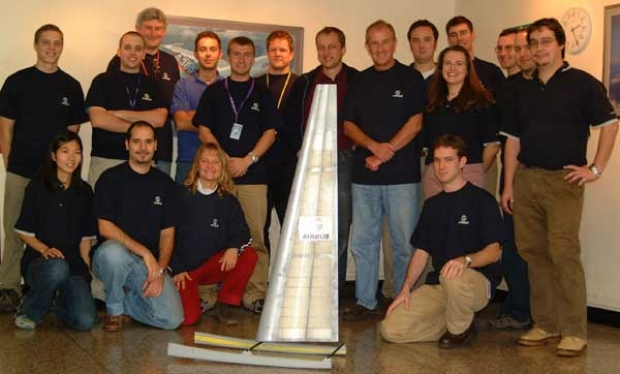
British challenger
Thursday December 18th 2003, Author: James Boyd, Location: United Kingdom
The British are back in the Little America's Cup with a challenge that looks set to be their best effort since Reg White and John Osborne aboard
Lady Helmsman made the Americans on
Yankee Flyer eat transom back in 1968.
True, there was a British challenge in 1987 by The Hinge, but this was poorly prepared and ended up being no match for the industrious Australians in The Edge who roundly dispatched them 4-0.
Helmsman of The Hinge was former Tornado sailor and Concorde pilot John Downey. "Basically we ran out of time but the Australians were very keen for us to come," says Downey of their short-lived challenge. "So we took the boat to Australia and finished it off there. We were very very short on development time and so we had a lot of things fall off. The boat worked but it was very heavy because we couldn’t risk building a minimal structure as we didn’t have the money to rebuild anything if it broke."
Working on the perifery of The Hinge campaign was Norman Wijker, at the time recently graduated from Cranfield with a Masters degree in aircraft design. Wijker became captivated by the futuristic C-Class catamarans which with their futuristic solid wing rigs are by far the most efficient sailing machines afloat. After the British defeat Wijker attempted to keep the campaign rolling but without success...until now.
Two years ago Wijker decided to revitalise the campaign and among his first phone calls was John Downey who joined Team Invictus Challenge in the role of consultant and test monkey.
Team Invictus has strong links with the UK arm of European aircraft manufacturer Airbus based in Filton near Bristol. Wijker is currently contracted to Airbus on their new A380. Also integral to the campaign is aeronautical engineer Mark Bishop who works on fatigue and damage tolerance for Airbus.
"What Airbus have done, which is quite clever, is that they have a continuous flow of graduate engineers coming into the industry from all the Airbus countries - it is not just Airbus UK - and these people are usually sent on a tour around all the process within the manufacturing of aircraft to find out what they want to gravitate to," explains Downey. "Around 30 people have shown their interest in the sailing project and they have been seconded to it. It is a way of giving people who are very sharp at engineering but who have limited practical experience the chance to get their hands on making something without it being a major industrial process. It is a small enough project to see the whole thing happening in front of you."
John Downey and Phil Brown (in the background) get practical
"One of the things about C-class which has become evident over the years is that the people who sail them successfully are obviously competent sailors but they are people who have been intimately involved with the design and build process as well, so that they understand what it is they are sailing. If you are having problems with a sticking luff downhaul or something like that, then most sailors who sail normal catamarans would understand what is going on with that particular problem, but with a C-class having a unique wing structure, you have got to understand how it functions to sail it successfully. So it will be a case of if we can get people involved early enough then they will get to be sailing it."
It is likely that the first test pilots of the new boat will be Downey and 49er sailor Paul Craig who works on the wind tunnel at Airbus.
Among the other 'names' involved with the project are Martyn Smith former Chief Engineer for British Aerospace who has also designed a number of racing multihulls including Tony Bullimore's 60ft trimaran Spirit of Apricot, the Firebird 26 and the rigs on Team Philips. Recent recruits have been multihull speed freaks Paul Larsen and Helena Darvelid and there is a certain union taking place between their SailRocket campaign and Team Invictus. It is likely that Larsen and Darvelid will be involved on the sailing side too.
Last but not least Clive Everest, better known as the designer of the RS range of high performance dinghies, has drawn the hull lines for Team Invictus.

Rig
The reason why C-Class catamarans are such awesome beasts is due to the efficiency of their solid wing rigs. While a softsail monohull raceboat would be pushed to develop a lift co-efficient of 1:1 a fully developed solid wing rig can develop upwards of 3:1. A 25ft C-Class catamaran fitted with such a rig can sail at 15 knots in 8 knots of breeze or over 20 knots in 10 knots...
The basic principle of a solid wing rig is similar to that of an aircraft wing:
a) When a modern aircraft wing needs to develop lift, high lift devices such as flaps extend in front and at the rear of the wing creating slots. These slots allow air to pass through from the underside of the wing to the top and encourages the air passing over the top to maintain its flow over the wing - the same principle as the slot between the mainsail and headsail on a conventional boat.
b) When the aircraft is 'at cruising altitude' then these flaps are retraced to reduce the amount of lift and particularly drag.
These two scenarios are respectively the equivalent of sailing downwind and upwind in a C-Class catamaran.
The wing rig on a C-Class cat attempts to mimic this, except with the added engineering horror show that it must work on both tacks (the equivalent of a plane having to fly upside down as efficiently as it does the right way up). In the not-so-distant past one American challenger, the Wingmill, had a one tack style rig where the rig inverted in its entirety on to the opposite tack.
While Lindsay Cunningham's Yellow Pages team and the present Little America's Cup champions, Steve Clark's Cogito solution is having multiple slot solid wing rigs like most modern commercial aircraft, Team Invictus are using what is known as a split flap rig in an attempt to achieve the same thing: a low drag, high lift aerofoil that works equally well on both tacks. (To read Steve Clark's views on C-Class rigs - click here.)

Above: aircraft examples from which the C-Class has borrowed. The Split Flap at the top is used by Team Invictus while the slotted flap arrangement has been used by Cogito and Yellow Pages.
The reasoning behind Invictus' choice is partly born of their analysis of the Little America's Cup course, which like Olympic courses of old is a combination of windward-leewards and triangles. Considering the efficiency of C-Class cats and that they are apparent wind generators par excellence, the apparent wind angle even when sailing deep is rarely going to be more than a close reach. Thus, they reason, it is better to have a boat that is rocketship upwind.
"When we analysed the course we discovered doing VPP-type analysis, that majority of the course is either upwind or a close reach in C-Class terms which means we are not operating at maximum CL [co-efficient of lift] for a large percentage of the course," explains Downey. "So we decided it was worth going for a split flap, where you don’t get the same lift co-efficient because you don’t have a slot, but you have a very clean efficient aerofoil, with the ability to generate higher CLs where necessary."
Multiple slots a la Cogito are excellent for sailing fast downwind. They generate collosal lift and the slots allow the wind to be bent through as much as 90 degrees while keeping flow attached - a feat completely unfeasible with a soft sail rig. The more slots you have the higher the lift generated, but the major drawback is that the drag also increases, which is where the Invictus team believe they will win out.
"So our thinking with rig of The Hinge was an asymmetric section with two flaps on the trailing edge," continues Downey. "It was very clean upwind because this flap would be closed and then downwind you would have a flap deployed at various angles depending on the point of sail. Aircraft have used it, it is just that over the years slotted flaps have become a more acceptable way of doing things."
Aside from the increased drag Downey says there are other disadvantages of the multiple-slot approach. "The only way to make it behave like an asymmetric section is by flying the wing at a higher angle of attack, which means it is not quite so good as an aircraft wing."
The Invictus rig comprises three elements, starting from the front:
- a D-section leading edge. This is built in carbon fibre with aircraft grade spruce structural member inside it.
- Attached to the back of the D-section by hinges are a stack of what Downey describes 'floating ribs', which ressembles a ladder running up the height of the rig. Covered in a layer of transparent mylar these ribs articulate like a parallogram.
- Attached to the back of the ribs, again by hinges are the flaps. There are two pairs of flaps down each side of the back of the floating ribs. They are unable to use one pair down each side because there is a kink in the trailing edge of the middle element.
"If you look at the section, the working side of the aerofoil is a perfect aerofoil with a couple of dimples on the windward side," explains Downey. "So you end up with pretty much a perfect aerofoil with slight hollows. The ability this gives us is that going upwind, we don't have to any flap deployed at all to give us effective camber. We can sail with the section as it is. So upwind it is very clean and we are expecting it to be an absolute rocket ship. With a relatively small amount of flap deployed on a close reach we think we'll have plenty of performance on a close reach as well."
The hinges themselves will not be hinges in the conventional sense. It is likely that they will be thin plastic that is ultrasonically scored to weaken it where it is required to bend although Downey says they may add some small chicken hinges as a safety measure. The team have built working models of the hinges to test.
From an engineering standpoint being able to operate the trailing edge flaps has been an interesting exercise as they have to hang off the central element which moves. "Typically where you want smaller throws, you end up with lower loads and therefore you end up with the best mechanical advantage where you least need it and the other way round," says Downey.
Next comes the issue of twist. In order to reduce heeling while maintaining power, the wing is designed to twist from the base to the tip. Shearing the main spar induces the D-section leading edge to twist and lengths of Vectran string criss-crossing between the floating ribs in the centre element assist. At one point as many as 28 of these strings were running into the rig to induce twist, each requiring its own gearing because different amounts of twist are required throughout the height of the rig. Invictus have built a model of this set-up to prove their theory.
On Cogito they have the added ability to apply reverse twist to the leading edge of their rig, but the Invictus rig will not be able to do this and Downey doesn't feel it is necessary for their rig. "For us it is different - the twist works by differential movement of all these bracing wires and it is like a stack. As you pull one and release the other it allows the whole thing to twist off, it physically twists it, so as you slacken the bracing it allows the whole thing to move with the airflow more like a sail. If you get a puff, as long as you are releasing the twist control, the aerodynamic loads will help you operate the twist control. It is twisting the way the structure wants to move as well.
"Like all these things you have got to build the thing to make it all work, but one of the advantages of having this structure is that it is very accessible."
The aerofoil section they are attempting to emulate is based on a standard NACA section which comes with its full book of pre-researched characteristics. "Its behaviour at various angles of attack is already plotted out and we don’t have to worry about it. So you can derive lift figures from the NACA section - what lift at that angle of attack, the rig won’t stall at that alpha, so you can sail downwind at that angle."
The Invictus principle is simplicity and light weight. Downey says they are expecting the Invictus rig to weigh in at 54.5kg, around 22.7kg lighter than Cogito's already light rig - pretty impressive for a 40ft tall structure. While the boat isn't expected to be as fast as the slotted rig boats downwind, it is also expected that they won't be as fast in light conditions. Upwind in anything over 10 knots and they should be a rocketship.
Rig controls
The primary control for the Invictus rig will be what Downey describes as a traveller, that changes the angle of attack of the whole rig to the boat. "You don’t have a main sheet, because you don’t have to pull shape into the sail. The shape is there intrinsically, so you’re not trying to distort a piece of sail cloth." The traveller control will attach to a boom at the bottom of the rig.
The flaps will also be manoeuvred via this boom set up in such a way that it will automatically replicate the flap settings after a tack or gybe. Then there is the twist control. This won't automatically reset itself after a tack, because it is too complicated to try and achieve this, so the crew would have these controls duplicated on each side of the boat. The leeward flaps will always have a fixed setting, while the crew will be able to adjust the two weather flaps. The two weather flaps can be adjusted independently of one another.
"Upwind, the helmsman would try and keep the boat at the optimum angle by use of rudder and twist and then it would only be if you became overpowered that you would dump the mainsheet slightly," says Downey.
"The other advantage is that all the controls on a C Class are very very quick, because you are not trying to pull against huge loads. All you are doing is manoeuvring the rig in the air stream as opposed to grinding a shape into a piece of cloth that doesn’t want to be in that shape. So you haven’t got the huge mainsheet loads that you get on a Tornado where you are pulling as hard as you can on a 10:1 purchase to make the leech stand properly. You don’t have that. Typically the controls are all 4:1 so you don't have big sheet movement and it can be much more precise.
"Once you get the whole thing set up and tuned, you can sail upwind almost like playing the luff downhaul on a Tornado, where you are just trying to twist the top off in a puff and feather up into it, take advantage of it and keep driving rather than getting up on your ear and dumping a lot of main sheet. So you can keep in the groove a lot more easily."

Hulls
The hulls of C-Class catamarans might seem to be distinctly secondary to the rig in terms of the overall performance of a C-Class catamaran. However with the Team Invictus hulls Clive Everest has attempted to make up for some of the rig's probable deficit of downhill pace. To achieve this he has designed planning hulls.
"We think we are going to be strong upwind with the rig, so we can afford to have a boat that is slightly draggy hull shape upwind, but we need to try and find something off the wind," explains Downey, who adds that it is possible that given the hull form and the power of the rig they could find themselves planning upwind as well as down.
The bottoms of the hulls will also be slightly toed out and their shape is optimised for when the boat is just flying the weather hull. They will have a slight rise in shear but will not have the built-up bows of some of the Australian cats. "They discovered with Cogito that if you sail it right you don’t need a huge bow because it generates quite a lot of windage and you get a huge vortex off the bow," says Downey.
Obviously the hulls are being built in carbon fibre, but unusually they will be monolithic (ie there will be no foam or Nomex sandwich material). "The composite hotshots at Airbus have worked out that the gains in having a sandwich structure for something this size are minimal," says Downey. "You are not looking at something that is ocean going, that can absorb impact damage and so on, so you can have a more optimum structure."
The downside of this is that the boat may be susceptible to impact damage, but the advantage is that the laminate can be laid-up perfectly and there will be no issues of core sheer. They will not be using pre-preg, but a resin infusion system to ensure optimum wet-out of the carbon fibre cloth.
At present the moulds are being built for the various components. The D-section front element and structural spar for the rig are finished and the hull moulds are being started. They have the beams and the tiller mechanisms and will be making the moulds for the foils over Christmas.
Once all the moulds are made the lamination process will just be a matter of hours. Resin and carbon fibre are being supplied by Matrix Mouldings.
Due to space constraints at Airbus, the hulls are being built by Dan Emuss at Independent Composites under aerospace supervision while the cross beams are being made in Australia. Components for the rig are being built in-house.
All up weight for the Invictus catamaran is expected to be 160kg. In comparison Cogito is around 180kg and the Hinge was around 270kg, although Downey reckons sheshould have been closer to 200.
While funding of the project has been an issue in the past recently Airbus have said that they underwrite enough of the cost to see the campaign through to its conclusion. This may involve enough budget to build two boats enabling the team to carry out some proper two boat testing and a much faster optimisation program. The team are looking for additional backers too.
Launch of the first boat is expected to be in March once the rig is assembled and its exact operating system finalised. Test sails are likely to take place at Datchet Water which is where Downey sails and where, conveniently, there is enough space to store a container, which Downey explains is vital because of the fragility of the rig.
Then on they will embark on a major test program. "The basic premise is to treat it like test flying an aeroplane where we have to expand its envelope until we know what it can do at various angles to the wind and then come up with various benchmarks of how we sail it and how we operate it. The problem is that you have to be fairly careful with how you expand the envelope because you don't want to capsize it. You have to accept that financially you have got to have enough money in the kitty to rebuild the rig perhaps a couple of times. If you did capsize you’d break the flaps off, but the actual main section is probably strong enough to cope with it. But you have to have a rubber boat out with you at all times, you luff up away from the shore and have a line to rubber boat and get taken back to the beach."
As to why it has taken seven years for a challenger for Cogito to emerge Downey thinks: "Steve [Clark] produced something which was so awesome in terms of its quality that people thought ‘how are we going to beat that?' It is also a lot of money for what is quite a small boat, so I presume people were quite unnerved and they thought ‘how are we going to get the where-with-all to do something like that?'"
Steve Clark has said that the whole Cogito campaign set him back $500,000 although this is all up and includes assets such as RIBs. Downey says the Invictus project is likely to cost a fraction of this thanks to support of Airbus and considerable amounts of talented, but ultimately free labour.
"The other thing is that there are only a few people who are totally fascinated by these rather esoteric boats. A lot of people are fascinated by them, but there are only a few prepared to go and get their fingernails full of epoxy."
Considering the last major C-Class campaign from the UK occurred 35 years ago and the Little America's Cup, on the sporadic occasions it has run, has taken place in Australia, it is understandable why interested in it from Europe has all but vanished.
Downey, like ourselves at thedailysail, feel it is high time that the C-Class and the Little America's Cup (as opposed to the International Catamaran Challenge Trophy that is currently raced in Formula 18HTs) should have a new lease of life. The boats are exciting and undeniably the technological leading edge in our sport, more so than the big America's Cup (or the 'slow' America's Cup as Randy Smyth once referred to it) or even the ORMA 60ft trimaran fleet.
One wonders what could be done to popularise it - maybe production C-Class hulls, allowing teams to conjure up their own rigs?
What is certain is that Downey is looking forward to getting the new beast out on Datchet Water next spring and showing a few Tornado Sports the way around the course. We are too.
Most Read
Most Commented
Comments
Businesses

Pro businesses
Editor's choice
Member blogs
-
 Ned Collier Wakefield: MOD70 round BarbadosWell that was intense. 12 hard fought for seconds for the win. In idyllic conditions, Tony Lawsons MOD ...
 -
 Mini Transat leg 2 reportThe second leg of the Mini Transat started on 31st October, just over a month after ...
 -
Leg 1 reportI’ve been working towards the Mini Transat now for three years. In 2013 I was part ...
Business blogs
-
 The Island Sailing Club in Cowes, Isle of Wight, is delighted that Prince Michael of Kent ...
 -
Peta Stuart-Hunt chats with the 25 year-old British solo sailor Lizzy Foreman before she sets sail ...
-
The 2015 Student Yachting World Cup (SYWoC), an ISAF-recognised event hosted and run by students for ...
Editor's Choice
All time favourites...
-
 Three legs down into Ian Walker’s
 -
 Winning all but two races at
 -
 For the first time in its
Latest Comments
Add a comment - Members log in