
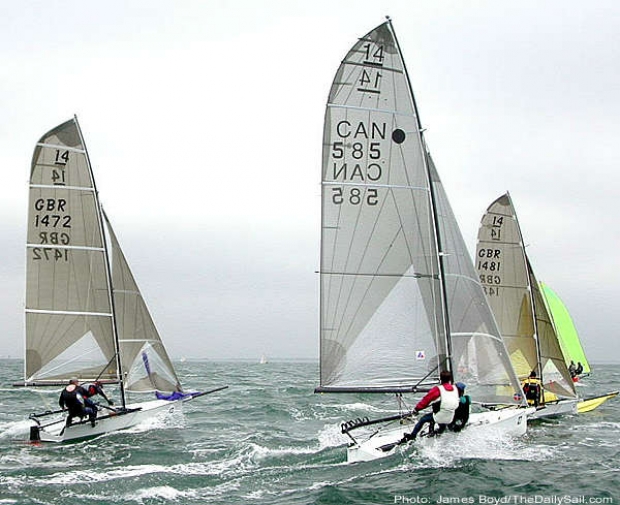
14 technology - part 3
Friday June 20th 2003, Author: James Boyd, Location: United Kingdom
Click here to read
part 1
and
part 2
of this series
The power house
While there is a lot of hype in the International 14 class presently over T-foils, Beiker builder Chris Turner thinks that the greatest gains performance-wise are likely to be had in the rigs.
Up until recently most of the top rig and sail packages were coming out of Australia - however increasingly UK manufacturers are getting a foothold.
In terms of masts, all are carbon-fibre tubes and the art is in creating a laminate for the mast so that its bend characteristics work to the optimum with the mainsail. The most widely used mast is the Bieker, where the tube is manufactured in the States and in the case of UK boats spreaders and rigging are added by Chris Turner. This system even features on some of the Morrison boats and they can boast the top three in the Worlds last year and three out of the top four at the Europeans last week.
For their Morrisons RMW Marine specify tubes made by Clive Watts at CST in Australia, which they fit out. "Basicially the mast is stiffer overall and much more controllable," says Richard Woof of the spars they are fitting to their latest Morrison 11s. "We’re still able to depower it through wind range but we are able to fly a fuller heavier roached sail which we’ve designed to go to the Japan Worlds where we are predominantly going to get light to moderate conditions. The other advantage of this mast is that it is much lower profile (smaller diameter) than the Bieker spar, so from a windage point of view we win and there is no weight penalty. Clive Watts at CST has managed that by using intermediate modulus carbon fibre."
The exception at the Europeans was Zeb Elliott's new Beiker 4 which had a new Proctor/Selden mast section that is elliptical rather than round, resulting in a lighter weight spar. "We tried to stiffen up the lower panels and we've done a little bit of work between the lower and upper spreaders," Zeb told us. At present this is in development and they have been working to perfect the laminate of the mast. Carbon spreaders are the next step, he says.
At the Europeans Chris Turner was trying out a new rig configuration. "The CST mast originally had D2 midwires in it. To eliminate those Bieker came up with these little stumps sticking out the front of the spreaders to act as a support for the middle of the mast. But then the CST I used this year, is almost identical. It’s identically rigged to the Bieker mast, but I’ve got no D2s or stumpy little spreaders. So that's one less rigging expense."
Above: spreaders with the Bieker earlets
While there are at present two main players in the mast game, the same cannot be said of the sails. RMW Marine opened their sailmaking premise RMW Sails last year. Morrison 11s came first and third at the recent POW using RMW sails and it is likely that this will make an impression. Ian Pinnell was sailing at the Europeans with his own suit of sails.
However Australian-made sails are still the most popular, particularly those by Dave Alexander, which Chris Turner recommends for the Biekers.
Aside from the different manufacturers there are also a lot of different shapes being used.
At the Europeans Chris Turner was trying a new mainsail with a giant roach (see below) from Dave Alexander. Turner says he has been monitoring 14 developments in Australia where mainsails with giant roaches are a current vogue. When we spoke to him the day before the Prince of Wales Cup, he was still attempting to master the beast. "You would think this would be quick in light airs, but these mains are good in 6-8 knots+. That's what they've found in Australia. But I have no idea why..."

The future
In the 14 class the constitution states that items that are proposed and given the thumbs down cannot be raised again for two years. This has bred welcome stability within the class and although it is a development class with all manner of new widgets, foils and foil canting mechanisms, sails and sail handling systems and masts being tried out the overall effect is that the boats are remarkably even in their performance.
"I don’t think the Europeans showed anything dominant by anybody," says Chris Turner. "Rob [Greenhalgh] and Dan [Johnson - the POW winners] are the ultimate professional sailors and they are just awesome on the boat. Andy Partington is a long seasoned 14 campaigned. Mark Upton-Brown is a very good sailor and then there's Geoff Carveth and Ian Pinnell. So I can’t believe there is a huge difference between the boats at the moment."
He points to his big roached mainsail. "Who is to say what is right and wrong? We were quite quick in the breezy stuff, but then Pete and I have always been good in the breeze stuff. Was that the rig set-up or being just a bit overweight?!"
Ultimately will the International 14 become a Flying 14? This is unlikely to happen in the short term because of class fears over another arms race. However the 14s are a development class and if this is a development that proves to be faster round the race track then at some point in the future the class must embrace it.
Chris Turner states the case against: "I think it would be ridiculous for us flayling around on fully flying boats that are already pretty ludicrous. It would become horses for courses, because you’d have a super fineboat that popped straight up on to the wings, then what do you do when it is lighter? You’ll end up taking two hulls to a regatta.
"At the end of the day, there’s a good spirit and we've got a good bunch of guys in the class at the moment and people just need to develop what they’ve got now otherwise a lot of people will be priced out of it again. There’s been a really good influx, the likes of Geoff Carveth and Richard Lovering. Those guys coming in and doing well straight off is good for the class. Geoff had a standard one from me and Richard had a standard one from Woofie [RMW] and they have gone straight into the top 10.
"I’d like to see it pretty stable now for a couple of years so that we can build on what we’ve got."
Most Read
Most Commented
Comments
Businesses


Pro businesses
-
France
-
United Kingdom
-
-
Italy
Editor's choice
Member blogs
-
 Ned Collier Wakefield: MOD70 round BarbadosWell that was intense. 12 hard fought for seconds for the win. In idyllic conditions, Tony Lawsons MOD ...
 -
 Mini Transat leg 2 reportThe second leg of the Mini Transat started on 31st October, just over a month after ...
 -
Leg 1 reportI’ve been working towards the Mini Transat now for three years. In 2013 I was part ...
Business blogs
-
 The Island Sailing Club in Cowes, Isle of Wight, is delighted that Prince Michael of Kent ...
 -
Peta Stuart-Hunt chats with the 25 year-old British solo sailor Lizzy Foreman before she sets sail ...
-
The 2015 Student Yachting World Cup (SYWoC), an ISAF-recognised event hosted and run by students for ...
Editor's Choice
All time favourites...
-
 Three legs down into Ian Walker’s
 -
 Winning all but two races at
 -
 For the first time in its
Latest Comments
Add a comment - Members log in