
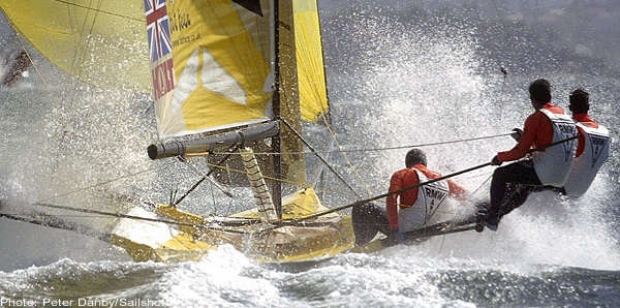
Getting their act together
Friday May 16th 2003, Author: James Boyd, Location: United Kingdom
18ft skiffs may have been around for around 110 years, but it is only now that the class is maturing in the UK, with what looks set to become one of the premier race circuits with a record number of boats expected at the EuroCup event to be held in Weymouth in June.
Like most development classes, the 18ft skiffs have been through cycles of extreme popularity to near dissolution yet it has survived because the boats are extreme and therefore desirable. Because the class is so old it has had more opportunities to reinvent itself than most.
I am constantly stunned whenever I re-read the history of the class and how they were originally raced - a boat 18ft long and 8ft wide carrying as much sail as possible... For example Zanita, raced in Sydney Harbour during the 1930s, used to sail with 11-15 crew and could carry a highly unfeasible 3,500sqft of sail split between her main (on a 32ft boom) and ringtail, topsail, ballooner, water sail and spinnaker - all flown at the same time. A contempory of hers, Britannia, can still be seen in the Maritime Museum in Sydney.
The last major peak in the 18 footer class came in the 1980s when the boats were none the less extreme, sporting 40ft tall rigs and 29ft wide racks at the height of the arms race. Sydney-based boatbuilder Peter Ullrich, who was heavily involved with the class at this time remembers that the last one of this generation they built weighed just 102lb (50kg). Today a one design Ovi hull is 63kg with an all-up dry weight of 170kg. "They used to last about two days before you had to repair them," Ullrich recalls.
At the time it was worth it - the teams were all heavily sponsored, and the companies backing them got good return because events were televised. But inevitably costs were spiralling upwards and this cycle came to an abrupt halt when Australian TV cameras became distracted by the 1987 America's Cup at the same time as Australian corporate dollars were being called upon to pay for the event in Perth to be staged and defended.
Ever since then the class has been going through a recovery period.
To contain costs an Iain Murray one design hull was adopted by the Australians in 1997 and soon after by the UK Class Association.
While the Australian fleet still like to consider themselves the class' fearless tough-nuts it is telling that the JJ Giltinan Trophy, the highlight of the international 18ft skiff calendar, has been slowly prised out of their hands first by Tim Robinson aboard Rockport in 1999 (ending a 28 year winning streak for the Aussies), and then over the past two years by American Howie Hamblin, who pipped the British RMW Marine team led by Rob Greenhalgh at the post at the last event in January.
While Hamblin is one of the few sailors from the US campaigning a skiff internationally, the class has seen some success in Europe where over the last few years the Skiff Pro Tour, has seen teams fielded from Switzerland, Italy, Germany, Austria, Denmark, Holland and the UK. Last year they competed at events in Palermo, Travemunde, Garda and Lagos in southern Portugal. This year the 'Pro Tour' has been replaced by the Euro Cup with events in Carnac, Weymouth, Switzerland and Italy.
But it is in the UK that the 18ft skiff class is really revving up. Around 20 boats are expected to be taking part at the UK Nationals in Plymouth on 18-20 July and this year for the first time since 1997 the UK can look forward to staging an international event, the Euro Cup in Weymouth on 12-15 June. This event is likely to be attended by an as yet undetermined number of the European fleet as well as Howie Hamblin from the US and somewhere between four and seven boats from down under including Tony Hannan and his Total Recall and John Winning's Yandoo team.
For the last three seasons the UK skiff circuit has be completely dominated by RMW Marine and their three man team led by Rob Greenhalgh. This domination has upped the anti in the UK fleet, although it has left the remainder of the fleet resigned to fighting for second place.
So why are RMW Marine so good? The boat was built by Dave Ovington, but was lovingly put together by RMW Marine. It is driven by the talented Greenhalgh brothers. "We’ve spent a lot of time in the RIB with the video camera, trying to short circuit 20 years of Australian development, which I have to say we have been bloody successful at," comments RMW Marine boss Richard Woof.
This may change this season. RMW Marine will be taking part only in the top events such as the EuroCup events in Carnac and Weymouth, while they and Rob Greenhalgh concentrate on their International 14 campaign with their new Mk11 Morrison design which they are taking to the Worlds in Japan.
RMW taking a rest from the 18ft skiff circuit is leaving room for some others to show their form and it was telling that at the only race of the domestic circuit to have been held so far this year (at which RMW were absent) there were three different winners in six races.
Highly rated for this season are Emma Richards' brothers Andy and Dave who sail Radii. They only made it to the last day of racing at the first event and cleaned up. This weekend they will racing in their home waters up in Largs and there are great expectations for them. "Andy and Dave Richards are showing the work they have put in over the last two season now," agrees RMW Marine boss Richard Woof. "If they’d played on Saturday they would have walked away with the event."
While the numbers of boats is slowly creeping up - there are around 25 18ft skiffs in the UK - it is the standard of the racing which is improving. Aside from RMW Marine there are now four or five competitive boats as Woof. This has come about in no small part due to the efforts of RMW Marine who have not only set the benchmark with Greenhalgh's team but have been sharing their knowledge at training camps for the class the most recent held on 12-13 April in Weymouth.

RMW Marine's Richard Woof
"What we have proved is that the UK fleet can sail these boats properly, rather than if you step back 4-5 years, when there was way too much swimming going on - it was a joke honestly," says Woof. "It was a case of cart before the horse. I felt very strongly about that. I said we’ve got to stop this and get sailing these boats and do it well to be able to prove our point, so that if someone feels that our image might help them along the road as far as marketing is concerned, we have something genuine to show them."
The training sessions are a 50/50 blend of in the class room and out on the water.
"The first thing is you’ve got to make sure your boat is going to stay together," says Woof. "You’ve got to check certain points on the rigging, things which people aren’t used to looking at. T terminals, for instance, they crack on the 18s and you've got to be able to spot them before they let go.
"How to set up the mast in approximate terms so it is at least structurally stable. Which fittings give trouble, make sure they’ve got the right fitting to do the jobs and where they get breakages so they can check. With the 18 the watchword is if you think it’s not going to do the job, don’t even trust it, get rid of it there and then because, sure as hell, it will let you down in the worst possible circumstances. And one little bang leads to a bigger bang and it will take you off the water for a few weeks while you mend the mess. And that’s self defeating because you don’t get the time on the water.
"And the other thing to run alongside the boat work is to understand some of the fundamental boat handling. There are two really dodgey bits of boat handling on the 18s which you have to get right: launching and tacking. You come more unstuck launching… Tacking – it’s down to speed and co-ordination. And occasionally gybes in big breeze, but no more than any other boat."
The class upping their game is having the effect of slowly attracting more sailors. One addition this season will be a team led by 49er sailors Alex Tobutt and Henry Clarke, who have purchased a second-hand boat. Serious enquiries for boats are coming from other top 49er sailors as their prospects for Athens diminish, says Woof.
While new boats are available from Ovingtons, getting a boat is particularly difficult on the secondhand market. "There’s the odd one or two about, but most have been sucked up which is indicative of how people are viewing the 18s," says Woof.
The class is also getting its act together internationally.
In Europe the introduction of a one design led to a split between Europe and the rest of the world "They made a very rash decision three years ago that they wanted to stick to what they felt were more to the rules of the 18s - 18ft long and any old shape will do," explains former UK 18ft Association chairman Rob Dulson and whose Base 1 was recent winner at the first UK Grand Prix this year. "There were influences among the fleet that wanted to build boats themselves whereas the UK and the Aussie fleets are strictly one design based around the International League design."
Thankfully the one-offs have been built and to date have not been as fast as the one-designs, even two new Julian Bethwaite designs.
"The thing about the Murray design which makes it such a good boat is that it has a very forgiving hull shape and so it flatters sailors," says Dulson. "So a good sailor could do very well in a good Murray, but put that good sailor in a brand new B18 and he would probably fall over in it and couldn’t get it around the race track. A top 18ft skiff sailor – you could count the people in the world who could do it on two hands probably - could make that B18 go around the course and win by as much as 10% faster." Thankfully this scenario hasn't happened yet.
The UK Class Association is hoping they can sign a 'Treaty of Weymouth' where the European class association agree to grandfather their boats by keeping their hulls but complying with the International League Rule when it comes to their rigs.
At present the Class are hoping to secure themselves an overall sponsor, although this is a double edged sword. While event sponsorship would raise the profile of the class, and possibly make it easier to attract more boat sponsorships, there is a slight reluctance to go down this route for fear of repeating what happened to the Ultras, when the class dissolved the moment the first year they were unable to secure a class sponsor.
"No one wants to sail an Ultra for the sake of it, but you can't get people out of the 18s, it is such a great boat, so that is difference," says Woof. "I want to make sure our fall back situation is still a good situation and if we get sponsorship in, then that’s great and a few more people can join the fleet."
"The class has really started to come of age," sums up Woof. "There are not just one or two boats at the front of the fleet. There is a depth of people who are really getting to grips with how to sail this boat. That is most important. And because of that it is attracting the right calibre of people, who want to sail it because it is an 18 and a big challenge."
Most Read
Most Commented
Comments
Businesses


Pro businesses
-
-
-
United Kingdom
-
Italy
Editor's choice
Member blogs
-
 Ned Collier Wakefield: MOD70 round BarbadosWell that was intense. 12 hard fought for seconds for the win. In idyllic conditions, Tony Lawsons MOD ...
 -
 Mini Transat leg 2 reportThe second leg of the Mini Transat started on 31st October, just over a month after ...
 -
Leg 1 reportI’ve been working towards the Mini Transat now for three years. In 2013 I was part ...
Business blogs
-
 The Island Sailing Club in Cowes, Isle of Wight, is delighted that Prince Michael of Kent ...
 -
Peta Stuart-Hunt chats with the 25 year-old British solo sailor Lizzy Foreman before she sets sail ...
-
The 2015 Student Yachting World Cup (SYWoC), an ISAF-recognised event hosted and run by students for ...
Editor's Choice
All time favourites...
-
 Three legs down into Ian Walker’s
 -
 Winning all but two races at
 -
 For the first time in its
Latest Comments
Add a comment - Members log in