
14 technology
Wednesday June 18th 2003, Author: James Boyd, Location: United Kingdom
For the committees who run development classes there is the constant juggling act between allowing whole scale innovation and disallowing it. A development class by its very nature should encourage its membership to go forth and innovate, however it is perhaps fortunate that our modern day lifestyles don't allow much time for this: A true development class is a horrible thing to administer, promotes arms races, envy, jealousy and other deadly sins within its membership and a speed discrepancy between boats that makes for poor racing.
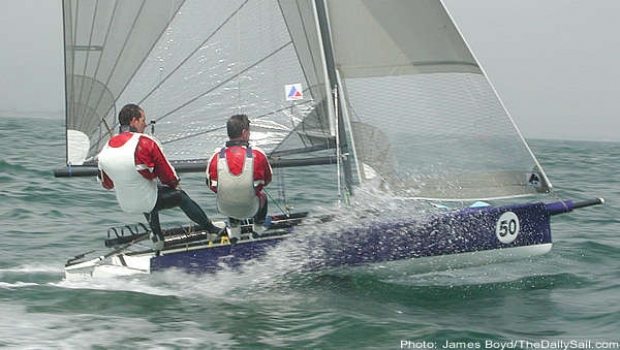
It is fortunate therefore that following it 75 years of existence, the movers and shakers within International 14 circles have become grand masters at the development class juggle as they have proved with the recent crisis over the use of T-foils.
To recap the foil crisis was two pronged. In Perth aeronautical engineer David Lugg developed a 14 with a fixed T-foil on its daggerboard and a T-foil with a hinged trailing edge flap on the rudder. Rumour has it that early attempts to sail the thing left the crew hospitalised thanks to there being too much pitch on the flap causing the 14 to either launch itself or to drill itself straight into the water. They did get it sorted and there are some mightily impressive photos (as well as a Loch Ness monster-style video - grainy and shot from the beach a mile away - click here to see it) of Bullet airborne.
Sail powered flying boats are nothing new. In the early 1990s foils had successfully lifted an International Moth above the water. There was the famous flying Tornado Icarus some two decades before that, a variety of boats that regularly attend Speed Week and one only has to trawl back through the journals of the Amateur Yacht Research Society to find crazy haired individuals who have been developing foil-borne boats on obscure lakes since the 1950s.
Meanwhile American 14 designer and hydrodynamicist Paul Bieker (who was employed by Bruce Farr as part of Oracle's design team) developed a rudder foil. Interestingly this was not primarily to make his 14 designs airborne, but to artificially extend their waterline length. Bieker's idea was to improve upwind performance by using the foil to generate lift from the boat's stern wave. As a result his T-foil was fitted half way up the rudder.
Bieker's T-foil made its debut at the Worlds in Beer in 2000 when it was fitted to both the designer's own boat and that of Kris Bundy. Bundy won the event and Bieker was further up the fleet than expected, yet the class consensus was that their results were not attributable to the foils, hence no gold rush.
It wasn't until Zach Berkowitz convincingly won the Worlds in Bermuda more than a year later using a set of T foils (see our interview with Zach at the time) that finally the potential benefits of using them were driven home. Suddenly the monster stirred and everyone had to have them.
Seeing an arms race in the making and demands coming in from different corners of the globe ranging from an outright ban to making them mandatory, the class association waded in with legislation. At present 14s can be fitted with a T-foils on the rudder or daggerboard - but not both - and the maximum area of the horizontal foil cannot exceed 0.14sqm. "The idea is to maintain the status quo without being too prescriptive," says Dave Spragg, the UK class' sailing secretary. "What we are quite conscious is of moving the goal posts."
The result has been a success. Almost all the modern boats at the Europeans last week had some form of T-foil arrangement and the class is still in remarkably good shape with boats that are faster than before, new examples in build and all this while at the same time maintaining racing good enough to attract new top notch dinghy sailing talent be it hotshot 49er sailors like Jarrod Simpson or dinghy racing stalwarts such as Geoff Carveth, Ian Pinnell and Richard Lovering. "The standard of racing is the highest I've seen since the early 1990s," leading 14 sailor Zeb Elliott confirmed to us at the Europeans.
The gear
Although the 14s are a development class. Most of the major development work is carried out by the designers or builders rather than in the sheds of the unemployed. Hence all the top boats these days are either designed by Phil Morrison or Paul Bieker, fitted with off-the-shelf spars and sails from Australian manufacturers but increasingly UK-based ones too.
In the UK Morrison designs are built by Richard Woof's company RMW Marine while in a new arrangement Bieker boats are moulded by Ovingtons and finished by Chris Turner at his premises in Lyme Regis.
New boats
The latest from these two camps are the Morrison 11 and the Bieker 4.
The Morrison 11 is a development of the 10. The 11 has the same hull as the 10, but Richard Woof (right) says that the geometry of the rig and daggerboard has changed dramatically. The daggerboard has moved aft to provide better balance.
The boats also have a foredeck improving aerodynamics under the jib and cleverly the new foredeck is removable to provide access 'under the bonnet' to the pole launching mechanism.
Also new this year is the Bieker 4. Compared to the 3 this has reduced hull rocker, increased width at the stern, a narrower bow, more flare in the upper bow and the rig and foils have been moved aft. Bieker says that these are all moderate changes, but they should improve the planing performance of the boat and the feel of the boat upwind. The changes also reflect the use of T-foils on the rudder and the crew standing at the back of the bus when sailing upwind.
"The Beikers have always been renowned for being a bit nose divey, which we have inherently made worse by fining them up and making them more Veed, but then they’ve all got hydrofoils now so they don’t nosedive," says Chris Turner.

Above: Andy Partington's Morrison 11
In terms of differences between the Morrison 11 and Bieker 4, the consensus is that there are minute. The Bieker is a tad wider at the transom relying on the foil to lift the stern. It is also a bit slimmer in the bow has a tad more rocker and is more Veed.
"There isn’t a huge amount between them because the rise of floor measurement," explains Turner. "So the mid-station is going to be pretty similar and the gap between the racks is pretty similar, so I would imagine the width throughout the hull is pretty similar. There is only so much you can do over 14ft..."
Richard Woof says that they are trying to make the Morrison boats simpler to sail. "Our boat has less and less equipment in it and it relies on the sheer design of the boat to cope with the change in the conditions without resorting to major figuring with the rig settings."
There are also differences in their T-foil arrangements and rigs - but more on this later....
Some notable exceptions to the norm are the modified Biekers which effectively have their topsides chopped off and replaced with near vertical topsides making for an exceptionally narrow boat.
"Zach’s one [Berkowitz] was done first," says Chris Turner. "That was designed by Paul [Bieker] as a fined-up boat, to show the class that the bump rule was stupid." The 14 rule includes mid-station measurement 2.134m aft of the bow. "Because you could get blooming great bumps on it you could make a really fine boat which turned out to be quite quick. I built one like that in 1999 which I was quite successful in and Paul Vine wanted a sistership to it so I made one exactly the same."
The Berkowitz Bieker is known as the B2Z and is narrower than Turner and Vine's version. Although clearly boats with race winning potential they are supposed to be harder to sail, although their handling has been much improved by the addition of rudder T-foils.

Paul Vine's narrow Bieker
As an indication of how much it can cost to get competitive in the 14 fleet, Dave Spragg points out that earlier this year there were two Bieker 2s on the market for less than £5,000, both of which could easily be made competitive by upgrading the foils, sails and spars.
The hot-off-the-press, heard-it-here-first news is that for the Worlds in Japan the Bieker and Morrison hull will have fresh competition. A new hull has been developed in Australia and is being taken seriously in the class as she is to be sailed by 2000/1 Aussie National Champion Jason Bebbe.
Tomorrow in part two of this three part series we look at the latest thinking in foil and rig development in the International 14 class
Most Read
Most Commented
Comments
Businesses


Pro businesses
Editor's choice
Member blogs
-
 Ned Collier Wakefield: MOD70 round BarbadosWell that was intense. 12 hard fought for seconds for the win. In idyllic conditions, Tony Lawsons MOD ...
 -
 Mini Transat leg 2 reportThe second leg of the Mini Transat started on 31st October, just over a month after ...
 -
Leg 1 reportI’ve been working towards the Mini Transat now for three years. In 2013 I was part ...
Business blogs
-
 The Island Sailing Club in Cowes, Isle of Wight, is delighted that Prince Michael of Kent ...
 -
Peta Stuart-Hunt chats with the 25 year-old British solo sailor Lizzy Foreman before she sets sail ...
-
The 2015 Student Yachting World Cup (SYWoC), an ISAF-recognised event hosted and run by students for ...
Editor's Choice
All time favourites...
-
 Three legs down into Ian Walker’s
 -
 Winning all but two races at
 -
 For the first time in its
Latest Comments
Add a comment - Members log in