
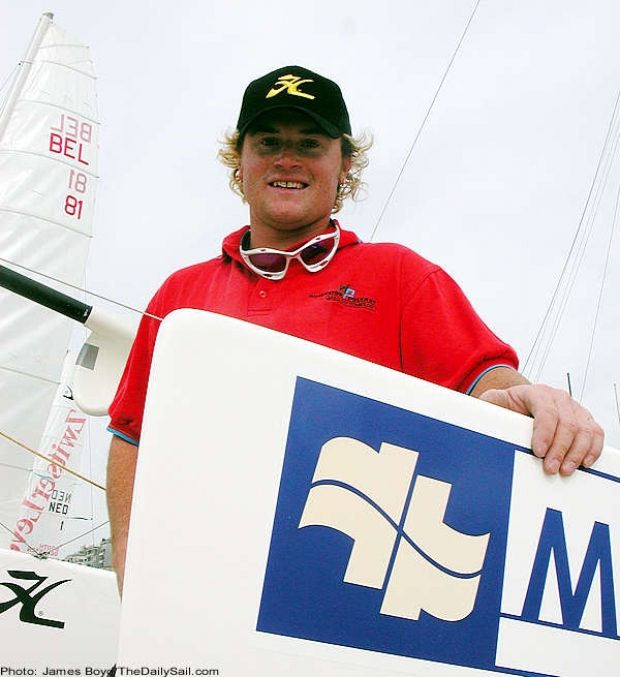
The A-Team
Wednesday August 20th 2003, Author: James Boyd, Location: Australasia
Australia is top of the pile when it comes to racing A-class catamarans at present as exemplified at last month's Europeans where Glenn Ashby added the European championship to his current World title.
Ashby heralds from Bendigo some 140km north of Melbourne in the heart of rural Victoria. In Bendigo they have Lake Eppalock where Ashby is a member at the club, but he has spent most of his formative years racing down on Port Philip Bay in Melbourne. In fact Bendigo is far from being Hicksville, Arizona and has a thriving cat scene and is home to Australian High Performance Catamarans, manufacturer of the Taipan 4.3, 4.9, 5.7 and F18 and the Auscat A-class catamaran.
"I started off in dinghies," Ashby recalls. "I went through them until I was 13 and then started changing over to catamarans. I sailed a Paper Tiger catamaran that is very popular in Australia and New Zealand. It’s 14ft and it has no trapeze - just a hiking boat - but it is a really good class and they have a really good youth training until you’re an adult. You can still be 16-17 years old and still be quite competitive."
When not in Bendigo or in Melbourne, Ashby spent most of his time travelling around and racing on the regatta circuit. "I sailed Laser Radials for a while and I flopped back and forth between classes. I started sailing Tornados in amongst all that, when I was about 16. Then I went back to the Paper Tiger, did a few other bits and pieces, some keelboat sailing and got into sailboardng, so I do a bit of everything."
This contrasts with the backgrounds of his fellow Australian cat technicians Darren Bundock and Mitch Booth. "Darren is much more from a catamaran background, whereas I grew up sailing dinghies and made the transition across. I think that is equally good. Darren has done very well, but for myself to be able to jump from a Laser to a Tornado and back again, from a mental side of things, tactically being able to know what other classes are like, I think it has helped me in my sailing. It just all goes into the knowledge bank. For me to be able to sail a Laser and then a 49er or singlehanded on the A-Class - all those bits and pieces put together make for a good foundation. It has certainly been a good thing for me."
These days Ashby is more specialised in catamarans and particularly the singlehanded A-Class. "I suppose I’ve spent more time sailing that in the last six years than sailing anything else. I’ve certainly put a lot of time and effort into that, because it is a singlehanded boat - being able to train when I want to to without crew hassles has been very good. And in Melbourne we have got a really good hardcore group of guys that are really competitive. There are around 15-20 boats and if you can beat those guys you are pretty much on the pace with the rest of the world. And you don't have the big set-up you have with the Tornado. That takes about 2-3 hours, but we’re 20 minutes off the trailer and then you’re racing. It is a good way to do a lot of sailing."
Impressively Ashby won his first A-Class Worlds in 1996 in Spain when he was just 19, the youngest person to do so by some five years. "It was a bit of surprise, but it was a really good one for me - it was quite windy and wavy and I’d only been sailing the A-Class for three months and I was still learning to sail the boat! It just worked out really well." Since then he has won five European championships in the A-Class.
The A-class is about the only one of the original IYRU catamaran classes to have survived - the B class becoming the Tornado, the C-class having been dropped from the Little America's Cup and only a handful of the larger D-class cats ever having been built. In a world where one designs proliferate even in openish classes like the F18 and F18-HT, the A-Class is a full development class, where only length (18ft), beam (7ft 6.5in - 2.3m) and sail area (150sqft - 13.94sqm) and minimum weight are restricted.
"You can have any hull shape but it's got to weigh 75 kilos which is the only catch," says the World and European Champ. "The weight limit was introduced 7-8 years ago to prevent people spending hundreds of thousands of dollars to get a new boat that is super light. Apart from that it has got to the stage where everyone is using pretty standard equipment, because there are only small developments all the time which increase speed.
"Different hull shapes surprisingly don’t seem to make a huge difference through the water. Everyone has been refining their sails and masts and hulls to a certain level now. There are between five and 10 manufacturers, but the boat speed is so similar it gets back down to who has the best sail on the day who gets in front." So even with this development class, moving technology on has happened at quite a slow pace. ( Click here to see the different models of A-class catamarans).
Participation in the A-class Ashby says goes up and down. "You get a lot of guys coming from Formula 18s and Tornados jumping on the boats especially in the off-Olympic years. So the competition is very good. You get up to 100 boats at the Worlds and Europeans and there’s a lot of past champions that are sailing. The A-Class is a sort of boat where you can be 16-17 years old or 50-60 years old and still be competitive. They are not such a super-physically demanding boat like a Laser where you have to be hiking all the time. They are a very nice boat to sail and being so light means you can move them around easily and put the mast up and down easily."
For the Europeans Ashby was sailing a German-built Flyer platform made by Peter Egner's company Flyer Competition in south Germany (this company also have F18 and F18-HT cats in development). Flyers have won the last four A-Class world championships and they are made from carbon/Kevlar with the beam permanently bonded to the hull, making the boat particularly stiff and Ashby was using the standard appendages. He uses all Ronstan running gear and fittings and a centre sheeting mainsheet with only a ratchet and no cleat which forces him to trim all the time.
He used a Fiberfoam mast made by Scott Anderson (an Australian living in Austria who came second at this year's Europeans). "This mast has been extremely versatile in all conditions and has been very easy to tune and to use. It works well in flat water and waves." Obviously in addition to this he uses his own Ashby Sail main. "The sail is very versatile which is so important. It is very important to have all areas and conditions covered. The sail and mast combination work very well together and combined with a great platform have been a crucial factor in success."
Aside from the A-class this year Ashby has been racing on the Tornado with Darren Bundock when Bundock's regular crewman John Forbes is back in the Australia. He says it is unusual not to be steering but the arrangement with Bundock works well. "John's got work and family commitments, so it works well for me to come over and step in for him. I can keep my finger on the pulse with rigs and what’s going on and John does the regattas that count to go to the Olympics. And Darren gets to do all the regattas, John gets to spent time with his family..."
Ashby says he'd like to do his own Olympic campaign but is open to suggestions. One glaringly obvious way forward is that Athens is likely to be Forbes' last Olympics while Bundock is planning to do at least one more Olympics in the Tornado.
He has also been crewing from Bundock on the F18 as part of the Hobie Cat works team, demolished the competition at the Eurocat at Carnac, winning four out of five races. This was the first time they'd set foot on a Hobie Tiger. They subsequently finished third at the F18 Worlds behind the Boulogne brothers and Gavin Colby/Cori Camenisch.
When not racing Ashby makes sails and has his own loft in Bendigo called Ashby Sails. "I generally make sails for catamarans but I’m pretty much open to anything. I just work out of a big shed with a couple of sewing machines and computer plotter and stuff. It is very low key but with the A-Class sails, I’m been really happy with the way that's been going. We’ve only been running about eight months now. Using my own product on the A-Class and doing reasonably well has certainly helped." Ashby also makes sails for Formula 18s and the Taipan cat classes in Australia in which he is also a regular competitor.
Just 25 at present, Ashby says he plans to stick in small catamarans, possibly concentrating more on the Tornado and the F18. Once past 30 he sees himself getting into bigger multihulls and larger programmes, although he'd like to remain in dinghies as well. "I’d still like to stay in touch with this side of sailing, because I think it is really good. Business-wise and sailing wise it fits in really well - and I like that."
In the shorter term Ashby's next major A-Class regattas are the Australian nationals in January followed by the Worlds in New Zealand in February. In the meantime it is back to the sewing machine to earn some much needed cash after his European 'holiday'...
Most Read
Most Commented
Comments
Businesses

Pro businesses
-
Italy
-
-
Italy
-
United Kingdom
Editor's choice
Member blogs
-
 Ned Collier Wakefield: MOD70 round BarbadosWell that was intense. 12 hard fought for seconds for the win. In idyllic conditions, Tony Lawsons MOD ...
 -
 Mini Transat leg 2 reportThe second leg of the Mini Transat started on 31st October, just over a month after ...
 -
Leg 1 reportI’ve been working towards the Mini Transat now for three years. In 2013 I was part ...
Business blogs
-
 The Island Sailing Club in Cowes, Isle of Wight, is delighted that Prince Michael of Kent ...
 -
Peta Stuart-Hunt chats with the 25 year-old British solo sailor Lizzy Foreman before she sets sail ...
-
The 2015 Student Yachting World Cup (SYWoC), an ISAF-recognised event hosted and run by students for ...
Editor's Choice
All time favourites...
-
 Three legs down into Ian Walker’s
 -
 Winning all but two races at
 -
 For the first time in its
Latest Comments
Add a comment - Members log in