
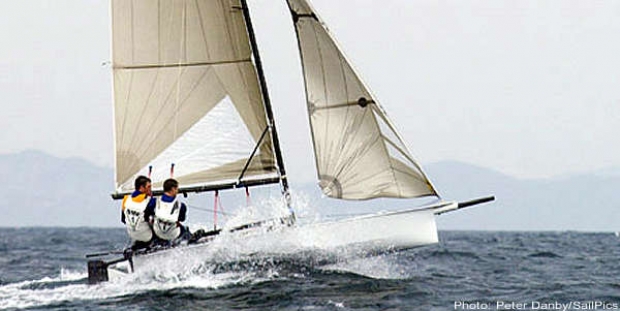
Winning machine
Wednesday September 3rd 2003, Author: James Boyd, Location: United Kingdom
Rob Greenhalgh has yet again been proving himself one of the UK's most talented skiff sailors. For the third successive season his RMW Marine team have dominated the 18 footers and this year with his faithful crewman Don Johnson they have transferred this success to the International 14s winning the prestigeous Prince of Wales Cup and at the weekend the world championship in Japan.
This was Greenhalgh's first world championship win in the 14s. "We should have been third in Bermuda, but we had gear damage and we didn't have T-foils. There were a few boats with T-foils then," he recalls.
In Japan Greenhalgh and Johnson were in a league of their own. "It started lightish and we were pretty quick in the light stuff and we didn't do anything wrong," describes Greenhalgh. "We had good starts and the first three races we led start to finish virtually." In fact he is being modest. The first two races they won by six minutes...
The next day there was more breeze - around 20 knots - and they snapped their daggerboard prior to the start. Fortunately RMW Marine's omni-present Richard Woof was on hand and zoomed them across another in his RIB which they fitted moments before the start. With the new board they still finished third.
In the lighter breeze in the subsequent race they won again and at the end of play on Friday, after five races they had won the Worlds with a race to spare.

The new International 14 World Champions, Rob Greenhalgh (left) and Dan Johnson.
So how come they did so well? In the 18s and to some extent the 14s Greenhalgh and Johnson are considered to be the 'professionals' among an otherwise mostly amateur fleet and benefitting greatly from the support of Richard Woof's RMW Marine. Theirs is very much the 'works' boat.
They got out to the regatta early and put in six days of training. In addition to this they had also tweaked their RMW Marine-built Morrison 11 with new sails including a giant square topped mainsail. Richard Woof says that the new RMW mainsail, which Andy Partington and Ian Teasdale also used, is some 8-9% larger than the sail they used to win POW, although they had the old main out in Japan too for when the wind was up.
They were also using a new asymmetric rudder T-foil (their previous one was symmetric) with better lift to drag characteristics. Aside from it being asymmetric Richard Woof says the new foil is similar to the very high aspect ratio foil they had at POW. Because the foil and rudder are one, with the whole rudder assembly tilting on the transom to alter the pitch of the T-foil, Woof says their T-foil is roughly half the thickness of the Bieker ones, where the pitch of the foil is altered relative to the rudder blade.
Beyond this they just sailed really well. As Greenhalgh puts it "everything came together really nicely. We were going very well. There was a tiny bit of boat speed and then you always go the right way after that. I don't think we did anything wrong for the whole regatta. We even won the practise race."
At the regatta some of the Australian boats had been trying out new ideas the most radical being Stewart Vickery's boat which had a fixed T-foil on the underside of the transom. "I don't know if that was allowed, but they didn't seem any good anyway," says Greenhalgh.
Another Australian, Anthony Anderson, has been trying a fixed T-foil right under the hull just aft of the daggerboard. While this has succeeded in getting his 14 airborne in just 6 knots of wind, but by all accounts it pitches wildly. Aside from the physical problems sailing the boat, Anderson didn't use this configuration for the Worlds as it is believed the class in Australia have been frowning upon this avenue of experimentation, despite the 14s being a development class and flying boats being trialled in other equivalent classes such as the Moths.
Zach Berkowitz, the man who revolutionised the class with the introduction of rudder T-foils, has been attempting some new developments such as a trim tab on the daggerboard, but had not had time to get them to work for the Worlds. He was using pretty much the same gear as he used in Bermuda.
So with the Worlds and the Prince of Wales Cup in the RMW trophy cabinet, is that it as far as Greenhalgh and RMW Marine's participation in the 14 class is concerned? Far from it. Currently RMW Marine have started the build of another new boat - the Morrison 12. This promises to be a very different animal altogether. "It is going to be narrower with a different deck layout and faster to what you see at the moment," says Greenhalgh. The hull will be more slab-sided like the modified Biekers and as a result Greenhalgh predicts it will be a bit harder to sail.
"It's really playing on what we found the T-foil will do," says Richard Woof. "The boat's frontal area is substantially smaller to reduce penetration and windage. The front of the boat was always built with reserve buoyancy above the waterline to stop the bow dropping on the bear aways, but by using the T-foil it is simply not necessary. The T-foil is hugely more effective and more efficient at controlling the fore and aft pitch.
"Other than that the boat is a little bit straighter and a little bit finer underneath, but still with enough displacement to carry the crew weights you need to sail 14s. You can't make them unduely narrow, because the boat is only 6ft wide with a big rig and you've still got to put 24-25 stone into it."
Woof expects first trials on the prototype to take place in around one month's time.
Meanwhile the RMW Marine team are currently in San Francisco for an 18ft skiff regatta that was supposed to have started yesterday. Unfortunately at this time the six overseas boats were still locked up in their containers the wrong side of the US customs barrier.

Most Read
Most Commented
Comments
Businesses

Pro businesses
-
France
-
United Kingdom
-
France
-
Editor's choice
Member blogs
-
 Ned Collier Wakefield: MOD70 round BarbadosWell that was intense. 12 hard fought for seconds for the win. In idyllic conditions, Tony Lawsons MOD ...
 -
 Mini Transat leg 2 reportThe second leg of the Mini Transat started on 31st October, just over a month after ...
 -
Leg 1 reportI’ve been working towards the Mini Transat now for three years. In 2013 I was part ...
Business blogs
-
 The Island Sailing Club in Cowes, Isle of Wight, is delighted that Prince Michael of Kent ...
 -
Peta Stuart-Hunt chats with the 25 year-old British solo sailor Lizzy Foreman before she sets sail ...
-
The 2015 Student Yachting World Cup (SYWoC), an ISAF-recognised event hosted and run by students for ...
Editor's Choice
All time favourites...
-
 Three legs down into Ian Walker’s
 -
 Winning all but two races at
 -
 For the first time in its
Latest Comments
Add a comment - Members log in