
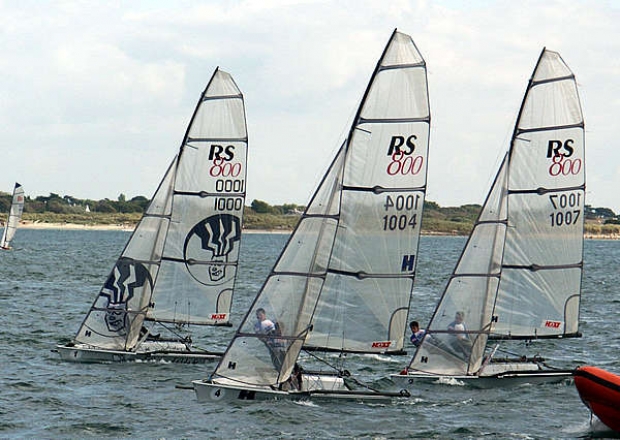
RS - state of the nation
Thursday February 27th 2003, Author: Andy Nicholson/James Boyd, Location: United Kingdom
Does the market drive the industry or the industry drive the market? The case of LDC Racing Sailboats is possibly an example of the latter with their diverse and forward looking range of dinghies including high performance single and double handers, asymmetric and non-asymmetric, trapeze and non-trapeze dinghies, plus the K6 keelboat.
"Small boat sailing looks very different to the way it did 10 years ago," says LDC Managing Director Martin Wadhams. "People who sail with their legs over the side of a 40 footer see dinghy sailing as being very different to how it was."
Following the launch of the K6, Southampton Boat Show last year saw another departure for the Chandler's Ford-based company the introduction of the RS Feva. The Feva is LDC's new boat for entry level - a market LDC have not tackled previously.
The concept of the Feva is such that people can buy the basic boat - the 'S' version - and can hotrod it as they improve by upgrading it to the XL version with the addition of a bigger fully battened mainsail and asymmetric spinnaker. "The ideal is to bring younger sailors into the RS family," says Wadhams.
Hence LDC have been marketing the Feva hard to schools and institutions as well as to holiday companies for whom the 'bullet proof' construction of the Feva is ideal.

The UK dinghy scene many feel is well beyond saturation point in terms of the number of classes and as a result Wadhams hoping to break into new markets overseas. "The UK is a phenomenon," he says. "There are pockets in other places but to have a nation with so many classes and all so successful is almost unmatched around the world. In the States it is almost uncool to sail a dinghy once you've left college. In many other countries dinghy sailing is in the doldrums." Part of the reason is that in countries such as France it is the national sailing federation, clubs and local councils who own the boats and he says "they are using antiquated kit".
 Unlike Laser where there is a class association for each boat, the RS Class Association now represents all nine of the RS classes. For Class Secretary Heather Chipperfield (left), the 700s, Vareos, K6s and the new Feva have been her main challenge over the past 18 months. With so many boats and sailors now under the RS Association umbrella they are being forced to adopt a new approach this year to the running of their events.
One of the highlights of 2002 was six fleets racing at the same time for their national championships at the Weymouth and Portland Sailing Academy. The daunting task of running 64 races was conducted extremely well by the hosts, says Heather, but the ever increasing size of the association has now outgrown a single venue.
The nationals for this year will be split into six separate events each for one or two fleets. Heather says that this will mean that they can now visit a much broader range of smaller clubs.
The 200s will be sailing on their own in Falmouth, the 300s and Vareos will race at Lee on Solent, the 700s and 800s nationals will be held at Hayling Island, the 400s and 600s will head to Looe and Torbay respectively and finally the K6s will race out of the RCYC.
The inlands will be split across two venues. Grafham will host the 200s, 300s and 600s on 27-28 September and Rutland will host the 400s, 700s and 800s on the 18-19 October.
One of the highlights for the calendar this year will be a new pursuit race in December which will be open to all RS classes.
In addition to the Gul-sponsored UK championships there is also RS Eurocup, sponsored by Fat Face. The first foreign trip is to Carnac, Brittany, at Easter. In July the second event will be held at Lake Como, Italy. The 200s and 400s will also be going to Graystone’s near Dublin in October
The above are just a few of the events in the calendar - in all there are over 50 across the board, hence why a class administrator is vital.
Heather is involved in some way with everything above from organising the various committee meetings and then implementing much of what is decided to liasing with sailing clubs and coordinating events through to helping sailors find a suitable coach and setting up training days.
It is up to the membership to vote in new classes and the new youth orientated Feva is the latest addition. One of the main challenges, says Heather, is looking after the varying demands of each class. With the boats sitting in small niches, they all attract a slightly different type of sailor who all have slightly different needs.
While to some extent, this growth in numbers, has led to a splitting up of the fleets it means that the whole social side works very well with a diverse range of people. The main event is the May Ball. Last year this was held in Torquay and attracted 300 sailors to a James Bond-themed night. This year the venue is Fort Brockhurst in Gosport, with the committees yet to decide what should be worn.

If you are an RS sailor it looks like you have a busy and well organised season ahead, just remember to email Heather and say thanks!
You can see the entire range of RS classes on stand GH B28 at Sailboat.
Feedback: What is the best thing about sailing RS boats?
Most Read
Most Commented
Comments
Businesses

Pro businesses
Editor's choice
Member blogs
-
 Ned Collier Wakefield: MOD70 round BarbadosWell that was intense. 12 hard fought for seconds for the win. In idyllic conditions, Tony Lawsons MOD ...
 -
 Mini Transat leg 2 reportThe second leg of the Mini Transat started on 31st October, just over a month after ...
 -
Leg 1 reportI’ve been working towards the Mini Transat now for three years. In 2013 I was part ...
Business blogs
-
 The Island Sailing Club in Cowes, Isle of Wight, is delighted that Prince Michael of Kent ...
 -
Peta Stuart-Hunt chats with the 25 year-old British solo sailor Lizzy Foreman before she sets sail ...
-
The 2015 Student Yachting World Cup (SYWoC), an ISAF-recognised event hosted and run by students for ...
Editor's Choice
All time favourites...
-
 Three legs down into Ian Walker’s
 -
 Winning all but two races at
 -
 For the first time in its
Latest Comments
Add a comment - Members log in