
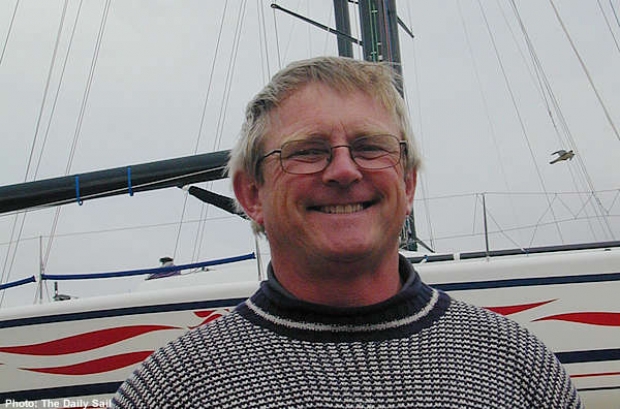
Dave Ovington, the man behind the boats
Monday September 29th 2003, Author: Andy Nicholson, Location: United Kingdom
Dave Ovington, the man who is Ovington Boats, will be well known to many readers of The Daily Sail. You may sail an International 14 or a 49er, maybe you dreamed of having an Ovington-built Enterprise or perhaps you own a Mumm 30.
Ovington’s story from aged seven, working on Whitley Bay beach in the north of England, through to being a highly influential character in the world of high performance sailing, is fascinating. While many northern hemisphere yards are struggling with ‘foreign’ competition, here is a man who has continued to put his head down and toil. In his words: “I just like building boats.”
He first got into sailing when he was 13. After several years of working on the beach to earn pocket money, he got himself a Gremlin Major. Unfortunately he couldn’t actually sail. So he took himself off to the local sailing club and persuaded a guy to take him sailing. "Must have been pretty awful, as I didn’t get asked again," comments Ovington. However the Commodore encouraged him to come back the next week, and got him sailing with someone else. This was the start of sailing every weekend between the ages of 14 and 21.

Messing about in boats - a Gremlin Major under power.
The Gremlin Major was moved on a couple of years later. Included in Ovington’s first sale was the trailer he had made for the boat, but not the bicycle he used to tow it with! A small profit took him up to the Enterprise class. As Ovington explains: "After smartening up the Gremlin, I sold it for more than I paid for it and I put this money into buying an Enterprise hull from Bill Bacon when I was 17. A guy in the club had some spare space in his workshop that he let me use to finish the Enterprise off and I then sailed it for a year or so."
Leaving school at 16 with eight 0-levels, he spent his time doing various jobs, including working for his father’s building company. Aged 21, it was time for the father–son chat. "When I got to 21," recounts Ovington, "my father took me aside and said: 'Listen son, you’ve been messing around for a while now and I think it’s time for you to settle down with a career. I think you should come and work for me building houses.'"
Fortunately for the rest of us Ovington did not take up this offer, but asked his father for some space in his workshop to start building boats. He put an ad in the Enterprise Magazine and set about constructing the hulls. So Ovington Boats was born.
Success wasn’t immediate and it took the new company a few hulls to start getting them right, but they were sailing fast. The first big regatta win for an Ovington Enterprise was in 1979. 220 boats were entered in the Nationals in Paignton with one Lawrie Smith helming the Ovington built boat into the top spot.
Ovington never won the Enterprise Nationals himself, although he was often in the top ten: "I could never afford to keep a boat in those days, so I used to get the last boat built before the champs. Sometimes we would still be screwing in the fittings on the way out to the start line. I would sell the boat after the champs, or even sometimes during them, and we would go home without a boat."
In the early 1980s the company was building all the top Enterprises and they had also started to build National 12s and the (then) wooden International 14.
In 1983 Chris Benedict turned up in Tyneside to help develop the production of the first fibreglass International 14s. "When I saw his boat, which was built out of glass, it was just the most beautiful thing I had seen - functional and sensible construction which was designed to incorporate the rig loads," says Ovington.
Benedict was looking for a glass builder for his 14 designs and came to northern England because of the growing reputation that Ovington had for using epoxy in the construction of his wooden 14s. Chris saw that Ovington was using epoxy in the right way, changing some of the joints to maximise the properties of the resin. In fact, Ovington was one of SP Systems' first major customers.
The new Benedict 4 International 14 was developed in 1983. Ovington was involved in the design of the new boat as well as its construction, incorporating changes to the after sections of the boat - based on his by then, considerable experience of sailing them.
This period was not an easy ride for the boatbuilder as he and Benedict struggled to get to grips with the required construction techniques. They had very little knowledge of glass laminating, so chose to build the boat with pre-pregs and gelcoat, which caused no end of difficulties. There were about ten boats built this way and all needed a lot of finishing and fairing. This just did not stack up economically. At this stage they nearly went bust and Ovington gave up sailing for four years to get the business back on track, working nights and weekends as a matter of routine.
What they did do was to develop a new construction technique, which used an epoxy wet lay up and, unusually, a polyester gelcoat. "We were probably the first people in the world to build boats like this. This system is tricky because the two just don’t like sticking together, but you can’t use epoxy gel coats [which would solve the problem] as they are not UV stable."
This new technique remained in-house for ten years until the launch of the 49er and its published construction manual, and propelled the company to the height of success. With championship-winning 14s it wasn’t long before Julian Bethwaite approached Ovington, with a plan to build his 18 foot skiffs using this same technique but using carbon fibre in the construction.
The relationship between Bethwaite and Ovington blossomed, and Bethwaite came up with the plans for a super fast twin trapeze boat. Ovington’s build techniques were incorporated and so the 49er was launched. Around this time, there was talk at ISAF that a new boat was needed for the Olympic Games, with the intention of making the sport more interesting to viewers and improve sailing’s television ratings.
The 49er was one of 11 different boats to turn up for the selection series at Lake Garda. 19 sailors took part in the selection, each taking out a boat in turn and then filling in questionnaires. For Ovington the sun must have been shining, as not only did the 49er win by a long way, but also in second spot was his latest International 14 design.
A bumpy ride was in store for the 49er in the early days as an Olympic boat. "When the boat got selected it was not long after the first boats had actually been produced, and there were the usual teething troubles to sort out," explains Ovington. "The class had a lot of knockers, because of the selection process - leaving ten boats behind."
Demand for the 49er was huge. In the first year they built 300 boats, almost seven boats a week. "We had to take more people on. Tynemouth is a great place, it’s got one of the best surf beaches in the UK, and so the experienced surfers came to our rescue. They’re expert at building lightweight boards, so we had about seven of them working for us for a period of about eight months, which is long enough to be in one place if you’re a surfer."
Further collaboration with the Bethwaites over the years has resulted in the Niner range of boats; the Julian Bethwaite-designed 29er, 49er and B14 and the Frank Bethwaite designed 59er. Added to this on the production line is the Musto skiff, Flying Fifteen, the Beiker 4 International 14 and the 18 Foot Skiff.

For this year, the 29er (above) was replaced by the 420 as the boat for the ISAF Youth World Championship, something Ovington is philosophical about: "I would have like it to be the 29er, because of my business, but there are so many more 420s in the world, and so many countries have them as their standard boat I think it’s just going to take more time to develop the 29er class."
A separate division of the business is called Ovington Marine and concentrates on yacht production, with the Farr 52 as the biggest boat the company has built. Bear of Britain and Chernikeef 2 were built at the Tyneside factory before demand dried up for the class in the UK. The moulds were then shipped out to DK Yachts in Malaysia who then produced Hollywood Boulevard for an Australian owner.
Ovington sees the smaller performance yacht as the sort of business he wants the Marine side to be involved in for the future. They have currently built more Mumm 30s than any other builder.
In some ways it is appropriate that one of Ovington's latest venture should be a move into what have been described as 'ocean going skiffs' - the Mini class. They have acquired the moulds to Jonathan McKee's Team McLube, a design by Simon Rogers with a keel that not only cants, but moves fore and aft on tracks.
For Ovington this almost sees a return to the roots of the company. The Mini will be offered as a complete hull, deck and bulkheads, the owner to finish off the boat to his/her own specification -very much in the way the company first started with its Enterprise hulls.
The business is firmly rooted in the high performance end of the market. Ovington’s personal favourite is still the International 14: "The 14 is still the best ride down-hill that I have ever sailed. It has tremendous power and it’s short."
Tremendous power and short….a bit like Dave Ovington himself…like.
Most Read
Most Commented
Comments
Businesses

Pro businesses
-
Netherlands
-
-
United Kingdom
-
France
Editor's choice
Member blogs
-
 Ned Collier Wakefield: MOD70 round BarbadosWell that was intense. 12 hard fought for seconds for the win. In idyllic conditions, Tony Lawsons MOD ...
 -
 Mini Transat leg 2 reportThe second leg of the Mini Transat started on 31st October, just over a month after ...
 -
Leg 1 reportI’ve been working towards the Mini Transat now for three years. In 2013 I was part ...
Business blogs
-
 The Island Sailing Club in Cowes, Isle of Wight, is delighted that Prince Michael of Kent ...
 -
Peta Stuart-Hunt chats with the 25 year-old British solo sailor Lizzy Foreman before she sets sail ...
-
The 2015 Student Yachting World Cup (SYWoC), an ISAF-recognised event hosted and run by students for ...
Editor's Choice
All time favourites...
-
 Three legs down into Ian Walker’s
 -
 Winning all but two races at
 -
 For the first time in its
Latest Comments
Add a comment - Members log in