
Asymmetrics - Lights Airs
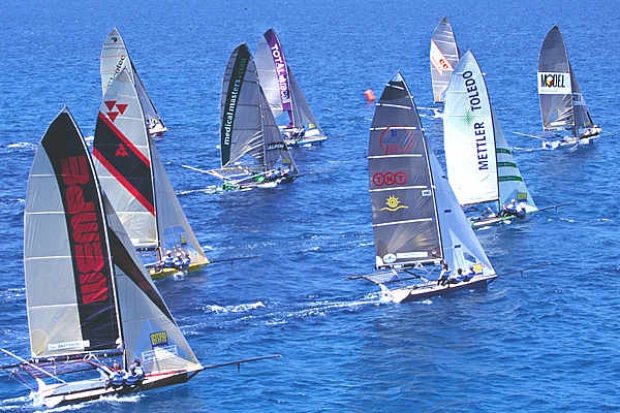
Dan Johnson crews for Rob Greenhalgh in the International 14 and the 18-foot skiff. He was part of the RMW crew that narrowly missed out on winning the JJ Giltinan Trophy earlier this year. Here, Dan shares his wisdom on light airs techniques in the 18-foot skiff and other asymmetric dinghies.Upwind boat trim
The skiff has got some hard chines, which can be useful in light winds. If you want extra height upwind, you can let it lean to leeward and the boat will point up a bit more. The boat is also a bit unstable like that, so it needs good balancing from the crew to make sure it doesn’t come flat again.
You also want to concentrate on staying well forwards, to get the big aft sections of the boat out of the water. When it’s extremely light, we’ll just have the helm sat on the wing, the bowman on the foredeck, and myself [the middle man] as far forward as I can be without being on the foredeck, so that I can move easily if there is a puff or a wind shift that unbalances the boat. The helm holds the mainsheet in this really light stuff, to enable me to move around more easily.

As soon as there is more than 2 knots, I’ll take the mainsheet and move up on to the wing with the helm. The difficult transition is in a few more knots of breeze, when the bowman needs to come out too. He needs to be quick to react because it is in these light to medium airs where the apparent wind really starts to kick in. So as the puff hits, the boat powers up very quickly as you’ve got the double whammy of real wind plus lots of new apparent wind.
Bear in mind the opposite is also true when you lose that puff; you lose not just the real wind but the apparent wind too, so the bowman needs to run quickly, even to the leeward side sometimes, to help maintain the balance of the boat. The bowman needs to be first to jump in, because the helm is busy steering and the middle man is focused on the mainsheet.
Rig set-up
On the skiff we’re very fixed on our settings, with pretty much the same forestay length as normal conditions, so we just let the shrouds off to power up the rig. We keep enough tension on, so that the rig will be stable when we’re all wiring. You don’t want the rig so slack that the windward shroud is waving around in the breeze, because the rig will pant and is in danger of snapping when it is unsupported.
Mainsail
The other thing to bear in mind is that our sails are quite flat, so we’re trying to get them as deep as possible in underpowered conditions. But if you’re more in the middle of the road with your sail depths, then you’ve got to be careful not to go too deep in light winds. Letting off the lowers a notch might help flatten the lower section of the mainsail, and pulling on the caps might help flatten the top.
We’ve got some longer-than-usual top spreaders on the skiff and the 14 so we can carry less cap tension, enabling us to hold the top of the mast stiffer sideways without pulling it backwards too much. On the 49er, this is a bit of a compromise setting, but in light winds you probably want a little more cap tension than normal to help flatten the top of the sail and open up the leech a little.
Your mainsheet strops want to be set up so that you can centre the boom without applying excessive mainsheet tension and jamming up the leech. We don’t adjust our strops on the skiff because we don’t move rake much, but if you are raking up in light winds then make sure your strops lengthen accordingly.
What you’re looking for is the top two tell tails to be streaming aft occasionally, just to let you know the flow is still moving happily across the top of the sail. We tend to hold the leech purely on mainsheet tension in light airs, with vang and cunningham both slack, and the outhaul eased only very slightly.
Jib
The No.1 jib on the skiff is a big sail with a fair bit of overlap with the mainsail, so we don’t want to choke the slot at all. We’ll leave it pegged in the same place on the jib track as normal conditions. But we will go up a hole on the clewboard, which means you’re sheeting more down the leech and less along the foot. This throws more depth and power into the jib, but be careful not to oversheet the jib. Better to have the slot slightly more open than jammed up, as you’ll stop if you sheet on too tight. Sheet tension needs to change quite quickly and subtly with changes in the windspeed though. Skiffs tend to have high-aspect jibs, which can open up quite quickly as the gust hits, so watch your tell-tails like a hawk in changeable conditions.
Downwind
When we’re rounding the top mark, Rob will stay on the wire even in the very light winds. The two front men run as far forward as possible while they do the hoist, standing side by side at the front of the cockpit. But the crucial thing is achieving a quick hoist so don’t compromise on your positions too much. More important to get the kite up and setting quickly.
Once you’re up and running, the middle man will sit on the foredeck by the base of the mast. The helm will stay forwards on the netting, and the front man will sit on the netting too, where he can see the luff of the gennaker. It’s up to those two to decide who goes out first on the wire when a gust hits. It’s really down to personal preference.
When the breeze picks up a little, as soon as they’re both on the wire, the middleman needs to come back to behind the mast and sit on the kite bag, so as to keep the bow out.

The guys out on the wire have to move fore and aft to keep the knuckle of the bow just skimming the surface. Downwind you want to aim for a flat boat, perhaps slightly heeled to weather. But the most important thing is the feel through the rudder, so the helmsman should call for what balance he wants, in order to achieve neutral helm.
In terms of sail trim, you want to keep the kite right on the curl, with the mainsail eased maybe a foot off the centreline in the really light. As soon as there is good flow over the sails, though, it’s back on the centreline. It’s not that critical really, because the main is fairly much held in by the flow of the kite. Steering and gennaker trim are the more crucial factors downwind in the skiff.
Most Read
Most Commented
Comments
Businesses
Pro businesses
-
-
-
France
-
United Kingdom
Editor's choice
Member blogs
-
 Ned Collier Wakefield: MOD70 round BarbadosWell that was intense. 12 hard fought for seconds for the win. In idyllic conditions, Tony Lawsons MOD ...
 -
 Mini Transat leg 2 reportThe second leg of the Mini Transat started on 31st October, just over a month after ...
 -
Leg 1 reportI’ve been working towards the Mini Transat now for three years. In 2013 I was part ...
Business blogs
-
 The Island Sailing Club in Cowes, Isle of Wight, is delighted that Prince Michael of Kent ...
 -
Peta Stuart-Hunt chats with the 25 year-old British solo sailor Lizzy Foreman before she sets sail ...
-
The 2015 Student Yachting World Cup (SYWoC), an ISAF-recognised event hosted and run by students for ...
Editor's Choice
All time favourites...
-
 Three legs down into Ian Walker’s
 -
 Winning all but two races at
 -
 For the first time in its
Latest Comments
Add a comment - Members log in